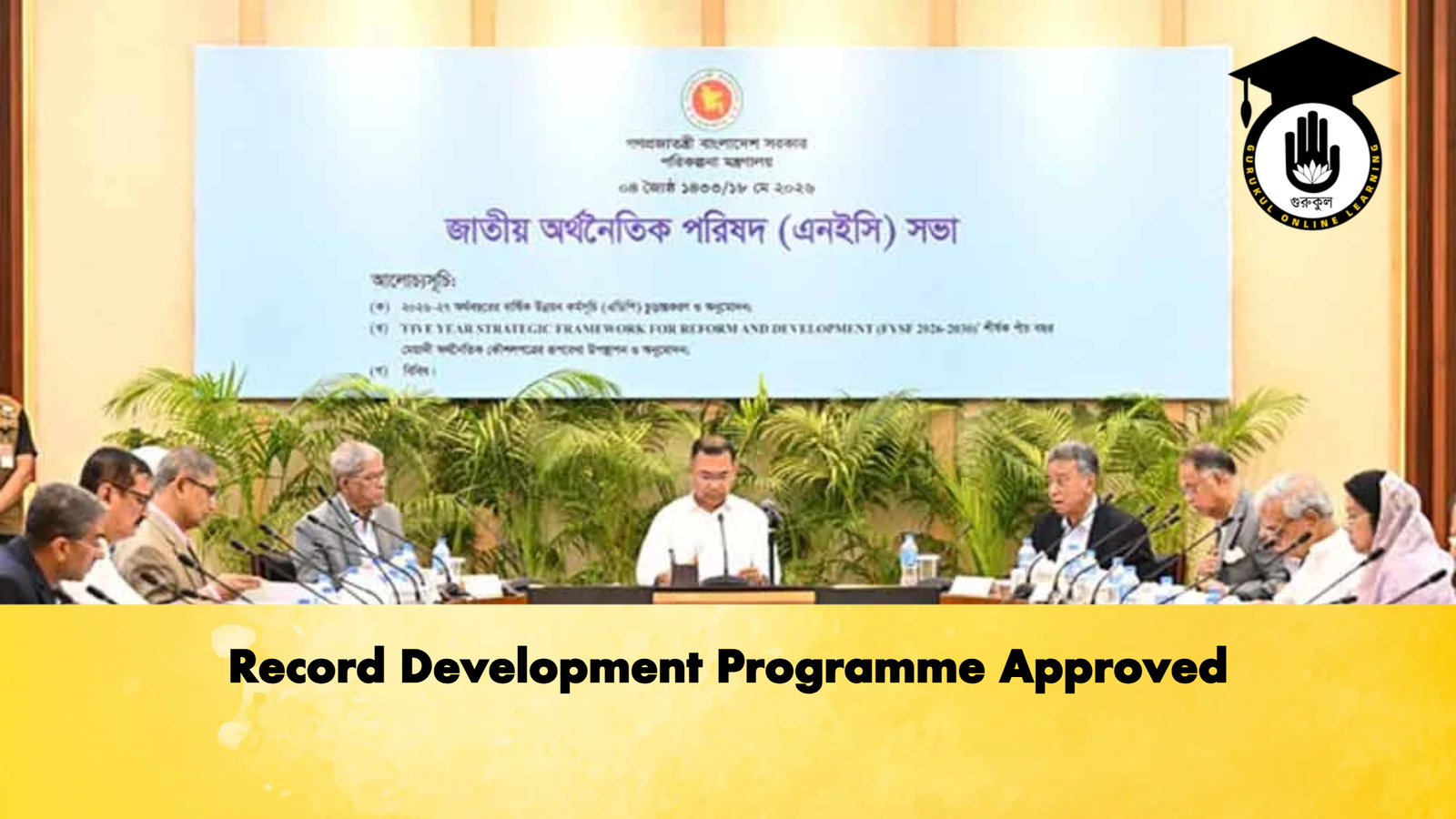
The National Economic Council has approved a record Annual Development Programme (ADP) worth more than Tk 3.08 trillion for the 2026–27 fiscal year, setting a new benchmark in the country’s development planning history. The decision was taken at a meeting held at the planning complex in Agargaon, Dhaka, where the government’s broader development strategy, economic restructuring, social protection strengthening, and reduction of regional disparity were placed at the centre of discussion. The meeting was chaired by the Chief Adviser, Tarek Rahman.
According to the Planning Commission’s proposal, the total size of the ADP stands at over Tk 3.08 trillion. Of this, nearly Tk 1.90 trillion will come from domestic government resources, while around Tk 1.10 trillion is expected from foreign loans and grants. An additional Tk 89 billion will be contributed by autonomous bodies and state-owned enterprises.
The development framework has been designed under a long-term strategic approach focusing on five core pillars: state reform, equitable growth, economic restructuring, regional balance, and social and cultural cohesion. Emphasis has also been placed on modernising public administration, strengthening judicial capacity, improving public investment management, and enhancing the efficiency of law enforcement agencies.
Table of Contents
ToggleKey sector allocations
Transport and communications remain the largest recipient of development funds, followed by education, health, energy, and housing. The allocation pattern reflects continued prioritisation of infrastructure expansion and human capital development.
| Sector | Allocation (Tk crore) |
|---|---|
| Transport and Communications | 50,092 |
| Education | 47,591 |
| Health | 35,535 |
| Power and Energy | 32,691 |
| Housing and Community Facilities | 20,361 |
Local government divisions received the highest institutional allocation at over Tk 33,700 crore, followed by the Roads and Highways Division with nearly Tk 30,700 crore. Significant allocations were also made to health, education, and energy-related agencies.
A notable feature of this year’s ADP is the substantial rise in block allocations, which now stand at approximately Tk 118,000 crore across various ministries and special assistance programmes. While this provides greater fiscal flexibility, analysts have stressed the importance of ensuring transparency and accountability in project selection and implementation.
Social protection priorities
Social safety net programmes have been further expanded. The Family Card initiative has been allocated over Tk 14 billion, while a similar amount has been earmarked for the Farmers’ Card programme. More than Tk 11 billion has also been set aside as honorarium support for personnel serving in religious institutions.
Implementation challenges
The new ADP includes more than 1,100 development projects covering investment schemes, technical assistance programmes, and autonomous initiatives. Over 1,000 additional projects are awaiting approval in the pipeline.
However, concerns persist regarding implementation efficiency. During the first nine months of the current fiscal year, ADP execution stood at around 36 per cent, which is considered relatively low. Experts caution that without stronger administrative capacity, improved financial discipline, and timely project completion mechanisms, effective delivery of such a large programme could face significant delays.
The council directed ministries to accelerate implementation, maintain fiscal discipline, and ensure completion of projects within stipulated timelines. The government expects the expanded ADP to play a transformative role in strengthening infrastructure, developing human capital, and promoting more balanced regional growth across the country.