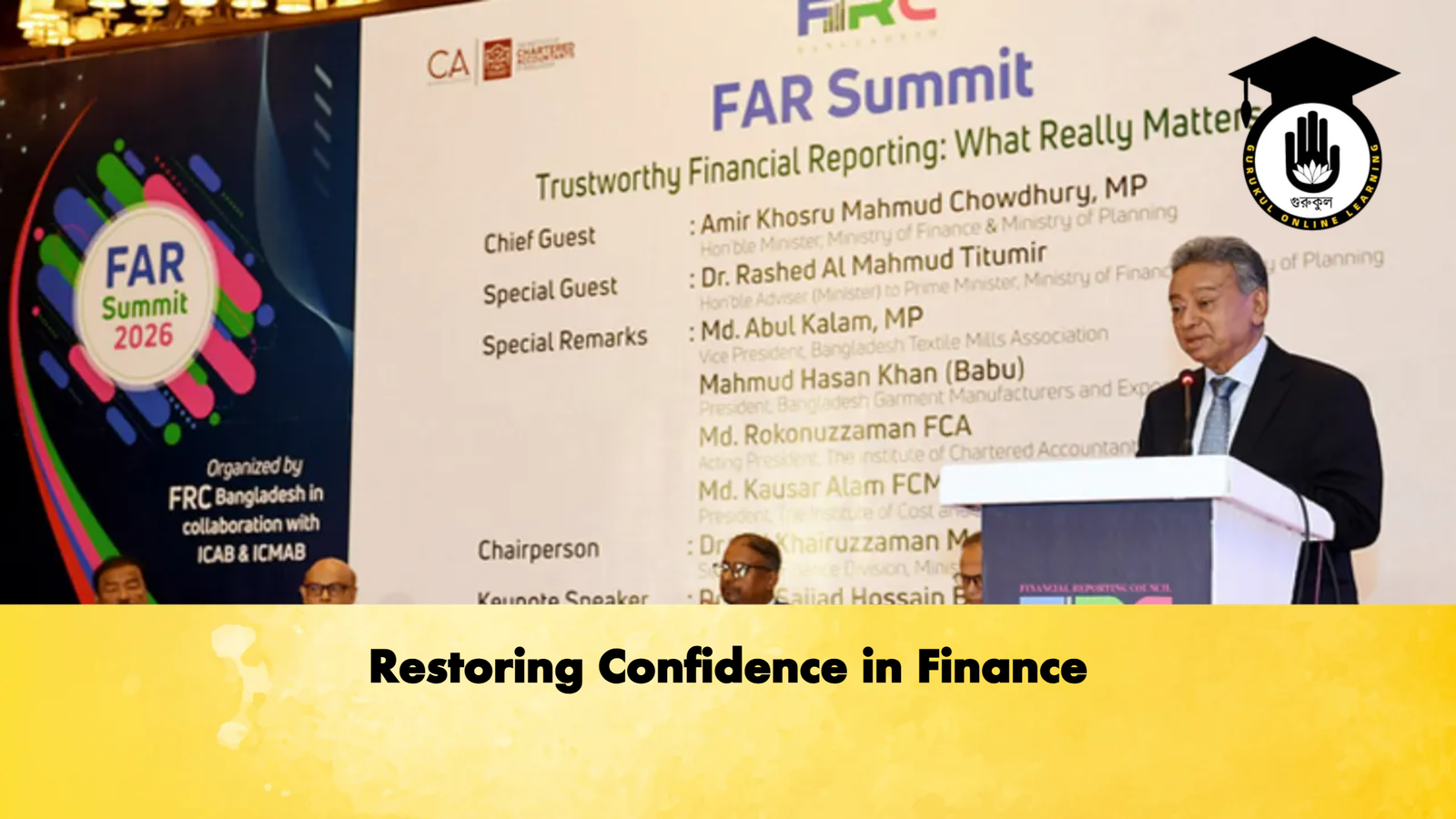
Senior Finance Minister Amir Khosru Mahmud Chowdhury has underscored the urgent need to rebuild public confidence in the country’s financial sector through strengthened transparency, accountability, and institutional integrity. He stressed that restoring trust in governance and credible financial reporting has become one of the most critical challenges for the nation’s economic future.
He made these remarks on Wednesday while delivering the keynote address at a national conference on financial accounting and reporting held at the Sonargaon Hotel in the capital. The theme of the conference was “Reliable Financial Reporting: What Truly Matters”. The event was organised by the Financial Reporting Council, with support from the Institute of Chartered Accountants of Bangladesh and the Institute of Cost and Management Accountants of Bangladesh.
The minister observed that regulatory and supervisory institutions have, over time, suffered from weakened effectiveness. This deterioration, he noted, has contributed to serious deficiencies in auditing standards, financial disclosure practices, and oversight mechanisms. According to him, the legacy of corruption and mismanagement has significantly damaged key financial institutions, leaving the broader economy in a vulnerable and sensitive state of transition.
Drawing attention to irregularities in both the banking sector and capital markets, he stated that in several instances, organisations had entered the market using misleading or falsified financial statements. Such practices, he warned, have undermined fair competition by disadvantaging genuinely strong and well-managed institutions, thereby destabilising market equilibrium.
He further highlighted structural weaknesses in asset valuation and market-based pricing mechanisms, which have contributed to capital shortages in both banking and private sector financing. Rising non-performing loans, concerns over money laundering, and allegations of collusion between bank owners and management were also cited as compounding factors worsening the situation.
The minister added that, for a prolonged period, banks had largely operated using depositors’ funds, but in some cases these resources were diverted for private interests. He emphasised that such malpractice must be decisively addressed to restore discipline within the financial system. He also called for stronger professional responsibility among accountants and auditors.
A comparative overview presented at the conference illustrated the gap between the current state of the financial system and its desired future condition:
| Area | Current Situation | Desired Outcome |
|---|---|---|
| Financial reporting | Weaknesses and irregularities persist | Transparent and reliable system |
| Banking governance | Conflicts of interest and malpractice | Professional and accountable management |
| Regulatory bodies | Partially ineffective oversight | Strong and efficient supervision |
| Investment climate | Lack of investor confidence | Investor-friendly environment |
The minister also referred to past experience where delegating operational responsibilities to a private entity had yielded successful outcomes, suggesting that effective supervision combined with professional management can enhance self-regulation.
On foreign investment prospects, he noted that major global investment institutions, including J.P. Morgan Chase as well as firms based in London and Hong Kong, have shown interest in investing in the country. However, he cautioned that without credible audited financial statements and adherence to international reporting standards, attracting sustained foreign investment would remain difficult.
He warned that if investors perceive financial information as unreliable, confidence would quickly erode, potentially stalling investment flows. He therefore emphasised that long-term structural reforms must take precedence over short-term interests in order to build a sustainable economic framework.
The conference also featured contributions from the Prime Minister’s Economic and Planning Adviser Professor Dr. Rashed Al Mahmud Titumir as special guest, while the session was chaired by Finance Secretary Dr. Md Khairuzzaman Mozumder. The keynote paper was presented by Dr. Md Sajjad Hossain Bhuiyan, Chairman of the Financial Reporting Council. Senior government officials, chartered accountants, cost and management accountants, valuers, actuaries, and business leaders also attended the event.
Discussions throughout the conference focused on improving financial reporting standards, aligning with international best practices, and strengthening external audit mechanisms as essential steps towards ensuring a more transparent and stable financial system.