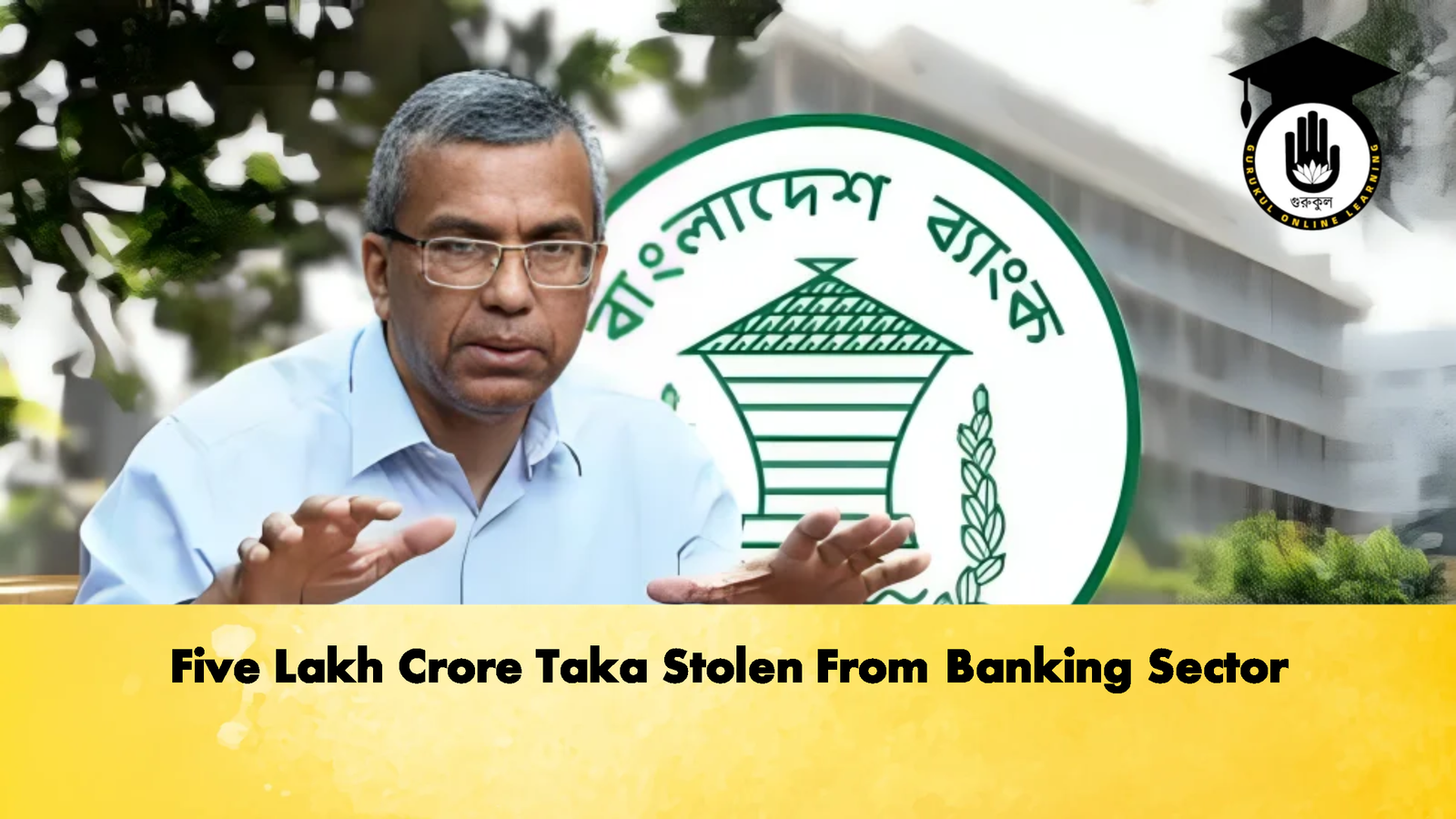
The Governor of Bangladesh Bank, Mohammad Mostakur Rahman, has stated that approximately 5 lakh crore Taka has been stolen from the national banking sector through highly sophisticated financial anomalies. Speaking at a formal press conference held at the central bank headquarters on Saturday, 23 May, the Governor revealed that an estimated one-third of the total capital within the banking system has effectively vanished. He noted that this deficit is conventionally classified within the financial industry under the refined terminology of Non-Performing Loans (NPLs).
The central bank chief explicitly highlighted that the vast majority of these fraudulent loans were disbursed entirely without any form of tangible collateral or security. Furthermore, he noted that a significant proportion of these stolen assets has already been illicitly laundered and transferred outside the sovereign borders of Bangladesh.
Financial Stimulus Package and Economic Restoration
The media briefing marked the first official press conference conducted by Governor Mostakur Rahman since he formally assumed office as the 14th Governor of Bangladesh Bank on 26 February of this year. The primary objective of the briefing was to outline the comprehensive operational details of a newly formulated economic recovery programme. In a clear bid to stabilise the national economy, resume industrial operations in closed manufacturing units, and stimulate employment generation across the country, the Governor announced a substantial financial stimulus package valued at 60,000 crore Taka.
Severe Systemic Distress and Investor Confidence
During his detailed address to the media, Governor Mostakur Rahman provided a candid diagnostic assessment of the prevailing macroeconomic indicators and the deep structural vulnerabilities currently plaguing the domestic financial architecture.
“Our financial sector is operating under immense systemic distress,” the Governor stated. “Within this framework, non-performing loans have escalated exponentially, and a considerable volume of capital has been illegally siphoned out of the country. Consequently, depositor confidence had deteriorated significantly. Our immediate institutional priority is the comprehensive restoration of that public trust.”
The Governor conceded that the physical recovery and repatriation of the laundered offshore funds would be a protracted and time-consuming administrative process. However, he reaffirmed that the central bank is treating the retrieval of these stolen national assets as an absolute institutional priority.
Commenting on the structural deficits embedded within the outstanding bad loans, the Governor explained the severe lack of underlying assets available for regulatory recovery. He pointed out that borrowers who had extracted 100 Taka from the banking system no longer possess equivalent assets of that value. The central bank is currently designing administrative mechanisms to ascertain how these outstanding debts can be effectively liquidated and recovered.
Strategic Planning to Prevent Institutional Mismanagement
The regulatory authority expects that the successful implementation of the newly declared 60,000 crore Taka stimulus package will significantly enhance industrial productivity. This targeted intervention is projected to expand domestic employment opportunities, boost national export capacities, and facilitate a robust economic turnaround.
The key parameters guiding this economic strategy include:
Restoring Asset Value: Developing legal mechanisms to locate and claim secondary assets from defaulting borrowers.
Securing Public Deposits: Rebuilding baseline liquidity to guarantee the safety of public money in commercial accounts.
Monitoring Fund Flow: Instituting strict oversight over the disbursement of the new 60,000 crore Taka package.
Responding to queries from financial journalists regarding the historical mismanagement and embezzlement associated with previous financial stimulus packages, the Governor acknowledged the validity of these concerns. He noted that the country’s historical experiences with similar financial interventions were undeniably poor.
Nevertheless, Governor Mostakur Rahman expressed firm optimism regarding the structural integrity of the current initiative. He clarified that prior to finalising the operational parameters of this package, Bangladesh Bank had conducted extensive consultative sessions with prominent domestic economists, various internal departments of the central bank, trade and business leaders, and microcredit specialists. The entire package has been structurally designed to mitigate risk and ensure that the institutional failures of the past are not repeated. The central bank has pledged to deploy its maximum administrative capacity to ensure transparent and exact implementation across the financial sector.