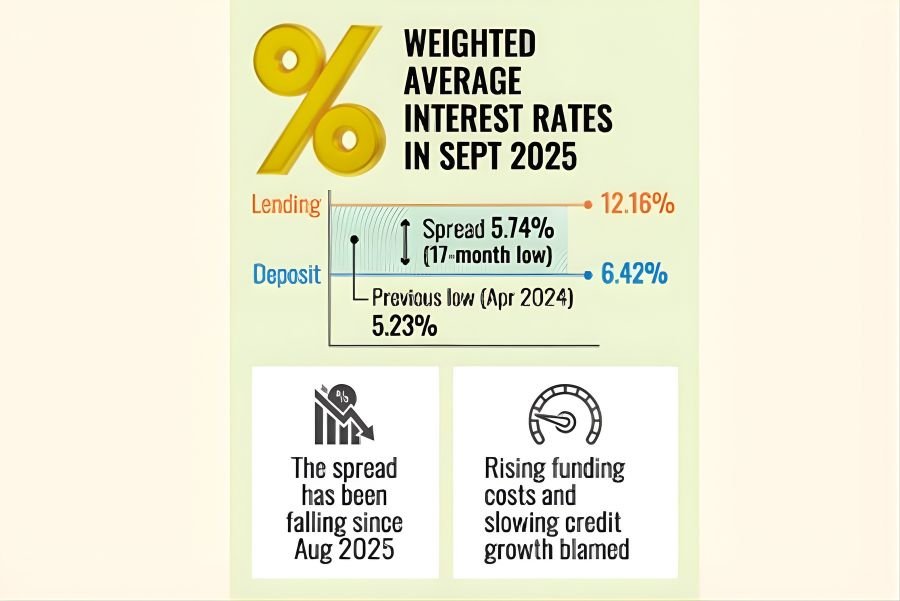
The banking sector is under increasing pressure as the gap between lending and deposit rates — a key indicator of profitability — fell to a 17-month low in September.
The squeeze comes as banks grapple with rising deposit costs and sluggish lending growth, leaving many struggling to maintain their profit margins.
Bankers and central bank officials say the trend signals growing strain across the industry, with profits being eroded by higher non-performing loans (NPLs) and weak credit demand amid a slowing economy.
According to data from Bangladesh Bank, the weighted average deposit rate in September 2025 stood at 6.42%, while the average lending rate was 12.16%, resulting in a reduced spread of just 5.74%. This is the lowest figure since April 2024, when the spread narrowed to 5.23%, with deposit and lending rates at 5.30% and 10.53%, respectively.
The spread, also known as the net interest margin (NIM), represents the difference between what banks pay on deposits and what they earn from loans.
A senior Bangladesh Bank official, speaking on condition of anonymity, explained that some liquidity-strapped banks had recently raised deposit rates to attract funds, which further compressed the spread.
“The yield on treasury bills and bonds began to fall from late August, which has also contributed to the decline. This downward trend continued in October, so we expect the spread to narrow even further when new data is released,” the official noted.
Masrur Arefin, Managing Director and CEO of City Bank PLC, said that banks had previously offered attractive deposit rates earlier this year to invest in government securities, when yields were above 12%.
“Now that yields on treasury bills and bonds have dropped sharply, we’re seeing the impact in the reduced spread,” he explained.
Arefin, who also chairs the Association of Bankers, Bangladesh (ABB), added that banks set their deposit rates based on the higher yields at the time, without considering the slowdown in lending growth due to the economic downturn.
Syed Mahbubur Rahman, Managing Director and CEO of Mutual Trust Bank PLC, highlighted that the rising cost of deposits was exacerbated by the growing burden of non-performing loans (NPLs).
“Higher NPLs increase funding costs and directly impact profitability,” he said.