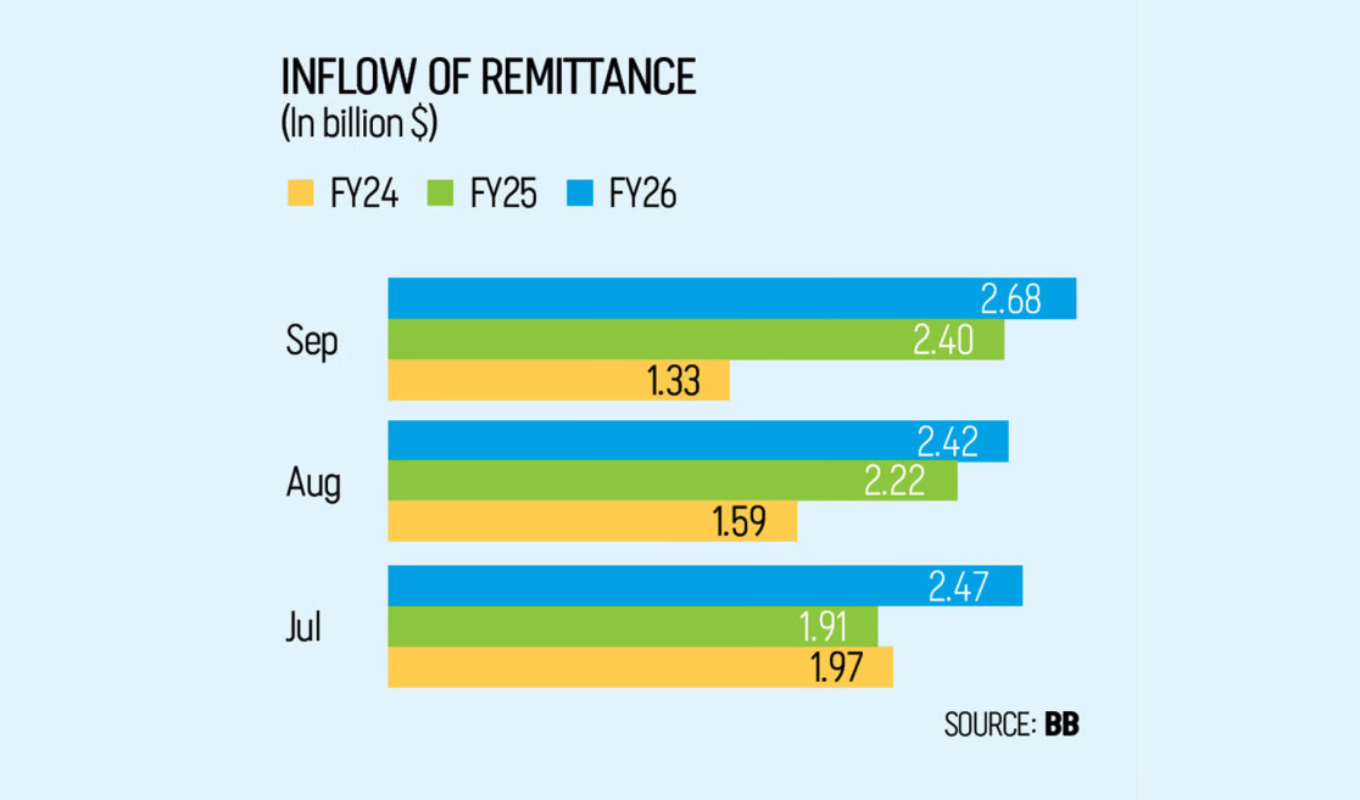
Remittance inflows to Bangladesh saw a 12% year-on-year rise in September, helping ease pressure on the country’s foreign exchange (forex) reserves and contribute to exchange rate stability.
In September, Bangladesh received $2.68 billion in remittances, up from $2.40 billion in the same month last year, according to Bangladesh Bank (BB) data. This increase has been attributed to greater use of official channels by expatriates, the crackdown on informal money transfers, and a narrowing gap between official and black market exchange rates.
The first three months of the 2026 fiscal year (July-September) saw remittances total $7.58 billion, an 8% rise from $6.54 billion during the same period last year. The increase comes as more than 4 million people have left the country for overseas jobs in the past four years, according to the Bureau of Manpower, Employment and Training (BMET).
Mati Ul Hasan, CEO of Mercantile Bank, attributed the rise in remittance inflows to government incentives and a stable forex market, which have encouraged expatriates to send money through formal channels. He also noted that the crackdown on informal methods, such as ‘hundi’, has reduced demand for dollars and further supported the shift to official channels.
Additionally, the Bangladesh central bank is closely monitoring Letters of Credit (LCs) for imports, with banks now required to consult the central bank before processing large LCs, ensuring that exchange rates and funding sources are legitimate.
Despite the progress, Hasan highlighted that Bangladesh still lags behind countries like Pakistan and India in remittance inflows. However, the recent surge in remittances has had a positive impact on the country’s forex reserves, which have risen to $26.62 billion, up from $21 billion in early October 2023.
Bangladesh received a record $30.3 billion in remittances in fiscal year 2025, a 26.8% increase compared to the previous year. This growth was driven by a competitive market-based exchange rate, ongoing cash incentives, and tighter regulation of transfers, according to the Asian Development Bank’s latest outlook.
The government has been offering a 2.5% cash incentive for remittances sent via formal channels. In March 2025, Bangladesh recorded its highest-ever monthly remittance inflow, with $3.29 billion sent home by expatriates.