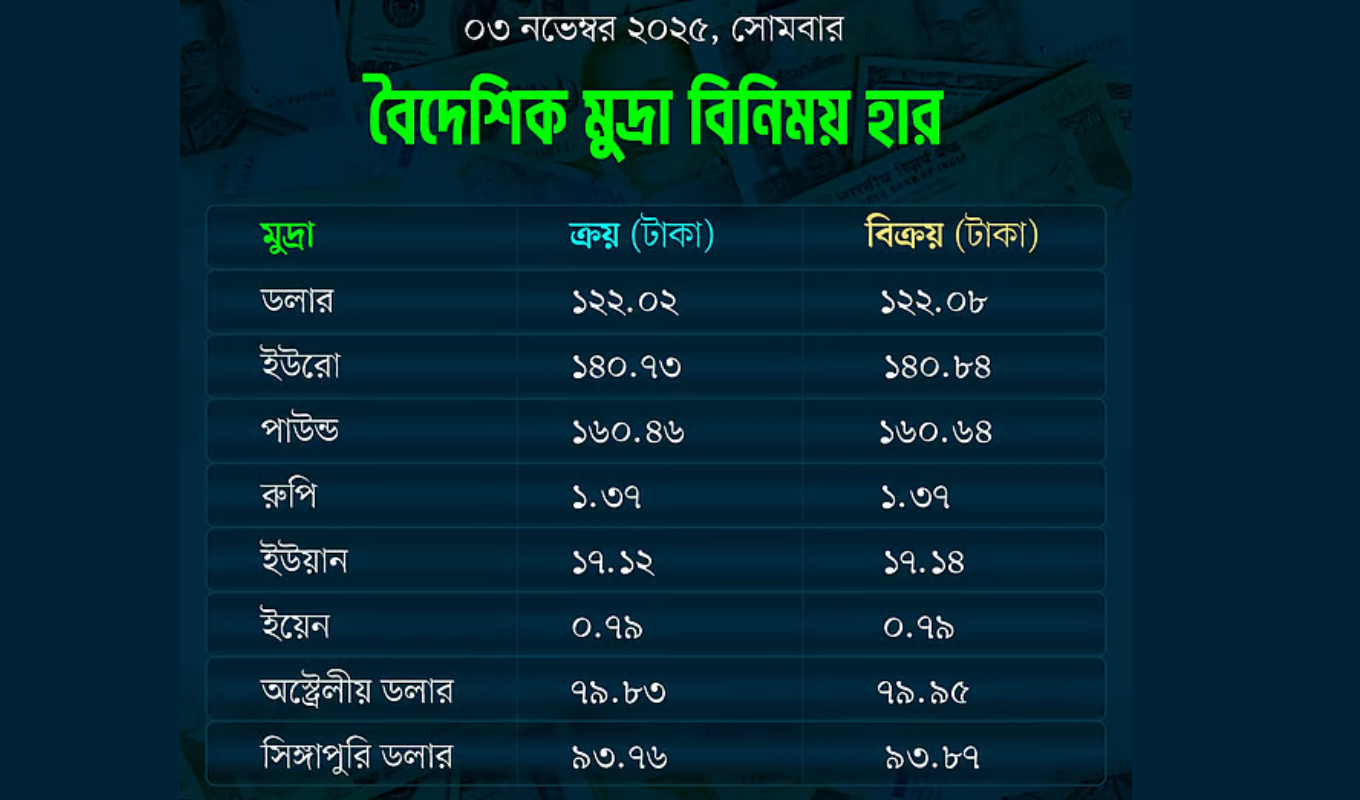
Today, Monday, the second working day of the week, trading continues in Bangladesh’s currency market. As seen yesterday, the price of the US dollar has decreased again today.
According to data from Bangladesh Bank, the highest exchange rate for the dollar today is 122.08 Taka, and the lowest is 122.02 Taka. The average rate for the dollar stands at 122.02 Taka. Since July, the dollar’s price has been fluctuating throughout the current month of October.
In today’s currency market, the prices of most major currencies have dropped. This includes the Euro, British Pound, Chinese Yuan, Australian Dollar, and Singapore Dollar. No currency has seen an increase today, with the Indian Rupee and Japanese Yen prices remaining unchanged.
In the open market, foreign currencies are being sold at slightly higher rates than those published by the central bank. The fluctuations in exchange rates also impact the costs of trade and business operations within the country.
Certainly! Here’s a more detailed breakdown of the exchange rate information based on the topic you provided:
Detailed Exchange Rate Update for Today, November 3, 2025
Today, Monday, the second working day of the week, the currency market in Bangladesh is seeing continued trading. As per the latest reports, the exchange rate for the US dollar has declined further compared to previous sessions, continuing the trend observed yesterday.
According to Bangladesh Bank’s official data:
- The highest exchange rate for the US dollar today is 122.08 Taka.
- The lowest exchange rate is 122.02 Taka.
- The average rate for the dollar stands at 122.02 Taka.
This represents a slight decrease from recent days and indicates that the dollar’s price has been fluctuating consistently since July 2025. The ongoing trend of dollar depreciation could be due to several domestic and international factors, including shifts in global economic dynamics, adjustments in local monetary policy, or changes in demand for foreign currency within the country.
Movement in Other Major Currencies
Alongside the US dollar, the value of most major foreign currencies has also decreased today:
- Euro (EUR): The Euro has continued its downward movement in the Bangladeshi market.
- British Pound (GBP): The Pound is also lower today compared to previous sessions.
- Chinese Yuan (CNY): Similarly, the Yuan has seen a decrease in value against the Bangladeshi Taka.
- Australian Dollar (AUD) and Singapore Dollar (SGD): Both of these currencies have also fallen slightly in value today.
Currencies with Unchanged Rates
- Indian Rupee (INR): The Indian Rupee remains unchanged in value against the Bangladeshi Taka today.
- Japanese Yen (JPY): Similarly, the Japanese Yen has not seen any change in its exchange rate.
Open Market vs. Bangladesh Bank Rates
While the official rates published by Bangladesh Bank are widely followed, it’s important to note that in the open market (or black market), foreign currencies are often sold at slightly higher rates. This is particularly noticeable when there is a shortage of certain foreign currencies or when demand spikes, either from individuals or businesses requiring foreign exchange for imports, travel, or remittances.
In recent times, the fluctuations in exchange rates in the official and open markets have contributed to a noticeable shift in costs for businesses involved in international trade. Importers, exporters, and those who rely on foreign currencies for their transactions have felt the effects of these ongoing exchange rate adjustments.
Impact on Business Costs
The constant fluctuation of exchange rates not only impacts individuals who exchange currency for personal use but also has a profound effect on Bangladesh’s business landscape. Here’s how:
- Importers face higher costs when purchasing goods in foreign currencies, particularly from markets such as China, the EU, and the US, where prices are directly tied to the exchange rate.
- Exporters, on the other hand, might benefit from a weaker Taka as their products become more competitive in international markets. However, these benefits are often offset by the rising costs of imported raw materials and supplies.
- Businesses dependent on foreign loans may also see their repayment costs increase if foreign loans are tied to fluctuating exchange rates, particularly if the local currency weakens further.
Future Outlook
Analysts suggest that the Bangladeshi Taka may continue to fluctuate within the current range due to global economic factors, the national inflation rate, and government interventions in the foreign exchange market.
- Global economic conditions: If the US dollar strengthens globally, it may put additional pressure on the Bangladeshi Taka.
- Domestic policies: Bangladesh Bank’s interventions, such as increasing foreign reserves or tightening currency controls, could influence exchange rates in the coming weeks.
The outlook for the next few months remains uncertain, as both internal and external economic conditions are expected to play a role in shaping the currency market.
In summary, today’s exchange rate scenario highlights continued volatility in Bangladesh’s foreign exchange market. The fluctuations in the value of the US dollar and other major currencies will have wide-reaching implications for both individuals and businesses in the country.