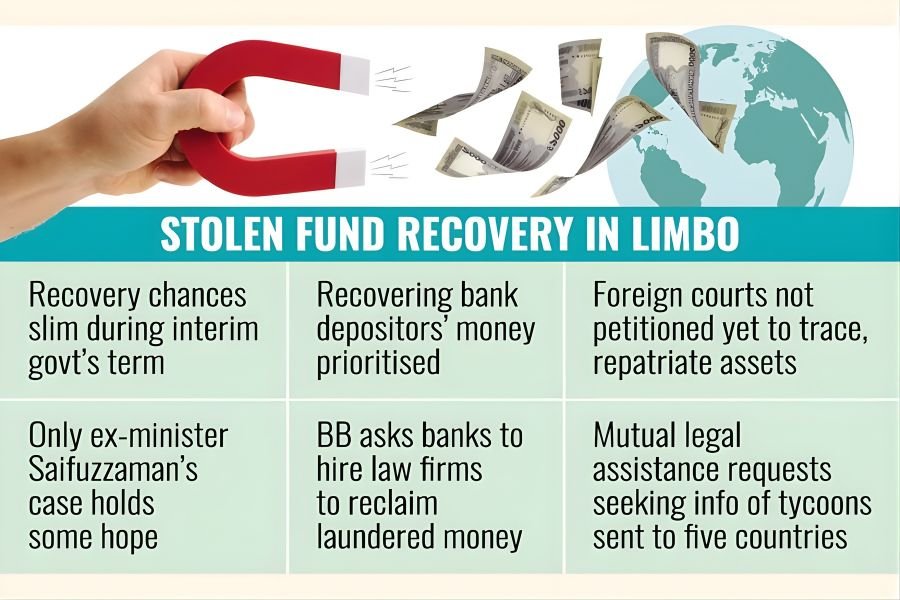
The interim government’s high-profile initiative to recover stolen assets following the 2021 uprising may not achieve its goals before its term ends, as insiders reveal persistent legal and interagency challenges. Despite widespread public and political support for the asset recovery drive, progress has stalled, with key hurdles remaining unresolved.
Tax recovery efforts are particularly stalled due to legal restrictions on assets frozen by the courts, following petitions by the Anti-Corruption Commission (ACC). While the tax authorities argue that recovering unpaid taxes from these bank accounts is feasible, court-imposed barriers continue to complicate the process.
Disagreements between various government agencies are emerging as one of the main roadblocks. The Central Intelligence Cell (CIC), under the National Revenue Board, previously sought a court order to unfreeze the accounts of the suspected tax evaders. Although the court allowed the de-freezing, the decision was quickly challenged, leading to a subsequent stay order.
Dr Ahsan H Mansur, Governor of Bangladesh Bank and leader of the asset recovery initiative, expressed concerns that the interim government’s reluctance to pursue out-of-court settlements would limit the potential for progress. These cases are politically sensitive, with opposition parties viewing such settlements as a form of tacitly pardoning the accused and allowing them to retain state funds.
Despite setbacks, Dr Mansur pointed to the example of the UK’s National Crime Agency (NCA), which recently froze assets belonging to Bangladesh’s suspected offenders, indicating that international efforts are underway. “The fact is, we may never recover the stolen assets. Only Saifuzzaman’s case shows some hope,” he said, underlining the grim reality of the recovery process.
The Governor also made clear that while asset recovery is crucial, the central bank’s primary concern remains protecting depositors’ funds, rather than focusing solely on tax recoveries.
In parallel, Bangladesh’s Financial Intelligence Unit (BFIU) has sent mutual legal assistance (MLA) requests to five countries regarding the assets of 11 prominent tycoons. However, responses so far have been slow, with many nations requesting further information, indicating a lack of experience in handling such complex legal requests. “We are in the process of training officials for drafting and pursuing these MLA requests,” said a senior BFIU official.
The Joint Investigation Taskforce (JIT), which includes members from the ACC, CIC, BFIU, and other agencies, is investigating the illicit activities of these tycoons. Yet the taskforce’s work has been hampered by a lack of manpower, with almost half of ACC’s staff tied up in the JIT, creating a resource vacuum.
Dr Mansur revealed that the government is exploring avenues to appeal to the UK for the return of stolen funds on humanitarian grounds, following previous successful asset repatriations from the UK to Bangladesh. However, he cautioned that the UK government would not make compromises to return funds if it conflicted with their own interests.
While speculation persists that the tycoons may have moved their assets abroad, Dr Mansur dismissed these claims, stating that movable property cannot be easily transferred or sold, and any such transactions would leave a traceable record.
Despite the legal and bureaucratic hurdles, officials are resolute in their commitment to recover assets for Bangladesh’s depositors. Yet, Dr Mansur’s remarks suggest that the prospects for significant progress before the end of the interim government’s term remain bleak. “Our priority is to recover depositors’ money and return it,” he reiterated, adding that any inflated tax claims on profits should be scrutinised further by the ACC.
In the meantime, the BFIU plans to release a comprehensive report summarising findings from ongoing investigations. However, senior officials from the unit remain sceptical about the likelihood of substantial recoveries, citing the challenges and slow pace of progress.
The process of reclaiming the siphoned assets from foreign jurisdictions is still in its infancy, with no petitions filed with foreign courts or bilateral agreements signed thus far. As the investigation continues, there are no clear timelines for its completion, and little visible progress has been made.
The probe into the 11 tycoons has seen a change in the roster, with Gemcon Group now excluded and HBM Iqbal added to the list. As the taskforce struggles with limited resources, the timeline for recovery remains uncertain, and experts are increasingly doubtful about the outcome under the current administration.