The Monetary Authority of Singapore (MAS) is set to trial the issuance of tokenised MAS Bills to primary dealers, with transactions to be settled using a wholesale central bank digital currency (CBDC). This trial follows the successful completion of the first live interbank settlement using wholesale CBDC, conducted by major local banks DBS, OCBC, and UOB.
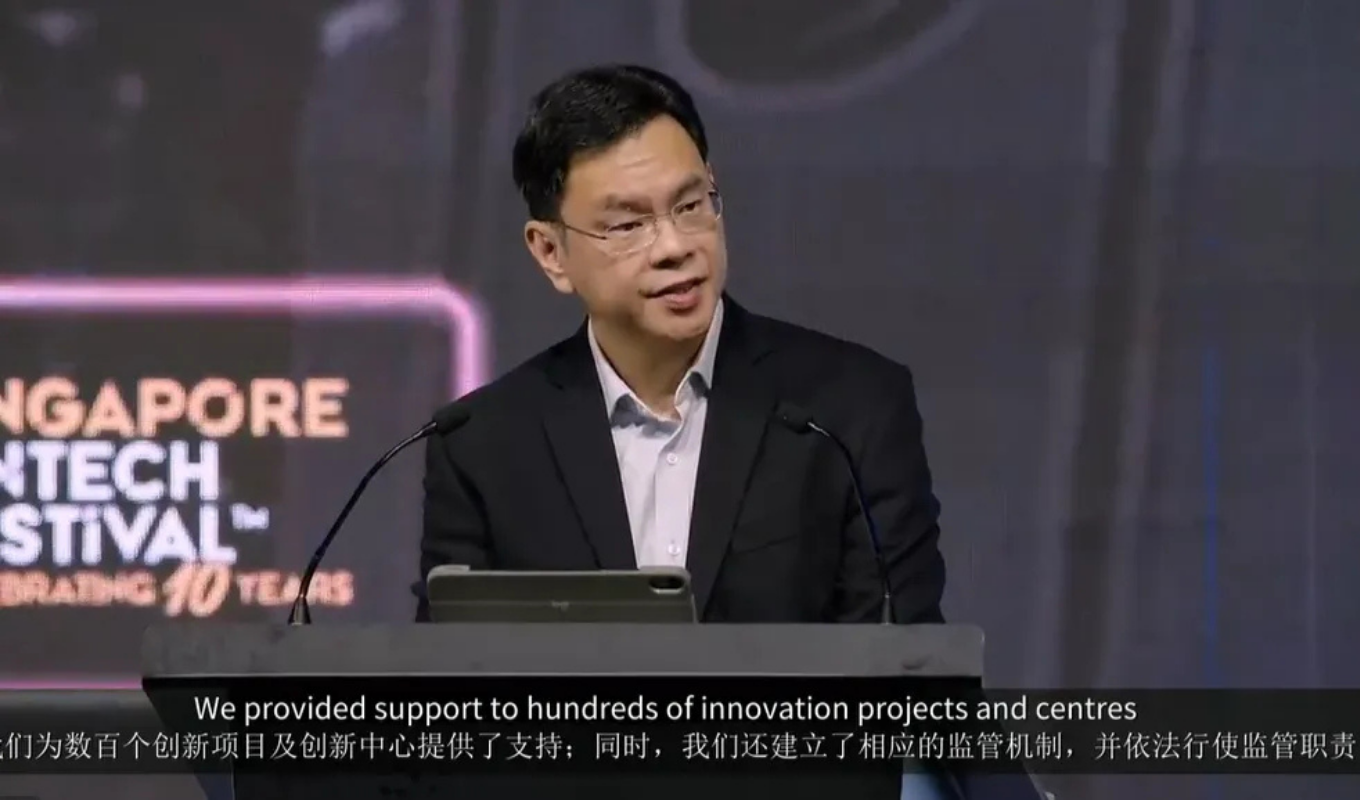
Chia Der Jiun, Managing Director of MAS, revealed the news during his keynote address at the Singapore FinTech Festival 2025 on 13 November. He noted that further details regarding the trial would be made public next year, once the initial live interbank CBDC settlements have been fully completed.
A New Phase for Tokenisation Efforts
Chia described the move as the next step in Singapore’s ongoing efforts to drive the tokenisation of financial products. He pointed out that several financial institutions have already issued bonds “natively and settled on the chain.” However, he cautioned that widespread adoption of tokenisation remains uneven, highlighting that while money market funds have been tokenised and major banks have rolled out tokenised cash management services for corporate treasuries, asset-backed tokens have yet to gain significant traction.
“Have asset-backed tokens achieved escape velocity? Not yet,” Chia said, emphasising the need for a more collaborative approach. He warned that if institutions continue developing their own closed networks based on differing specifications, there is a risk of creating fragmented systems or monopolies, which could lead to concentration risks in the market.
Collaboration and Standardisation Efforts
To mitigate these risks, the MAS has been actively working with global policymakers and industry players through ‘Project Guardian’, a collaborative initiative aimed at establishing common standards for tokenised funds, bonds, and foreign exchange transactions. The project also focuses on improving network interoperability across platforms.
“We are collaborating to promote network interoperability and to ensure that global tokenisation efforts are aligned,” Chia explained. He also mentioned the launch of the Global Layer One toolkit, a comprehensive set of 108 controls that can be used by network operators to ensure their blockchain infrastructures meet regulatory and market expectations.
In the coming months, MAS will publish a guide that will outline the regulatory treatment of tokenised capital market products. The guide will cover critical issues such as investor rights, smart contract governance, and settlement finality in a tokenised environment.
Exploring Safe and Reliable Settlement Assets
Chia acknowledged that the concept of “money” in a tokenised environment is still in its early stages. Currently, only a few options qualify as safe and reliable assets for settlement, including CBDCs, tokenised bank liabilities, and regulated stablecoins.
“At this stage, market participants are experimenting with various settlement assets for different use cases,” he said. “Each of these assets must prove its value through utility and safety.”
For wholesale tokenised transactions, Chia stressed the importance of institutional-grade blockchain networks. He outlined that such networks require clear governance, secure performance, predictable fees, privacy, optionality, settlement finality, and regulatory compliance—attributes that are often absent from public, permissionless blockchain networks.
Artificial Intelligence (AI) in Financial Services
Chia also discussed the growing use of artificial intelligence (AI) across the financial sector. From information retrieval and multilingual customer service to market analysis, software development, and fraud detection, AI is already enhancing various financial operations.
“One emerging area is the use of autonomous agents in more complex processes,” he said, referring to projects that develop consumer agents capable of collecting information and executing transactions. However, he highlighted the importance of guardrails to ensure that agentic autonomy is used responsibly.
To ensure the safe adoption of AI, MAS plans to publish new principles-based supervisory guidelines for consultation. These guidelines will cover governance and control mechanisms throughout the AI lifecycle. Additionally, ‘Project MindForge’ will soon release an AI risk management executive handbook to support financial institutions in managing AI risks effectively.
New AI Initiative: BuildFin
Chia also unveiled BuildFin, a new initiative aimed at addressing shared AI challenges within the financial sector. The initiative’s first project is a voice-to-text model designed to transcribe Standard Singapore English (Singlish) and mixed-language conversations. This new model aims to fill a gap in existing large language models, which Chia noted are currently “not fully ready” to handle such conversations.
As the financial world continues to embrace emerging technologies like CBDCs and AI, Singapore remains at the forefront of these innovations, working to ensure that the transition to a tokenised and AI-powered financial ecosystem is both secure and well-regulated.