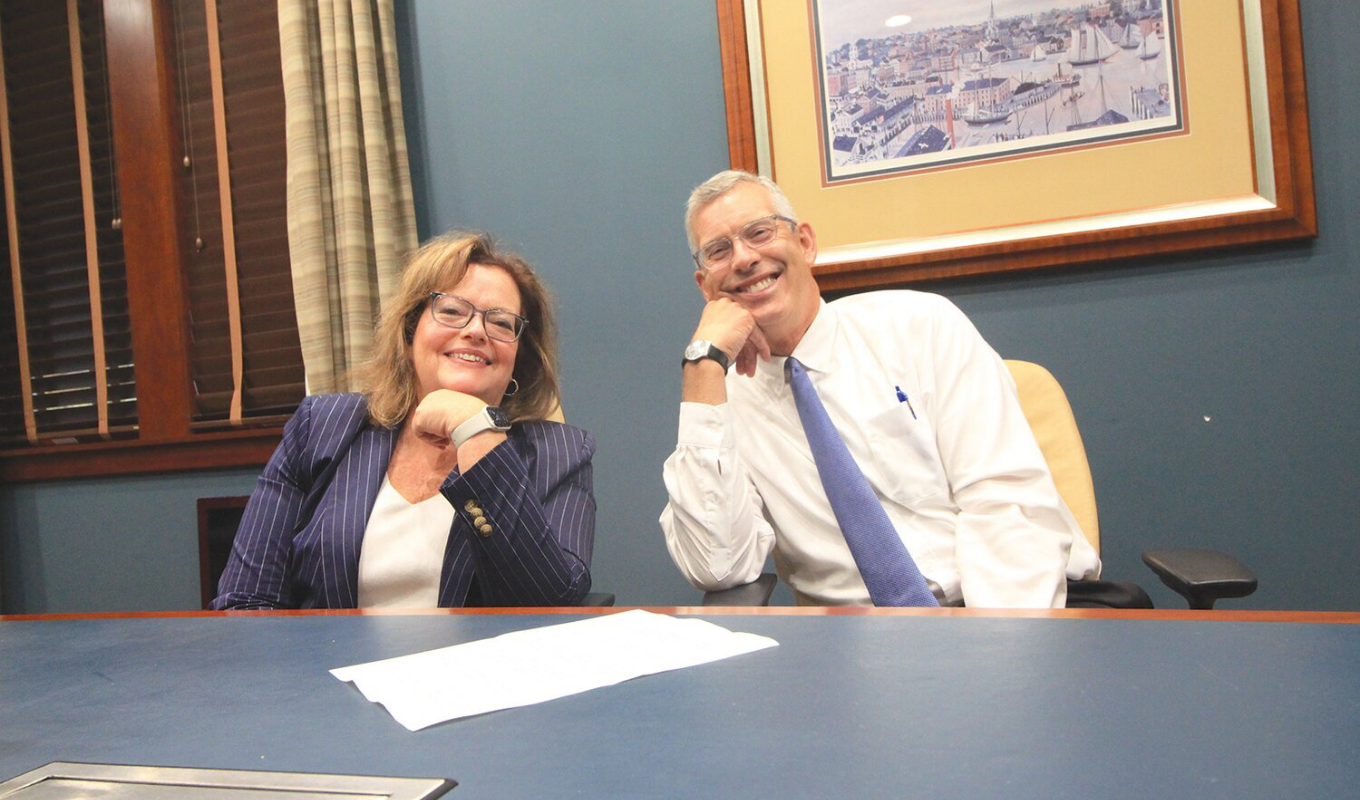
True to the weather alerts, the heavy rain arrived just before 10 a.m. on a recent Friday morning. Equally punctual for a 10 a.m. meeting at the Governor Francis Farm branch of Washington Trust was the CEO and Board Chairman of the Rhode Island bank, which this year celebrates its 225th anniversary.
Edward “Ned” Handy’s suit jacket was splotched with rain, despite his attempt to avoid the downpour by parking some distance from the entrance to give customers a better chance of staying dry. While this might seem like a minor gesture, it illustrates the philosophy that has helped Washington Trust endure for more than two centuries—and it is a gesture that could carry the bank forward for another 225 years.
Handy met with bank President Mary Noons to reflect on the anniversary, which was celebrated on 22 August. To mark the occasion, 50 bank employees boarded a bus early that morning, heading for Times Square in New York City to ring the opening bell for NASDAQ’s trading day. Though the event was exciting, it was followed by a grueling seven-hour return journey to Rhode Island, with heavy traffic making the trip far less glamorous.
225 Years of Adaptation and Community Roots
The 225-year journey of Washington Trust, like that of many long-standing institutions, has seen its share of ups and downs. Despite a rapidly changing financial landscape—marked by larger banks absorbing smaller ones and local banks like Citizens expanding into national players—Washington Trust has stayed true to its Rhode Island origins. Nearly all of its 28 retail branches are located within the state, with just one in Connecticut. Additionally, it operates five wealth management offices and six mortgage loan offices across Rhode Island, Connecticut, and Massachusetts.
A Historic Beginning
When the bank was founded in 1795, Rhode Island’s population was only 68,000, about two-thirds the size of Warwick or Cranston today. A group of local entrepreneurs established the institution to serve the region’s farming and fishing communities. At the time, Rhode Island’s longest-serving governor, Arthur Fenner, was 10 years into his term, and John Adams was the nation’s second president. Washington Trust was named in honour of George Washington and was the first bank in the United States to print currency bearing his likeness.
The challenges of the modern world, with technological advancements ranging from ATMs and mobile phones to the internet, e-commerce, and AI, would have been unimaginable to the bank’s founders. Today, these advances present both challenges and opportunities, and Washington Trust has responded with competitive products like online banking and is exploring the introduction of interactive ATMs (ITMs). These ITMs would allow customers to interact remotely with bank representatives via live video, enhancing the banking experience.
Adapting to Technology While Keeping the Personal Touch
Handy sees ITMs as a helpful tool in addressing the rising prevalence of financial scams, particularly those involving AI-generated voices that mimic family members in extortion schemes. Handy recounted a situation in which he and Jared Wilbur, Vice President of Enterprise Risk Management, visited a customer to verify the legitimacy of a large withdrawal. It turned out to be a scam.
Washington Trust offers a wide range of financial services, including mortgages, car loans, student loans, certificates of deposit, and wealth management. However, President Mary Noons believes that banking should always maintain a personal touch.
“Most people want to see a person … to know that somebody cares for you,” she said. Noons explained that the key to building these relationships is delivering services efficiently and effectively and being available when customers need help.
“We won’t just tell them to talk to a machine,” she added, underscoring the bank’s commitment to maintaining its customer-first approach.
Supporting Customers in Tough Times
As the cost of living rises and many people face financial difficulties, Washington Trust aims to support its customers without pushing them into deeper debt. Noons explained that the bank often reviews home equity loans and lines of credit to help customers through counselling, providing guidance without adding to their financial burdens.
This customer-focused approach is not new. During the Covid-19 pandemic, Washington Trust’s delinquency rate remained remarkably low at just 1%. In addition, the bank actively supports community programs, donating over $1 million annually and contributing more than 8,000 volunteer hours from its 650 employees to nonprofit organisations. These efforts focus on financial wellness, housing, and family services.
Strong Market Position and Growth Plans
Handy pointed out that Washington Trust consistently outperforms many of its peers in terms of retail branch deposits, and it currently holds the third-largest market share in Rhode Island, behind Citizens and Bank of America. For the third quarter of 2025, the bank reported assets of $6.7 billion, deposits of $5.2 billion, loans of $5.1 billion, and wealth management assets of $7.7 billion.
Handy followed up his meeting with an email after leaving the branch, coat now dry and the rain easing. In it, he shared that the bank had made several significant investments to support future growth. These included hiring a new senior executive to lead the commercial banking division and acquiring client accounts from Lighthouse Financial Management LLC, which added approximately $195 million in managed assets.
Reflecting on Washington Trust’s 225-year history, one might wonder what the bank’s founders would have thought had they seen where the bank is today—and where it is headed in the future.