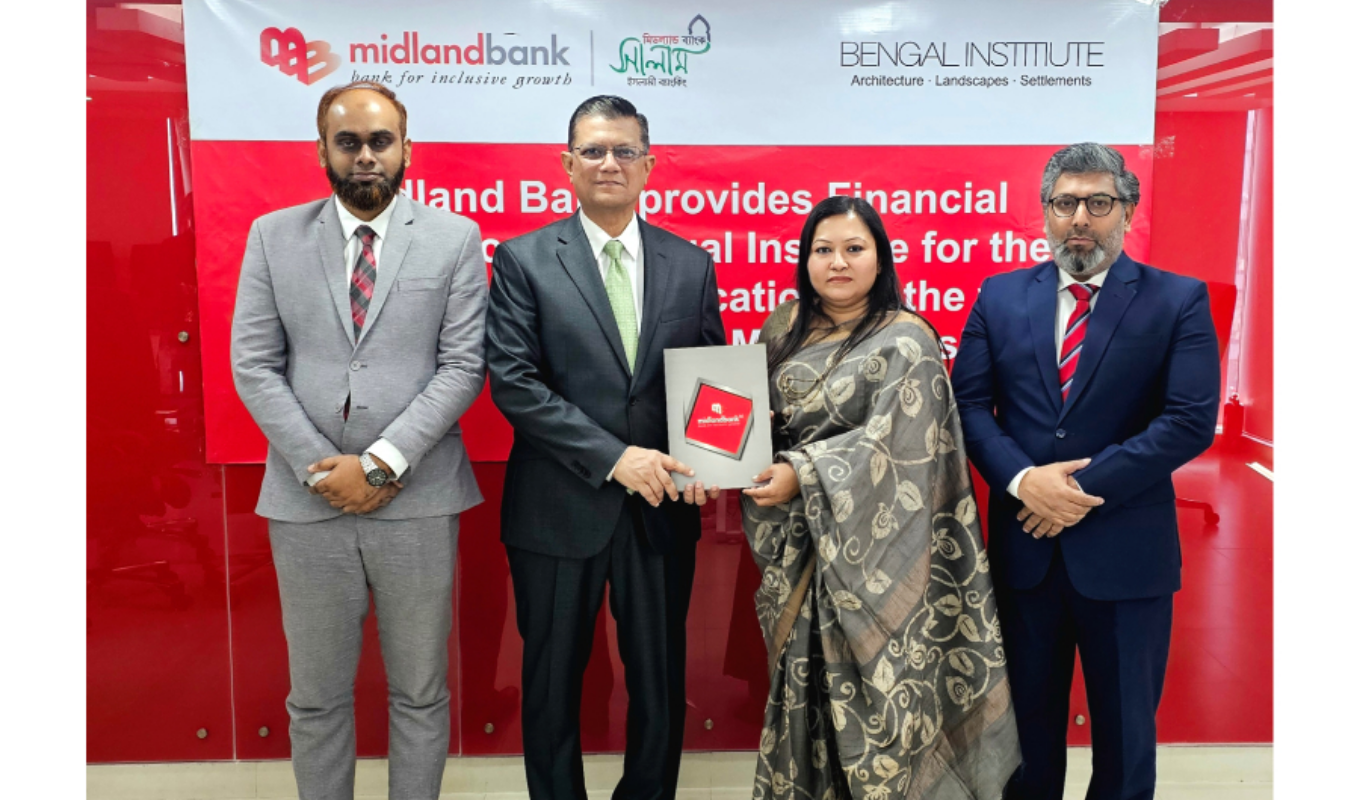
Midland Bank Family has generously extended financial assistance of Tk 10.00 lac to the Bengal Institute for Architecture, Landscapes and Settlements, supporting the comprehensive publication on the life and works of the eminent Architect Muzharul Islam.
Of the total contribution, Tk 5.00 lac was allocated from the Bank’s Islami Banking Fund as part of its ongoing Corporate Social Responsibility (CSR) initiatives. The remaining Tk 5.00 lac was voluntarily contributed by members of the Midland Bank Family, reflecting a collective commitment to promoting architectural heritage and cultural scholarship, according to an official media release.
The ceremonial handover of the cheques took place on 14 December 2025 at the Bank’s Head Office, where Md. Ahsan-uz Zaman, Managing Director & CEO of Midland Bank, personally presented the contribution to Ms. Nusrat Sumaiya, Research and Design Director of Bengal Institute. The event was attended by several key officials, including Md. Rashadul Anwar, Head of PRD, and Syed Saquibuzzaman, Head of the Islami Banking Division, who all lauded the initiative.
The financial assistance will support the publication entitled “Muzharul Islam: An Architect of Tomorrow”, a key component of the Architect Muzharul Islam Centenary Project, commemorating the 100th birth anniversary of the legendary architect. This ambitious project encompasses a memorial programme, a lecture series, a commemorative video, and the publication, which is scheduled to launch in early 2026.
Speaking at the ceremony, Md. Ahsan-uz Zaman highlighted the Bank’s dedication to fostering cultural and academic pursuits. He emphasised that initiatives like this not only honour national icons but also inspire future generations of architects, designers, and urban planners. Ms. Nusrat Sumaiya expressed heartfelt gratitude for the support, noting that the contribution would significantly enhance the Institute’s efforts to document and disseminate the life and legacy of Muzharul Islam.
The collaboration between Midland Bank Family and Bengal Institute exemplifies how financial institutions can play a pivotal role in supporting educational, cultural, and creative endeavours, reinforcing a shared commitment to preserving and celebrating Bangladesh’s architectural heritage.