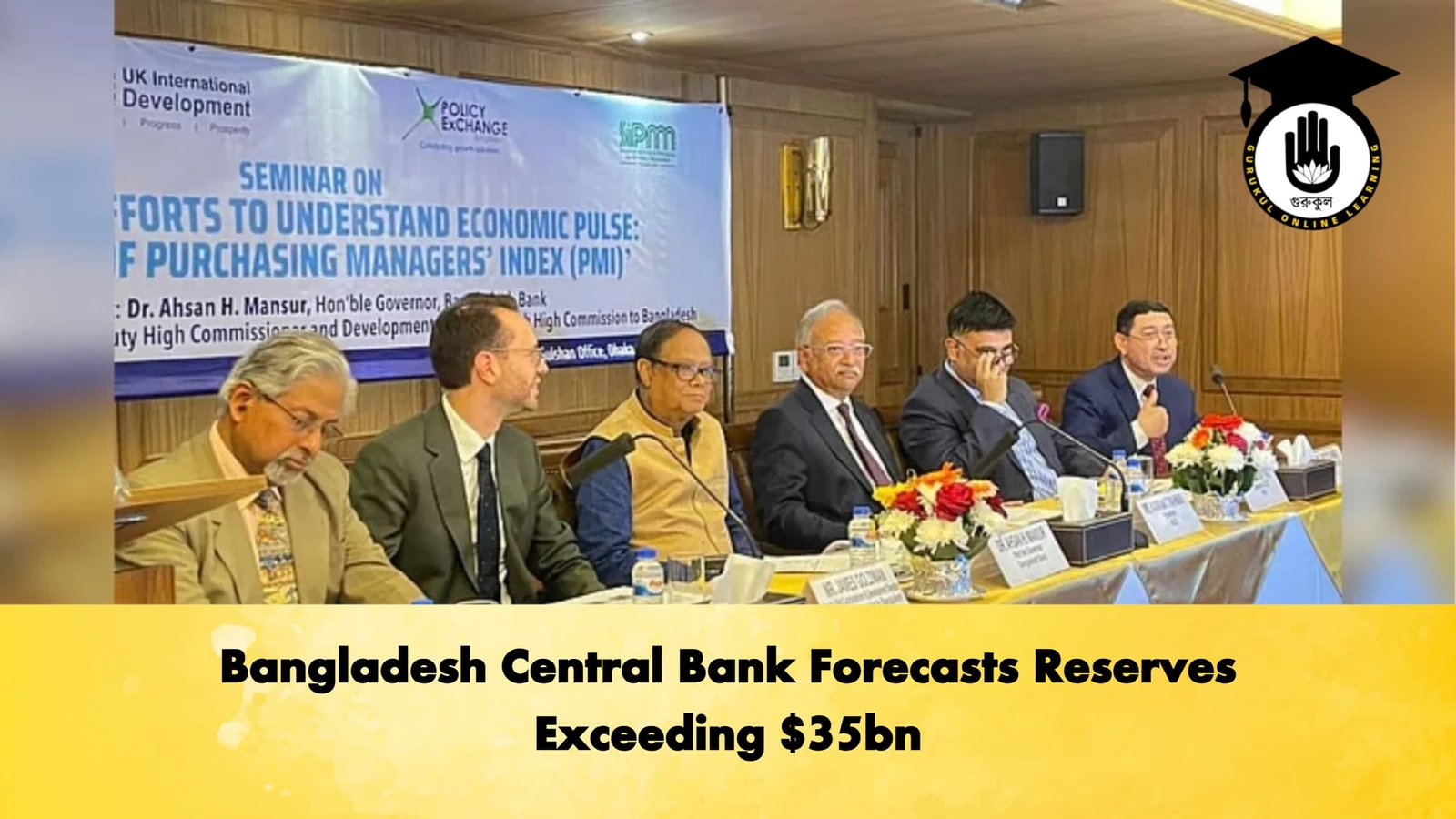
The Governor of the Bangladesh Bank, Ahsan H. Mansur, has delivered a robust vote of confidence in the nation’s fiscal health, predicting that foreign exchange reserves will surpass the $35 billion mark before the conclusion of the current fiscal year. Delivering the keynote at a seminar in Gulshan on Monday, 19 January 2026, the Governor asserted that this recovery is being driven by structural stability rather than a dependence on international bailouts.
Resilience Without IMF Dependency
The seminar, which focused on the Purchasing Managers’ Index (PMI) and the broader trajectory of the Bangladeshi economy, provided a platform for the Governor to outline a “Macroeconomic Consolidation” phase. Governor Mansur revealed that the central bank expects to meet its reserve targets even without the inclusion of the International Monetary Fund (IMF) loan tranches.
“We are on a trajectory to hit and likely exceed the $35 billion threshold,” the Governor stated. “Achieving this through our own market mechanisms, independent of IMF funds, puts us in a very comfortable position. Any additional external funding would simply be ‘icing on the cake’—we are not relying on it to maintain our stability.”
Consolidated Economic Outlook (FY 2025–2026)
| Economic Metric | Current Standing | Strategic Goal |
| Foreign Reserves | Rapidly accumulating | >$35 Billion |
| Market Purchases | $3.7 Billion (Unconditional) | Continued organic accumulation |
| Inflation Rate | >8% (Current) | <5% (Medium-term target) |
| Deposit Growth | 11% (as of Dec 2025) | 14% (Projected) |
| Private Sector Credit | Liquidity recovering | ৳2 Trillion potential funding |
Curbing Inflation and Restoring Liquidity
The Governor identified exchange rate stability and interest rates as his primary focus areas. He noted that banks are now voluntarily selling dollars to the central bank, which has purchased $3.7 billion from the market to date—exceeding the volume of current IMF support. This move has injected approximately ৳45 billion of liquidity into the local market.
While inflation remains a hurdle at over 8%, Mansur aims to drive it below 5% through consistent domestic supply management. “Once inflation settles and the exchange rate remains firm, we will begin lowering policy rates. Already, lending rates for top-tier clients have softened to between 11% and 12%,” he added.
A “Gold Mine” of Economic Data
The event, organised by the Metropolitan Chamber of Commerce and Industry (MCCI) and Policy Exchange Bangladesh, also featured the Deputy British High Commissioner, James Goldman. He remarked that Bangladesh is at a critical juncture where modern, transparent regulations are essential for long-term survival.
Dr M. Masrur Reaj, Chairman of Policy Exchange, highlighted that while the Bangladesh Bureau of Statistics (BBS) sits on a “gold mine” of data, the lack of timely and regular publication hinders investors. He stressed that aligning data transparency with international standards is vital for maintaining the economic momentum the Governor described.