A decade ago, large-scale imports of capital machinery and industrial raw materials were financed predominantly through foreign banks. Domestic lenders were constrained by limited foreign currency credit lines, underdeveloped risk management frameworks and comparatively modest technological infrastructure. That landscape has shifted markedly. Through sustained investment in digital systems, skilled personnel and correspondent banking relationships, local banks have consolidated their position in foreign trade finance, emerging as principal intermediaries in import settlement, export financing and bank guarantee issuance.
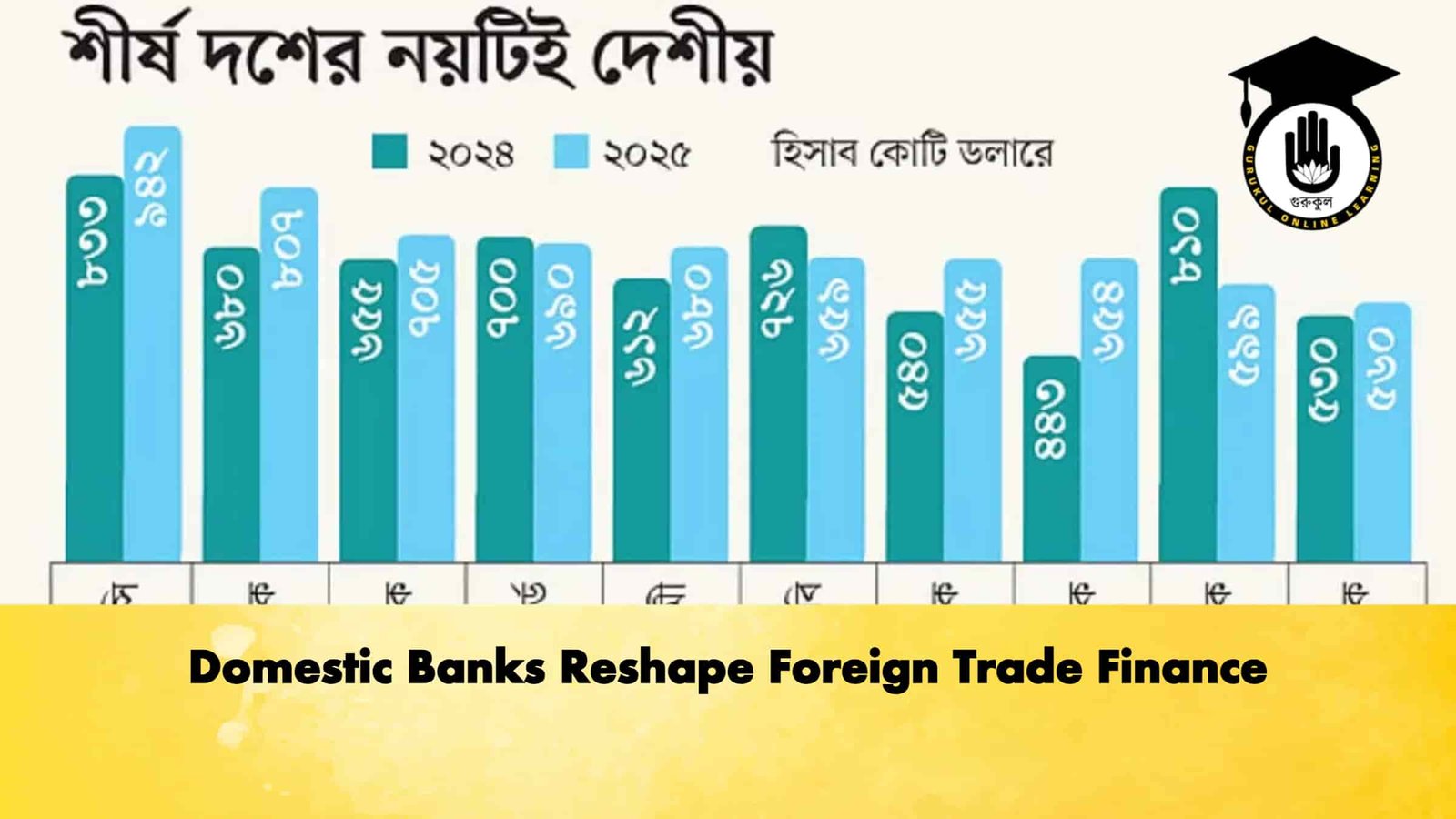
Industry data for 2025 underscore this structural transition. HSBC retained the top position in overall trade volume, facilitating transactions worth 9.42 billion US dollars, up from 8.33 billion dollars in 2024. However, domestic institutions now occupy two of the top three positions. City Bank handled 8.07 billion dollars in 2025, compared with 6.80 billion dollars a year earlier. Pubali Bank followed closely, surpassing 7 billion dollars in trade transactions.
The comparative performance of selected banks is presented below:
| Bank | 2024 (USD bn) | 2025 (USD bn) |
|---|---|---|
| HSBC | 8.33 | 9.42 |
| City Bank | 6.80 | 8.07 |
| Standard Chartered | 7.00 | 6.90 |
| Shahjalal Islami Bank | 6.12 | 6.80 |
| United Commercial Bank | 7.26 | 6.59 |
| BRAC Bank | — | 6.55 |
| Eastern Bank | — | 6.54 |
| Islami Bank | 8.10 | 6.54 |
| Southeast Bank | 5.30 | 5.60 |
Bangladesh’s annual foreign trade volume stands at approximately 120 billion dollars, of which nearly 100 billion dollars is executed through just 20 banks. The increasing concentration of trade flows among leading institutions reflects both consolidation and heightened operational efficiency.
Several factors explain the ascent of domestic banks. Technology-driven services, paperless documentation, automated compliance screening and expedited settlement cycles have enhanced competitiveness. Participation in international risk-sharing and structured trade finance programmes has broadened access to offshore liquidity, lowering counterparty risk for exporters. Close alignment with major export industries, particularly the ready-made garment sector, has further strengthened client relationships and transaction pipelines.
In some cases, individual banks have recorded more than a fivefold increase in foreign trade volumes over the past decade, illustrating the depth of institutional transformation. Enhanced foreign exchange management capabilities and client-centric advisory services have also contributed to sustained growth.
Challenges remain. Globally, an estimated 80 to 85 per cent of trade is now conducted on open account terms, exposing exporters to elevated payment risk. Although trade credit insurance mechanisms are expanding internationally, domestic penetration remains limited. Bankers argue that the introduction of modern risk mitigation instruments and stronger policy support would enable local institutions to capture a larger share of regional trade flows and reinforce financial resilience.
The trajectory suggests that domestic banks are no longer peripheral participants but central pillars in the country’s foreign trade architecture.