Following the fall of the Awami League government, Bangladesh’s economic environment became increasingly uncertain, leading to a slowdown in loan recovery across the banking sector. Private banks, including Bank Asia, faced significant challenges in collecting dues. Particularly, large and influential borrowers frequently deferred repayments, sought long-term rescheduling, or made only minimal advance payments.
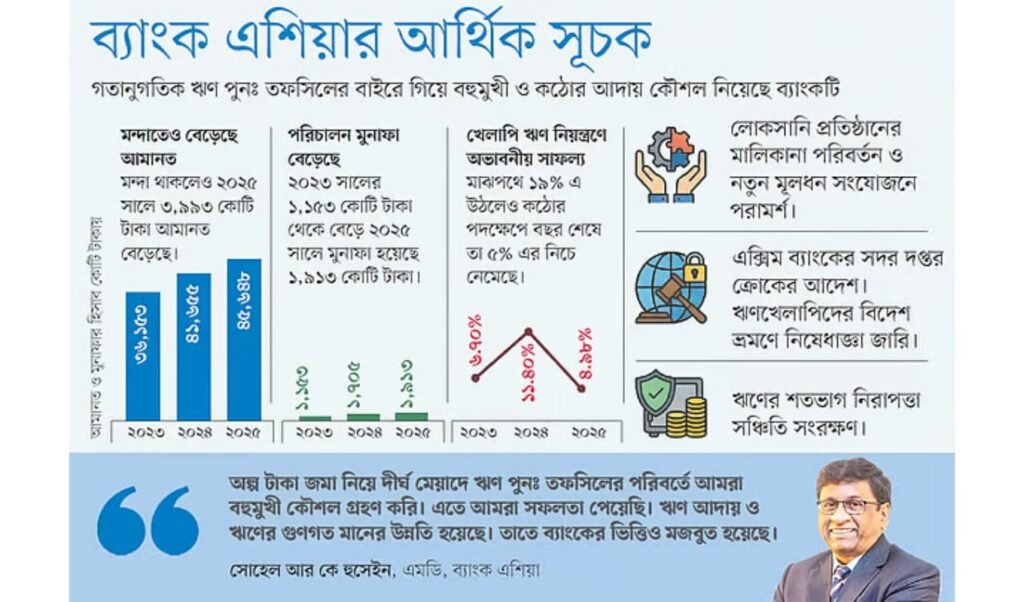
While many banks traditionally attempt to reduce non-performing loans (NPLs) through lenient rescheduling, Bank Asia adopted a more nuanced and disciplined approach. The bank prioritised realistic cash flow assessments, debt-to-equity ratio analysis, infusion of new capital, and enhancement of collateral when restructuring loans. As a result, in some cases, NPLs temporarily increased during negotiations with major clients, peaking at 19% in mid-2025. However, due to these strategic measures, the NPL ratio fell to below 5% by the end of the year.
Bank Asia’s multifaceted strategies included:
Assisting clients in selling business assets to repay loans
Initiating criminal proceedings and travel restrictions against willful defaulters
Seizing mortgaged and liened properties
Confiscating land and company shares owned by entrepreneurs
These measures yielded substantial results. By 2025, Bank Asia reported an operating profit of BDT 1,913 crore, demonstrating both financial resilience and operational efficiency.
Key Financial Indicators (2023–2025)
| Year | Deposits (BDT crore) | Operating Profit (BDT crore) | NPL Ratio (%) |
|---|---|---|---|
| 2023 | 33,769 | 1,153 | 6.7 |
| 2024 | 41,655 | 1,705 | 11.4 |
| 2025 | 45,648 | 1,913 | Below 5 |
Bank Asia’s capital adequacy reached nearly 16%, while its loan-to-deposit ratio remained under 60%, signalling a solid liquidity position and robust risk management framework.
The bank also ensured loan recovery through the strategic sale of client projects. Notable examples include the transfer of ownership and capital restructuring at Abdul Monem Sugar Refinery and Robintek Group, as well as share transfers at Spinning Mills, which facilitated debt repayment.
Additionally, the bank maintained a firm stance against deliberate defaulters, pursuing legal action, enforcing travel bans, and securing loans against the assets of companies such as Prime Ship Recycling and Makkah Multilayer.
Bank Asia’s Managing Director, Sohel R. K. Hossain, remarked, “By adopting a multifaceted strategy instead of relying solely on rescheduling, we have improved both loan recovery and asset quality. The bank’s foundation has been strengthened, and depositors’ interests are safeguarded. Our objective is to transform Bank Asia into a top-tier financial institution through skilled and professional banking practices.”
In summary, Bank Asia’s innovative approaches, meticulous financial evaluation, and effective legal measures have successfully reduced non-performing loans, establishing a new benchmark for the country’s banking sector.