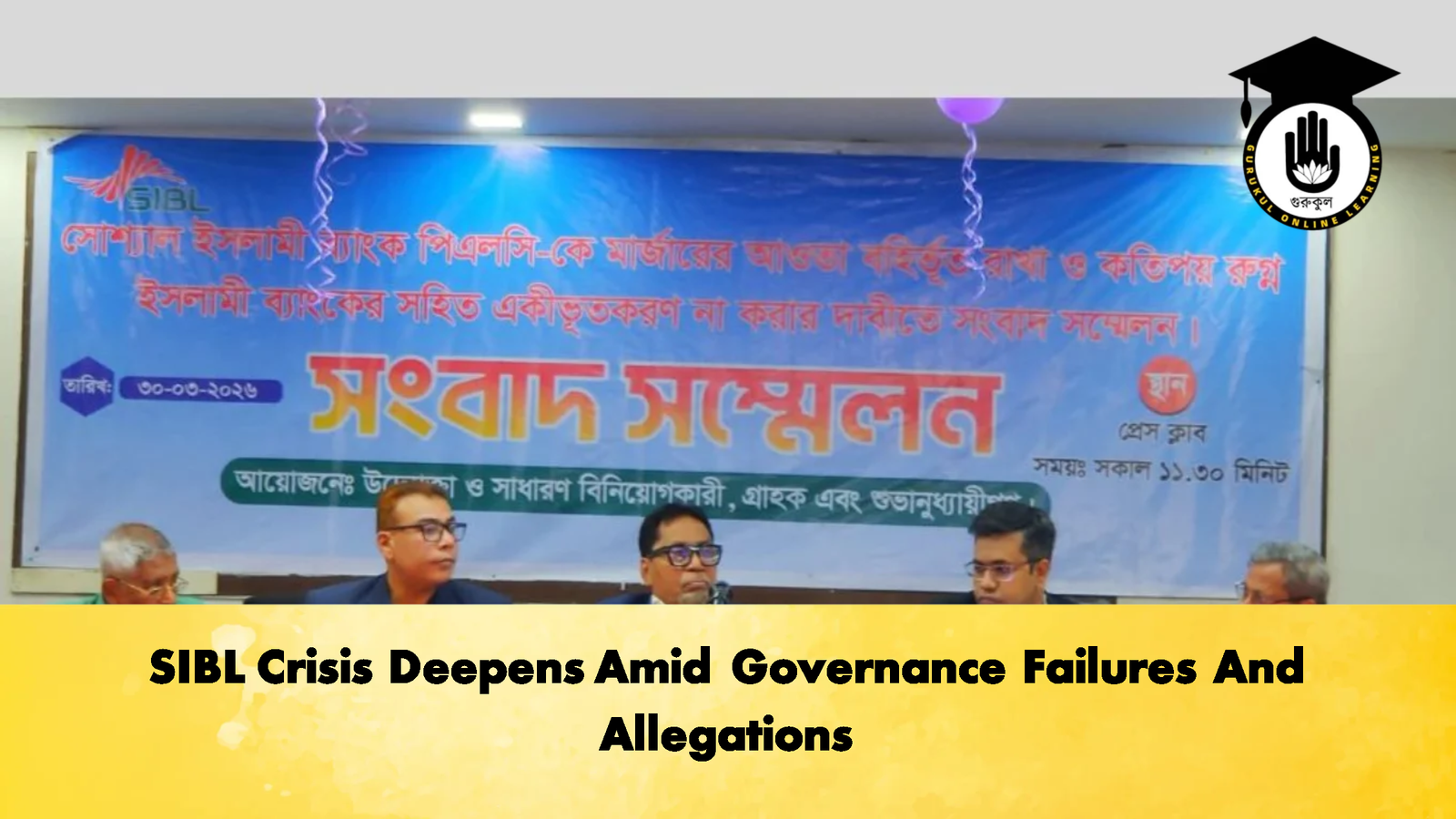
The prolonged crisis at Social Islami Bank Limited (SIBL) has drawn renewed scrutiny, as fresh allegations highlight deep-rooted governance failures, regulatory inaction, and controversial ownership changes that have weakened the institution over nearly a decade.
At a press conference held at the National Press Club, legal counsel for the bank’s founding chairman, Major (Retd.) Dr Rezaul Haque, presented a detailed account of what he described as the systematic dismantling of a once-profitable bank. Lawyer Mahmudul Hasan argued that SIBL’s decline over the past seven to eight years cannot be explained by internal inefficiencies alone, but must be viewed within a broader framework of institutional and regulatory shortcomings.
A central element of the allegations concerns the involvement of the S Alam Group, which has been accused of exerting undue influence over the bank’s operations and contributing to its financial deterioration. However, Mr Hasan emphasised that responsibility also rests with the Bangladesh Bank, which he claims failed to act decisively despite being aware of irregularities within the institution.
The allegations extend to politically sensitive developments during the tenure of former Prime Minister Sheikh Hasina. It is claimed that certain stakeholders were compelled, under pressure, to relinquish ownership stakes after being taken to intelligence offices and forced to sign documents. At the time, those affected reportedly remained silent due to fears for their personal safety and the prevailing political environment.
Following the political transition on 5 August, stakeholders had anticipated a shift towards reform and institutional recovery. However, these expectations have not materialised. According to the claims presented, the tenure of former central bank governor Ahsan H Mansur was marked by a lack of cooperation that further obstructed efforts to stabilise the bank.
Rather than reinstating experienced sponsor shareholders, management responsibilities were reportedly assigned to individuals lacking sufficient expertise in banking operations. Over the past eighteen months, these administrators are said to have operated primarily under regulatory directives, with limited focus on long-term institutional recovery. As a result, SIBL continues to face operational inefficiencies, mounting liabilities, and declining financial performance.
Key Issues Highlighted in the SIBL Crisis
| Issue Category | Details |
|---|---|
| Duration of decline | Approximately 7–8 years |
| Regulatory concerns | Alleged inaction by Bangladesh Bank despite known irregularities |
| Business group involvement | Alleged role of S Alam Group |
| Governance structure | Replacement of sponsor shareholders with inexperienced administrators |
| Non-performing loans | High and rising |
| Central bank borrowing | Significant dependence |
| Estimated recovery period | Up to 8 years |
| Investment interest | Interest from major industrial groups, including IDB-linked entities |
Mr Hasan further noted that no senior officials or banking professionals have yet been held accountable for the alleged misconduct, raising serious concerns about transparency and oversight within the financial sector. He argued that without a credible process of accountability, efforts to reform the institution are unlikely to succeed.
In response to media queries, he acknowledged the scale of SIBL’s financial distress, particularly its large volume of non-performing loans and heavy reliance on liquidity support from the central bank. Given these structural challenges, he suggested that a realistic recovery plan would require a long-term commitment, potentially extending up to eight years.
Despite the bleak outlook, there are indications of investor interest. According to the statement, several major industrial groups—including entities associated with the Islamic Development Bank—have expressed willingness to invest in the bank. Such investments could offer a pathway to recovery without increasing reliance on central bank liquidity injections.
In a written statement, Major (Retd.) Dr Rezaul Haque strongly criticised the current management framework, alleging that decisions taken over the past eighteen months have further eroded shareholder value. He claimed that sponsor shareholders had effectively been sidelined through mechanisms that rendered their holdings negligible, transferring the burden of alleged financial mismanagement onto ordinary investors.
He also urged the government to reconsider any plans to merge SIBL with other financial institutions. Instead, he advocated for a restructuring process that would restore control to the original sponsor shareholders, arguing that experienced ownership could have significantly improved the bank’s trajectory if given the opportunity.
Concerns were also raised about the impact on depositors and business clients. Thousands of customers are reportedly still awaiting the return of their funds, while many businesses linked to the bank are facing severe financial strain. Some enterprises, he claimed, have been forced to cease operations after being classified as defaulters and subsequently denied access to credit from other financial institutions.
Stakeholders have called for urgent government intervention, including structured dialogue with the central bank and the development of a comprehensive investment plan aimed at reviving the institution. They have also expressed reservations regarding proposed legislative measures, such as the Banking Regulation Act 2025, warning that poorly implemented reforms could further weaken the bank.
As the situation continues to unfold, the future of SIBL remains uncertain. The allegations, however, underscore broader systemic concerns surrounding governance, regulatory oversight, and accountability within Bangladesh’s banking sector. Without decisive and transparent action, restoring confidence in both the institution and the wider financial system may prove a prolonged and challenging process.