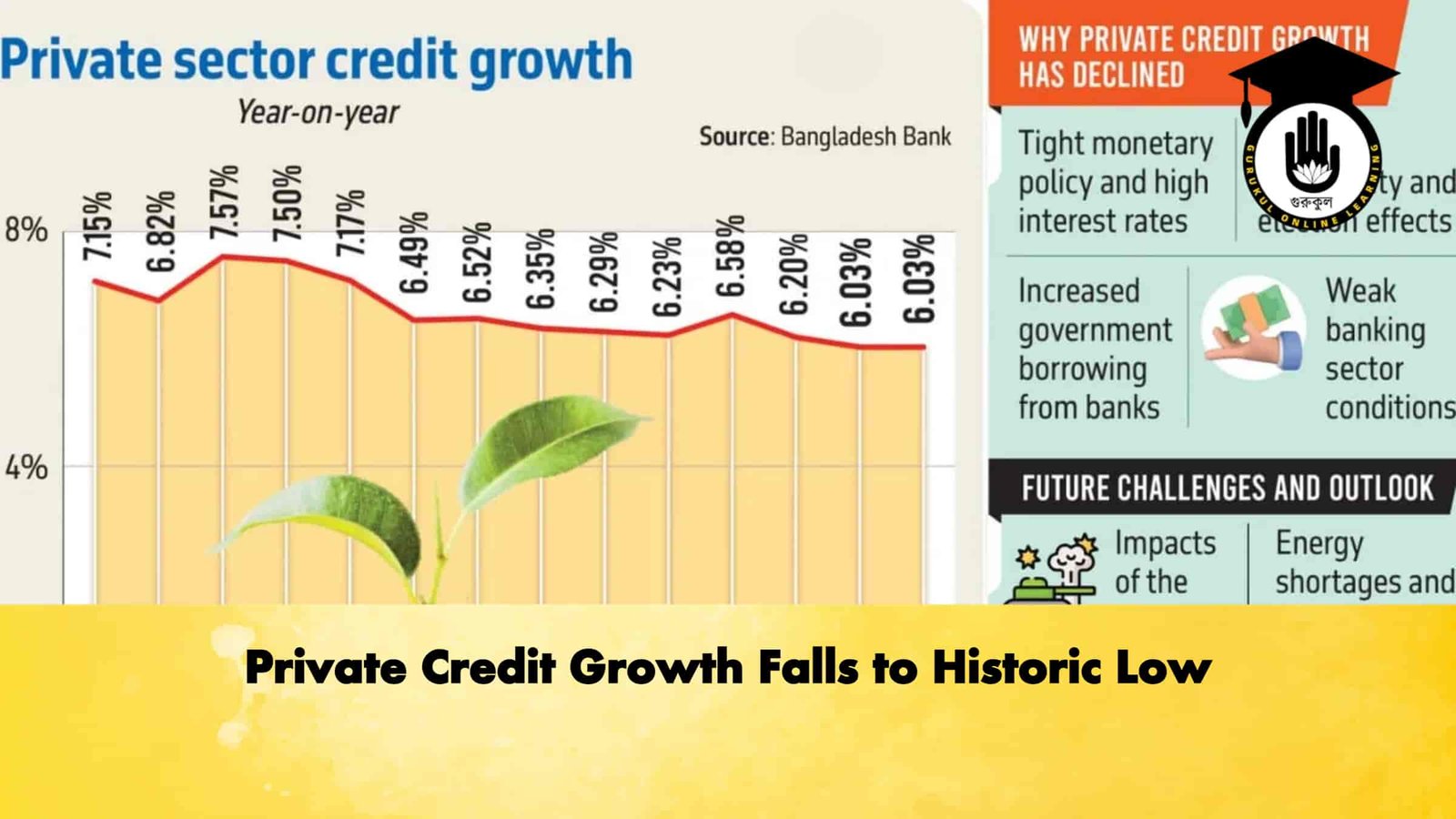
Private sector credit growth in Bangladesh plummeted to a record low of 6.03 per cent in February, as prolonged political uncertainty and persistently high interest rates weighed heavily on investment activity. Financial sector experts warn that, compounded by the geopolitical tensions arising from the Iran war, a near-term recovery in credit expansion appears unlikely.
According to the latest figures released by Bangladesh Bank, credit growth has been steadily declining since mid-2024. In July 2024, private sector credit growth stood at 10.13 per cent, but it has fallen sharply following the political transition in August 2024. Although a temporary rise to 6.58 per cent was observed in November 2025, analysts attribute this to loan restructuring ahead of the 12 February national election, rather than fresh investment in productive sectors.
Private Sector Credit Growth Trend
| Month | Credit Growth (%) |
|---|---|
| April 2025 | 7.50 |
| May 2025 | 7.17 |
| June 2025 | 6.40 |
| July 2025 | 6.52 |
| August 2025 | 6.35 |
| September 2025 | 6.29 |
| November 2025 | 6.58 |
| December 2025 | 6.10 |
| February 2026 | 6.03 |
In its January–June 2026 monetary policy statement, Bangladesh Bank highlighted that the slowdown reflects tight monetary conditions, increased government borrowing to finance the budget deficit, and weak loan demand amid persistent investment uncertainty.
Sohail RK Hussain, Managing Director of Bank Asia PLC, told The Business Standard, “Following the February election, the government prioritised private sector growth. However, the unforeseen escalation of the Iran war has dampened any immediate recovery prospects. Even if the conflict ends soon, credit growth is unlikely to rebound in the next few months.”
He added that energy costs are the largest hurdle for businesses: “Higher fuel import costs push up production expenses and could necessitate further interest rate hikes to control inflation. Combined with rising dollar rates and export uncertainties, the coming months will be challenging for the private sector.”
Newly appointed Bangladesh Bank Governor Md Mostaqur Rahman has signalled policy support to revive lending. He indicated that lending rates would be gradually reduced to encourage investment and that reopening dormant factories would be central to restoring economic momentum. However, concrete policy action remains pending due to geopolitical and domestic economic pressures.
Additional strains on the banking sector include record non-performing loans of Tk5.57 lakh crore (about one-third of total outstanding loans), high government borrowing—net credit to the government reached Tk98,000 crore by 19 March 2026—and limited deposit growth. Commercial lending rates hovering near 13.5 per cent continue to restrict borrowing, particularly for small and medium enterprises.
The cumulative effect of these factors is evident across the economy: slower industrial expansion, subdued consumer demand, underutilised factory capacity, and stagnating private sector employment. Experts warn that without targeted policy intervention and reliable energy supply, the private sector may remain trapped in a prolonged period of constrained credit growth.