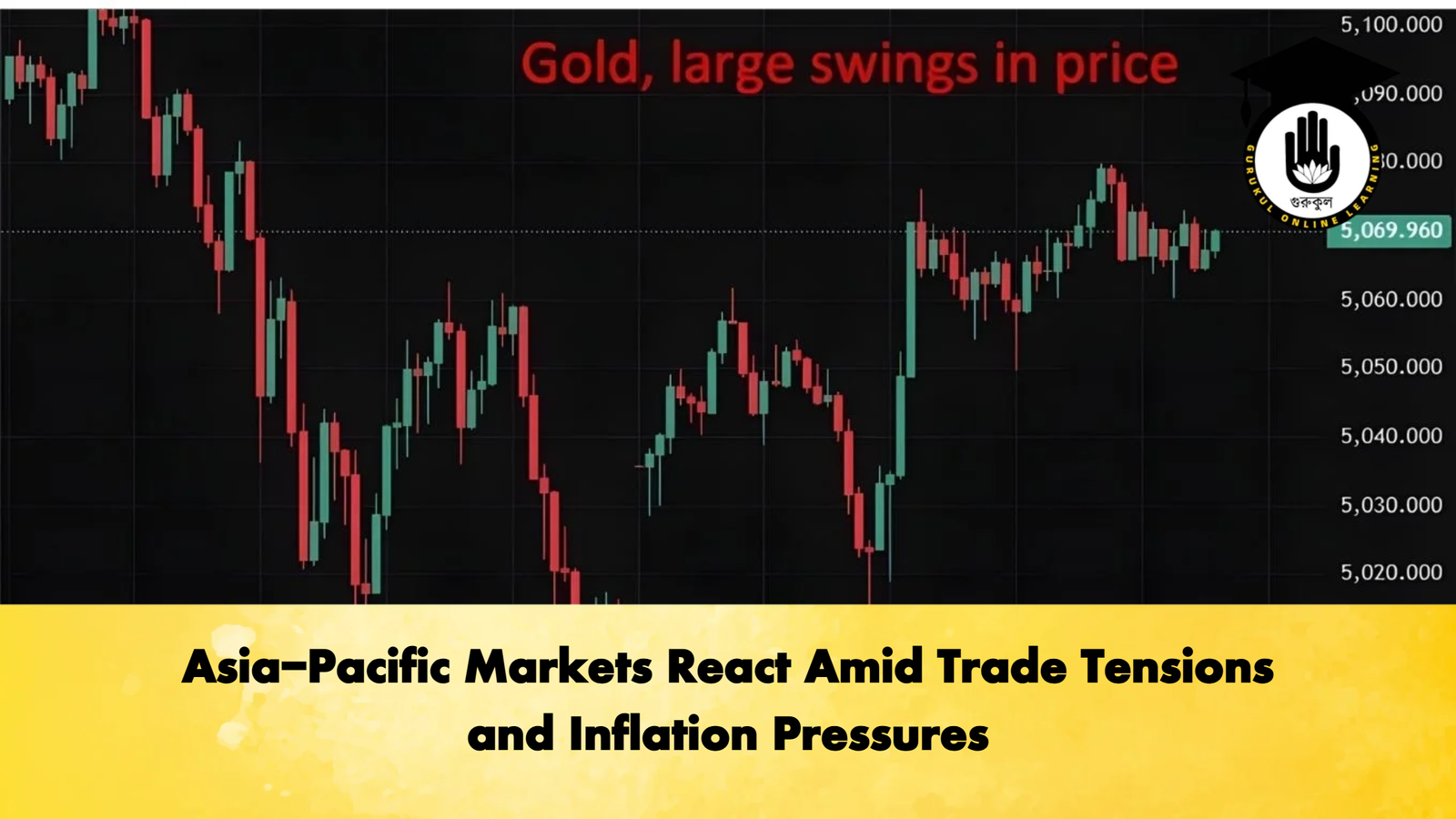
Hong Kong, 27 January 2026 — Financial markets across the Asia-Pacific region experienced notable volatility on Tuesday as global commodity prices, including gold and silver, staged a modest recovery, while a flurry of economic data from major economies captured investor attention. The announcement by U.S. President Donald Trump to impose tariffs of up to 25% on select South Korean goods has reignited trade tensions in the region, impacting the automotive, timber, and pharmaceutical sectors of South Korea.
In response, Seoul has swiftly initiated legislative measures. A senior government official confirmed that a bill aimed at facilitating compliance with the U.S. investment committee’s directives has been formally tabled in Parliament. Furthermore, South Korea’s trade envoy is scheduled to meet with the U.S. Trade Representative (USTR) in Washington imminently to address the new tariff framework.
Meanwhile, Japan continues to witness robust service-sector inflation. In December 2025, the Services Producer Price Index (PPI) rose by 2.6%, reflecting persistent labour shortages and wage pressures. The Bank of Japan has interpreted this as a potential signal of enduring, labour-driven inflationary trends.
Across the United Kingdom, retail inflation has climbed to a two-year high. Data from the British Retail Consortium indicate that shop price inflation increased by 1.5% in January 2026, driven largely by rising energy costs and increased National Insurance contributions.
In Australia, business conditions show modest improvement. The National Australia Bank (NAB) survey reported a business conditions index of +9 and a business confidence index of +3, though capacity utilisation remains at 83.2%, suggesting limited spare capacity in the economy.
China’s industrial sector displayed signs of profit recovery in December 2025, with industrial profits rising 5.3% following a sharp 13% decline in November. Notably, state-owned enterprises saw a 3.9% contraction in earnings, while foreign-invested enterprises contributed to overall growth.
Geopolitical concerns remain pronounced. Iran faces increasing internal pressures, potentially marking its weakest position since the 1979 Islamic Revolution, adding a layer of global risk.
Key Asia-Pacific Market Indices (27 January 2026)
| Index | Country | Daily Change (%) |
|---|---|---|
| Nikkei 225 | Japan | +0.4 |
| Hang Seng | Hong Kong | +1.2 |
| Shanghai Composite | China | -0.01 |
| S&P/ASX 200 | Australia | +0.82 |
Currency movements were subdued, with the Japanese yen and other regional currencies trading in narrow ranges against the U.S. dollar. Gold prices, following a recent decline, show potential to rebound to approximately $5,700 per ounce.
In summary, the Asia-Pacific region remains at the intersection of trade uncertainty, labour-driven inflation, and uneven industrial performance. Investors are navigating heightened market sensitivity, balancing optimism over sectoral recoveries against ongoing geopolitical and economic risks.