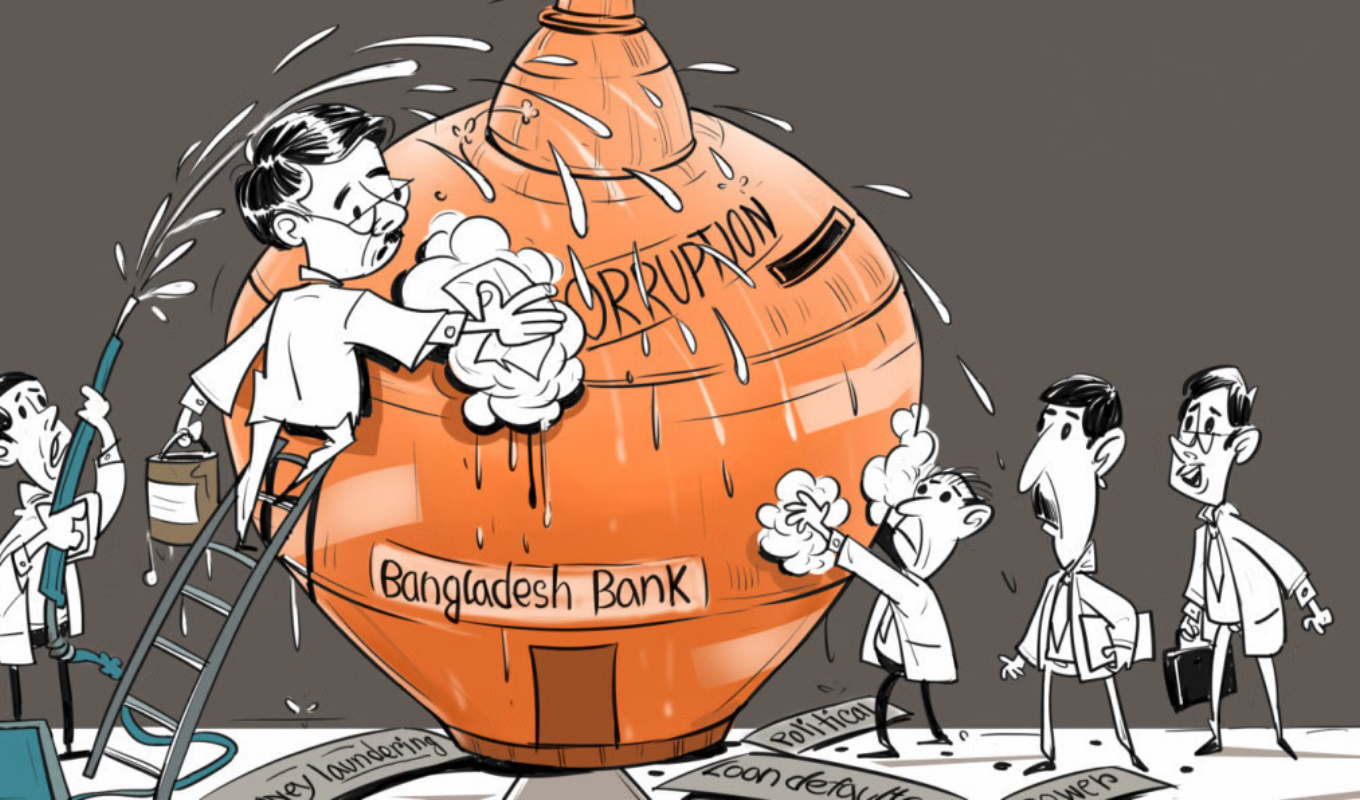
An independent central bank is crucial for ensuring economic stability and maintaining public trust, as it allows the institution to make critical operational and technical decisions, such as setting interest rates, regulating banks, and managing foreign reserves, without political interference. This autonomy enables the bank to base its monetary policies on economic realities rather than short-term political goals. The independence of a central bank serves as a signal of professionalism, credibility, and a commitment to long-term stability, all of which are essential for maintaining confidence among citizens, investors, and markets.
Unfortunately, in Bangladesh, successive governments have gradually eroded the autonomy of the Bangladesh Bank (BB), which was established under the Bangladesh Bank Order of 1972 with the mandate to safeguard monetary stability. Over time, BB has increasingly been treated as an extension of the government rather than an independent authority. This has compromised its ability to make timely and effective decisions necessary for ensuring the financial health and price stability of the country. The effects of this long-standing interference are visible in the current fragility of the banking sector, which is plagued by weak governance, poor oversight, and delayed or misguided policy actions.
The situation is compounded by the alarming rise in non-performing loans (NPLs). As of March 2025, NPLs had reached a troubling 24.13 percent of all loans, with state-owned banks suffering from a much higher rate of 45.79 percent. International auditors’ Asset Quality Reviews (AQRs) have highlighted the severity of the issue. Five Shariah-based Islamic banks were found to have NPLs almost equal to the total value of their loans, pointing to deeper institutional weaknesses, often exacerbated by the central bank’s inability to operate free from political influence and vested interests.
The absence of institutional autonomy in the central bank means it struggles to respond swiftly and consistently to the current economic challenges facing Bangladesh—such as high inflation, currency volatility, and weak banking discipline. When crucial decisions like raising interest rates or allowing currency adjustments are dependent on political clearance, the credibility of the central bank is undermined, and the effectiveness of its policies suffers.
In this context, the Bangladesh Bank’s recent move to revise the 1972 order is both timely and necessary. The proposed amendments include enhancing administrative and financial autonomy, reducing the number of bureaucrats on its board to limit government influence, providing stronger tenure protection for the governor, and establishing a formal Monetary Policy Committee (MPC). If these reforms are implemented effectively, they could restore the credibility of the central bank.
However, any new law must clearly define the primary objective of the Bangladesh Bank. The central goal should be price stability, with secondary objectives focused on promoting economic growth and employment. In recent years, the BB has refrained from tightening monetary policy, opting instead to cap lending rates at 9 percent and deposit rates at 6 percent, even in the face of persistent double-digit inflation. This policy largely benefitted politically connected borrowers but disadvantaged ordinary savers, whose returns were far below inflation. Price stability must be prioritized, even if higher interest rates temporarily burden businesses already grappling with issues like corruption, infrastructure gaps, and bureaucratic inefficiencies. Delays in implementing a contractionary monetary policy, combined with incoherent fiscal policy, allowed inflation to remain elevated for nearly three years. With inflation now easing, interest rates should be gradually adjusted, guided by data, not political considerations, to reduce business costs.
In addition, the appointment and removal of the governor and deputy governors must be transparent and merit-based. Their terms should be fixed and protected from arbitrary dismissal. A search committee should oversee appointments to ensure that only qualified professionals are selected. Appointing current or former bureaucrats to these positions compromises neutrality and increases conflicts of interest. Although the 1972 order includes this safeguard, previous governments have often ignored it, choosing loyal bureaucrats to serve political ends. Leadership integrity and expertise must be the foundation of the central bank’s independence.
Regarding the MPC, it should not serve as a mere advisory body but should be a legally mandated committee composed of both internal and external experts. The MPC should meet regularly, publish meeting minutes, and provide clear explanations for its policy decisions. Such transparency would increase accountability and strengthen the central bank’s independence by showing that decisions are based on evidence and analysis, not political influence. An empowered MPC would help ensure that monetary policy reflects economic realities rather than political moods.
There must also be greater coherence in exchange rate policy. While the government can suggest the overall framework for exchange rate management, operational control over interventions should rest with the Bangladesh Bank. The central bank should have a clear, publicly available foreign exchange intervention policy, supported by regular reporting. The previous government’s decision to artificially maintain the value of the taka, while neighboring countries allowed their currencies to depreciate, hurt Bangladesh’s export competitiveness and distorted market signals. When the taka was eventually allowed to depreciate, it happened suddenly, contributing to inflationary pressures and import disruptions. A gradual, market-based adjustment, monitored by the central bank within a coherent policy framework, would have mitigated these shocks.
At the same time, the government’s borrowing practices must be more disciplined. Weak domestic revenue generation and high public spending have led the government to increasingly rely on borrowing from commercial banks and the central bank to fill fiscal gaps. Borrowing from commercial banks crowds out private sector credit, while borrowing from the central bank is effectively equivalent to printing money, fueling inflation and destabilizing the economy. To prevent fiscal dominance and encourage better debt management, such borrowing must be strictly controlled. Instead, the government should focus on improving tax collection and reducing public sector inefficiencies.
Independence, however, must be balanced with accountability to prevent opacity and mismanagement. The Bangladesh Bank should have full control over its budget, staffing, and operations but should also be subject to rigorous ex-post oversight. This includes publishing audited financial statements, submitting performance reports to Parliament, and maintaining transparent communication with the public. The credibility of an independent central bank hinges not only on its autonomy but also on its integrity and transparency.
Moreover, the internal capacity and culture of Bangladesh Bank need to evolve. Even with legal independence, the central bank’s effectiveness will be limited if it lacks professional competence and analytical strength. The BB must invest in building expertise in monetary policy analysis, data-driven decision-making, and financial supervision, and foster a culture of integrity, evidence-based policymaking, and ethical conduct.
Achieving true independence for the central bank will face resistance, as it limits the discretion of powerful interest groups. The Ministry of Finance’s Financial Institutions Division (FID) may view greater autonomy for BB as a loss of control, while vested interests in the banking sector may resist stronger oversight and stricter regulations. Overcoming these challenges will require strong political commitment and public awareness. The independence of the central bank is not a mere technical issue; it is central to ensuring economic stability and protecting citizens’ savings from the consequences of poor policymaking.
Ultimately, passing a new law is just the beginning. The real challenge lies in the law’s implementation. Its success will depend on how future governors handle political pressure, how transparent the Bangladesh Bank is in communicating its policy decisions, and how consistently rules are applied across all banks, regardless of their size or political connections.
Institutional independence is not achieved overnight. If the principles of integrity, professionalism, and accountability are upheld, the Bangladesh Bank can function as the independent guardian of the country’s monetary and financial stability—an essential role that Bangladesh urgently needs.