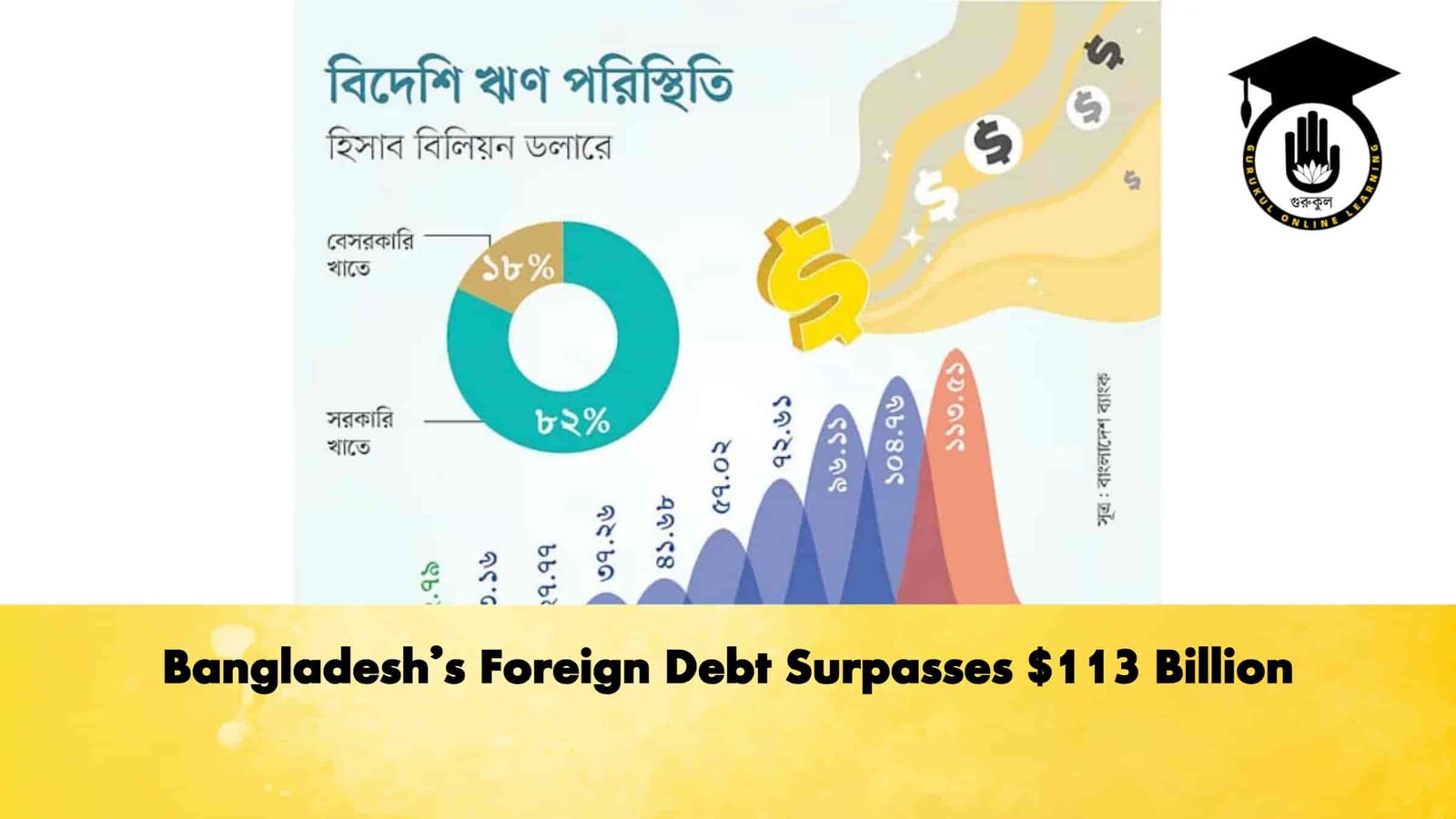
Bangladesh’s total foreign debt stood at $113.51 billion at the end of December 2025, equivalent to 13,96,173 crore Bangladeshi taka, according to the latest Bangladesh Bank report. This marks an increase from $112.21 billion in September 2025, while it is marginally lower than the $113.58 billion recorded at the end of June 2025. The figures reflect a slight quarterly rise after a minor mid-year dip, signalling sustained borrowing by both public and private sectors.
The report highlights that the majority of foreign loans remain long-term, with both government and private sector borrowing contributing to the year-end increase.
Distribution of Foreign Debt
By December 2025, the public sector accounted for nearly 82% of the total foreign debt, while the private sector represented the remaining 18%. Public sector loans primarily support government projects, infrastructure development, and state-owned enterprises, whereas private sector debt is concentrated in industrial investment and trade financing.
| Sector | Total Debt (Billion USD) | Share (%) | Long-term Debt (Billion USD) | Short-term Debt (Billion USD) |
|---|---|---|---|---|
| Public | 93.46 | 82 | 80.94 | 12.52 |
| Private | 20.05 | 18 | 9.87 | 10.18 |
| Total | 113.51 | 100 | 90.81 | 22.30 |
In the public sector, $80.94 billion is borrowed directly by the government, with the remaining $12.52 billion held by Bangladesh Bank, state-owned banks, and other government institutions. Private sector foreign loans rose above the $20 billion threshold in the October–December quarter, after three successive quarters of decline. Of these, $10.18 billion are short-term loans, including $6.06 billion in commercial credit, while $9.87 billion are long-term borrowings.
Debt Servicing and Economic Impact
Officials noted that foreign borrowing was crucial during the caretaker government to ease the dollar shortage, drawing funds from the International Monetary Fund, the World Bank, and other multilateral agencies. Previously, loans taken under the Awami League government for development projects have yet to yield sufficient foreign exchange returns, increasing repayment pressure. Consequently, both government and private borrowers rely on remittances and export revenues for debt servicing.
During the first seven months of the 2025–26 fiscal year (July–January), Bangladesh received $26.416 billion in foreign loans and grants, but repaid $26.768 billion to international creditors. Over recent years, repayment obligations have intensified, with over $4 billion repaid during the 2024–25 fiscal year alone.
The foreign exchange crisis, triggered by the Russia–Ukraine war in early 2022, pushed the exchange rate from 85 BDT to 123 BDT per USD, spurring inflation and increasing the cost of living. While the caretaker government managed to stabilise reserves and the exchange rate, foreign debt continues to climb, reaching $113.51 billion by the end of 2025, up from $104.76 billion in 2024.