In early 2025, Bangladesh’s banking sector seemed grim with rising deposit interest rates, persistent inflation, sluggish loan demand, squeezed margins, and political uncertainty—all pointing to a potential profit crisis. However, the reality turned out to be quite the opposite. Not only did profits for private banks remain stable, but many banks—especially the “strong banks”—actually saw significant growth.
This unexpected increase in profit did not stem from an expansion in lending or new business ventures. Instead, it was the government bonds and treasury bills that emerged as the major profit drivers. Government securities have now become a lifeline for banks, dramatically altering the entire financial landscape.
BRAC Bank: Treasury Investments to the Rescue
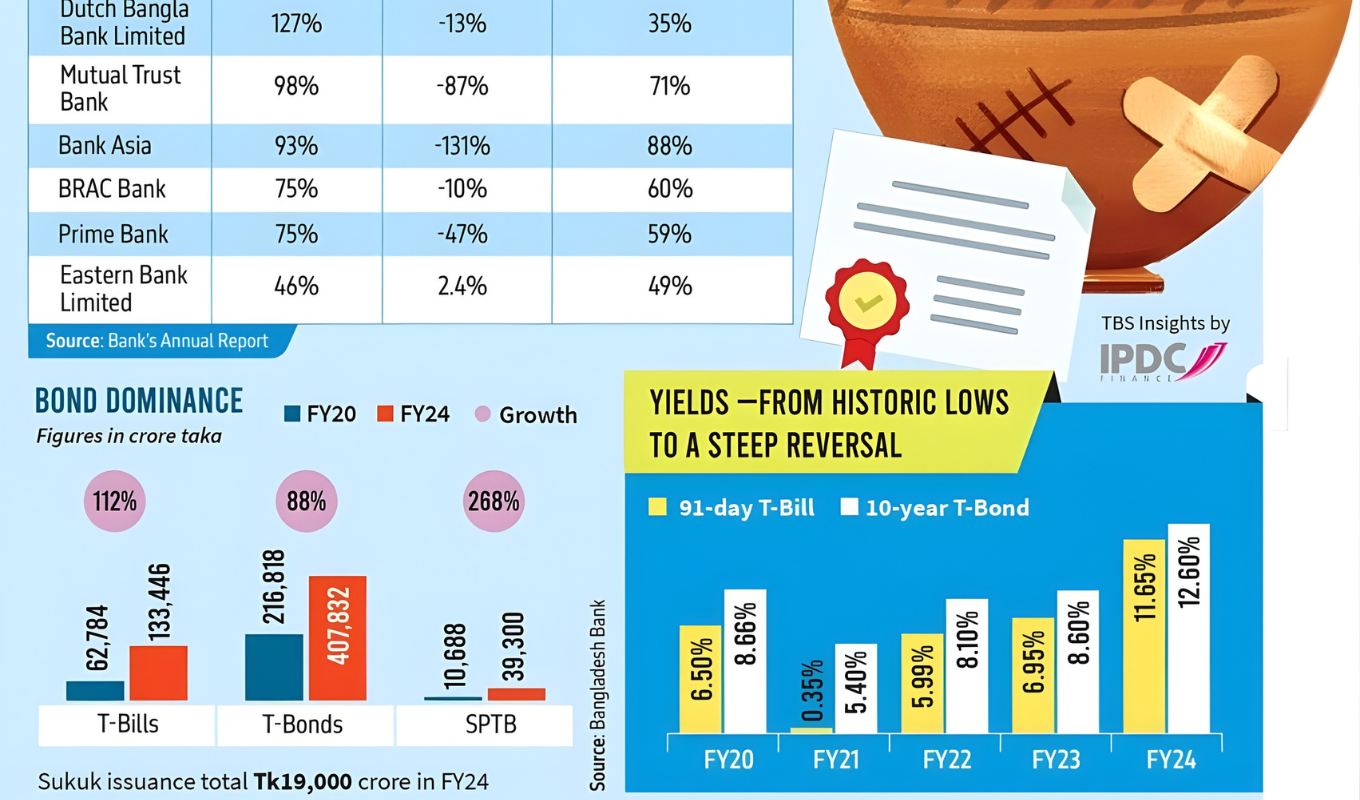
BRAC Bank’s shift was particularly notable. Between 2020 and 2022, the bank’s investment income hovered around Tk 700–800 crore. By 2024, however, that figure skyrocketed to Tk 2,880 crore—a nearly fourfold increase in just two years. Investment income grew by 67% in 2023 and an impressive 127% in 2024, outpacing income from loans or fees.
In the first nine months of 2025, the bank’s net profit rose by 50%, reaching Tk 1,553 crore. However, net interest income—a key source from loans and deposits—fell by 7%, down by approximately Tk 100 crore. This highlights how investment in treasury bills has become the key source of income.
According to BRAC Bank’s Managing Director, Tariq Refat Ullah Khan, “The surge in deposits due to our credibility is helping, but the opportunities to lend have significantly diminished. If we didn’t invest excess liquidity in government bonds, we would have had to lower deposit interest rates.”
However, he warned that reliance on bond income is “temporary and unsustainable” and urged staff not to depend on it long-term. “Loan growth is slow, and private sector credit growth has dropped to about 6%. In such a scenario, what can we do?” he added.
City Bank: Surviving on Bonds, Not Loans
City Bank’s situation reflects this trend even more starkly. From January to September 2025, the bank’s after-tax profit surged by 60%, to over Tk 722 crore, with most of that income coming from investments in government securities.
The bank’s investment income doubled to Tk 2,775 crore, compared to Tk 1,020 crore the previous year. This now accounts for around 77% of its operating income, with net interest income from loans dropping by 87%, falling from Tk 1,172 crore to just Tk 150 crore.
A market analyst commented, “This growth has not come from lending but from bonds. City Bank’s treasury desk has kept its financials afloat.”
Eastern Bank Ltd (EBL): Stable, But Bond-Dependent
Even conservative investors like Eastern Bank Ltd (EBL) have embraced the bond wave. Between 2020 and 2024, the bank’s investment income doubled from Tk 505 crore to Tk 1,017 crore, marking a 101% increase.
For the first nine months of 2025, EBL’s investment income increased by 39%, reaching Tk 1,095 crore, now accounting for 48% of the bank’s total operating income, up from 39% last year.
On the other hand, the bank’s net interest income dropped by 10% to Tk 712 crore. Thus, treasury returns have become the primary source of profit, with net interest income now contributing 39% of total operating income, up from 31% last year.
A senior treasury official at EBL stated, “With slow loan growth, increasing default risks, and liquidity instability, banks are finding refuge in risk-free assets.”
Mutual Trust Bank (MTB): Shrinking Loan Margins
At Mutual Trust Bank (MTB), the trend is even more pronounced. For the first nine months of 2025, the bank’s net interest income dropped by 58%, from Tk 629 crore to below Tk 263 crore. In contrast, investment income almost doubled to Tk 973 crore.
As a result, 60% of MTB’s operating income now comes from investments, up from just 37% last year. The shift indicates that the bank’s profit engine is increasingly relying on government securities rather than loan business.
MTB’s Managing Director, Syed Mahbubur Rahman, commented, “Our core banking income has shrunk because demand for loans has decreased.” He also highlighted that this is a common issue for many banks, where loan demand has decreased, non-performing loans have risen, and banks’ balance sheets are no longer expanding as they once did.
Prime Bank: The Bond Surge
Prime Bank’s 2024 revenue growth was also largely driven by government securities. The bank’s investment income doubled, reaching Tk 1,027 crore, up from Tk 513 crore in 2023. As a result, investment income now makes up a significant 22.5% of the bank’s total operating income.
The trend continued into 2025, with Prime Bank’s net interest income dropping to Tk 375 crore, a reduction from Tk 739 crore the previous year. However, total operating income increased by Tk 185 crore to Tk 1,962 crore, primarily due to a surge in income from government securities.
Bank Asia: A Dramatic Shift to Treasury Income
The most dramatic shift has been observed at Bank Asia. In the first half of 2025, the bank’s net interest income fell to negative figures, after earning Tk 353 crore in the same period in 2024. In contrast, investment income nearly doubled, reaching Tk 1,248 crore, up from Tk 646 crore the previous year.
Currently, around 90% of Bank Asia’s operating income comes from investments, compared to less than half in 2024. This shift highlights the extent to which government securities have become central to the bank’s profits.
Dutch-Bangla Bank: A Bond-Dependent Model
Dutch-Bangla Bank (DBBL) has also seen its income become increasingly reliant on government securities. In 2024, the bank’s investment income increased by Tk 305 crore, reaching Tk 1,047 crore, largely due to significant investments in treasury bills and bonds.
However, in the first half of 2025, while investment income grew by 127%, net interest income fell by 13%. As a result, more than one-third of the bank’s operating income now comes from treasury bills and bonds, up from just 20% the previous year.
The bank’s Managing Director, Abul Kashem Mohammad Shirin, noted, “Investing in government securities offers high returns, with no bad loan risks, and is entirely safe. With interest rates so high, many banks are investing in bonds with 10 to 20-year maturities.”
He added, “In the absence of new investments or business expansion, what else can banks do? Otherwise, we would have had to lower our deposit interest rates.”
Government Debt on the Rise
The government’s reliance on domestic debt has doubled over the past five years, with treasury bills and bonds becoming the main source of funding for an increasing budget deficit. As of the 2023-24 fiscal year, the outstanding government securities totalled Tk 580,578 crore, up from Tk 290,290 crore in 2019-20.
However, this has come at a cost. Interest rates on government securities have risen sharply, reaching 12–13% by June 2024, the highest in a decade. This has resulted from Bangladesh Bank’s tightened monetary policy and liquidity shortages in the banking system.
When Will Loan Demand Recover?
As for when loan demand will increase, most bank MDs and treasury heads agree that the situation will improve after the national elections. BRAC Bank’s Tariq Refat Ullah Khan said, “Domestic and foreign investors are waiting for the new government to come in before making investments. Once political stability returns, infrastructure and development projects will see new investments.”
Syed Mahbubur Rahman of MTB also expects business confidence and loan demand to pick up after the elections. Similarly, the Managing Director of Dutch-Bangla Bank shares the same view.
Economists’ Concerns
Dr. Fahmida Khatun, Executive Director of the Centre for Policy Dialogue (CPD), acknowledged that banks were right to invest heavily in government securities due to the lack of demand for private sector loans. However, she raised concerns over the lack of innovation and product diversification in the banking sector, warning that the rising domestic debt burden could have long-term consequences if revenue collection does not improve.
She stated, “If we cannot collect more revenue domestically, the debt burden will increase, putting pressure on revenue stability.”