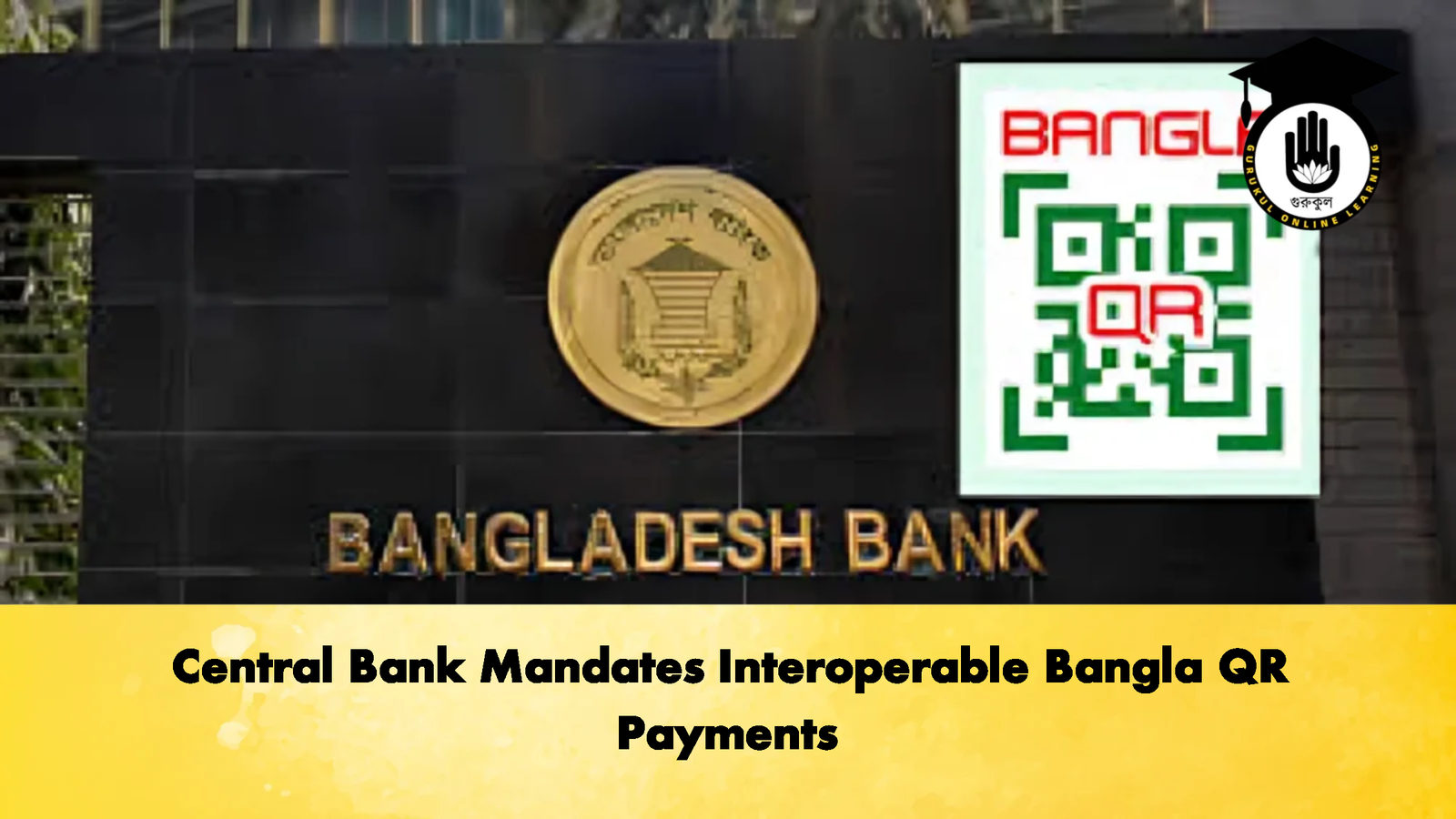
Bangladesh Bank has issued a new regulatory directive mandating all scheduled commercial banks, Mobile Financial Services (MFS), Payment Service Providers (PSP), and Payment Service Operators (PSO) to prominently display the ‘Bangla QR’ payment option on the homepages of their respective mobile applications. The official circular, distributed directly by the central bank on Saturday, introduces strict, time-bound parameters designed to reduce the country’s historic reliance on physical currency notes. By enforcing a unified visual placement on financial applications, the regulatory authority aims to accelerate the adoption of inclusive digital payment infrastructure and standardise the cashless transaction ecosystem throughout the nation.
The directive has been formally dispatched to the managing directors and chief executives of all scheduled banks and financial institutions for immediate, mandatory compliance.
Interoperability and Mandated Merchant Integration
The implementation of the Bangla QR code marks a critical shift away from proprietary, merchant-specific QR platforms. Historically introduced by independent MFS providers in 2018, early QR systems were non-interoperable, meaning a code issued by one provider could not process a payment originating from a different bank or wallet. To resolve this structural limitation, the central bank initially established the standardisation framework in 2021, routing transactions via the National Payment Switch Bangladesh (NPSB). The current regulatory mandate reinforces this infrastructure, forcing all licensed financial applications to make the common digital payment gateway highly visible. This ensures that customers can instantly complete person-to-merchant (P2M) transactions by scanning a single terminal, regardless of which financial platform they use.
According to the central bank’s circular, financial institutions and MFS providers must systematically increase consumer registration numbers on their mobile applications. User interfaces must be reconfigured so that the Bangla QR option occupies a primary position on the application’s landing page, ensuring that users can view and access the feature without navigating through secondary menus.
Furthermore, the central bank has made it compulsory for banks to onboard all retail account holders who possess a valid trade licence onto the Bangla QR channel. This measure aims to rapidly expand the merchant network to include micro, small, and medium-sized enterprises (MSMEs), such as neighborhood shops and local vendors, which have traditionally operated outside the formal electronic banking network due to the high setup costs of conventional point-of-sale hardware.
To reinforce this unified transition, Bangladesh Bank has ordered the immediate restructuring of its internal ‘Cashless Bangladesh Unit’. The specialized department has been officially renamed the ‘Bangla QR Implementation Unit’ to maintain a singular, dedicated focus on driving the nationwide execution of the interoperable standard.
Implementation Deadlines and Action Plans
The central bank has outlined specific deadlines for financial institutions to ensure complete compliance with the new digital payment framework:
| Objective / Requirement | Target Deadline | Destination / Status |
| Submission of a detailed action plan with specific onboarding targets | 3 June 2026 | Payment Systems Department (PSD-1), Bangladesh Bank |
| Execution of the action plan to increase app registrations and new merchants | 31 July 2026 | Final Completion Date |
| Deployment of a single, unified QR code across all merchant points | 30 June 2026 | Unchanged Existing Deadline |
To guarantee the effective execution of these initiatives at the grassroots level, all scheduled banks have been instructed to designate a specific officer at every retail branch location. This individual will serve as the dedicated ‘Bangla QR Branding Officer’ responsible for promoting the cashless service, onboarding local traders, and facilitating technical implementation at the field level.
Meanwhile, Bangladesh Bank confirmed that the previously established regulatory deadline of 30 June remains strictly unchanged. By this date, all merchant payment points must maintain a single, universal QR code capable of accepting transactions across all participating banking apps and mobile wallets. All other instructions from earlier circulars concerning electronic retail transaction protocols remain in full force.