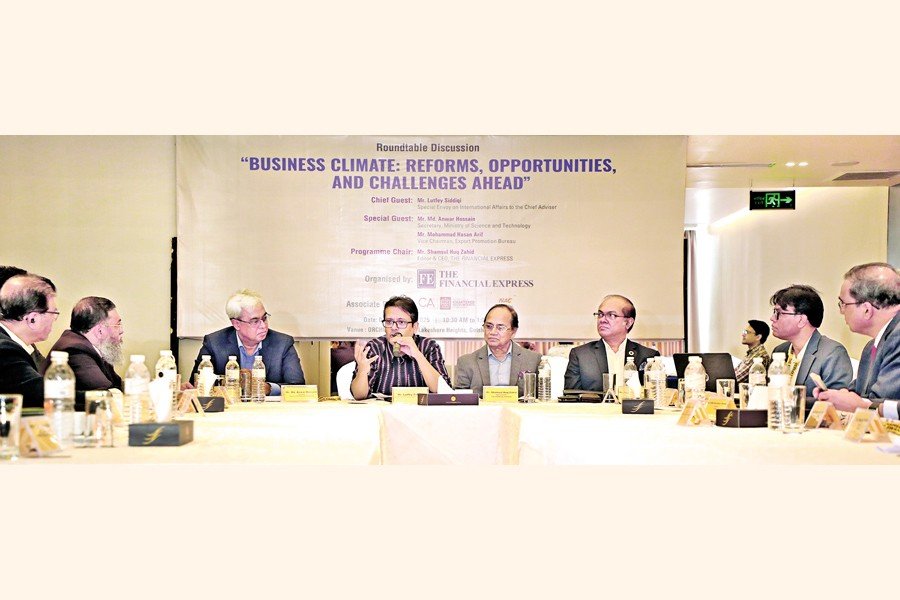
Experts have stressed the need for further significant reforms to overcome existing obstacles and enable Bangladesh to seize emerging business opportunities. They have also called for a faster democratic transition to accelerate the process of restructuring the country’s systems.
Speaking at a roundtable in Dhaka on Monday, the experts highlighted the importance of reforms aligned with the needs of entrepreneurs to boost business confidence and ensure sustained growth in the private sector.
The participants, which included leading apparel exporters, agrochemical entrepreneurs, ceramic manufacturers, chamber representatives, and regulatory officials, called for greater improvements to the business environment in order to attract investment and enhance competitiveness.
They argued that the next elected government must continue the ongoing reform agenda, making time-bound commitments to capitalise on new business opportunities, particularly as the country’s demographic dividend is rapidly shrinking.
The discussants also recommended adopting best practices from peer economies, noting that local businesses often face multiple regulatory hurdles that hinder their growth.
One key recommendation was for the government to submit an application to the United Nations for a further review of Bangladesh’s graduation from Least Developed Country (LDC) status. Many experts believe that the planned LDC graduation in 2026 could adversely affect the domestic industrial sector and the economy as a whole.
The observations were made during a roundtable on “Business Climate: Reforms, Opportunities, and Challenges Ahead,” organised by The Financial Express in collaboration with the Institute of Chartered Accountants of Bangladesh (ICAB) and National AgriCare.
Governance Reforms Required to Fix Systemic Flaws
Lutfey Siddiqi, Special Envoy on International Affairs to the Chief Adviser, stated that Bangladesh needs reforms “at the design level” to address the fundamental flaws in governance and administrative systems.
“We have a fundamental design flaw,” said Siddiqi, emphasising that the country’s bureaucracy lacks clear accountability, particularly in the logistics and export sectors. “Piecemeal reforms will not fix systemic issues,” he added.
Drawing comparisons with Singapore and Malaysia, Siddiqi highlighted that both countries have assigned inter-ministerial coordinators under the Prime Minister’s Office to ensure smooth operations. “We need similar structural redesigns,” he said.
He also warned businesses not to delay pressing for reforms under the next elected government, pointing out that previous opportunities had been missed after the student-led uprising in Bangladesh.
Achievements in Trade Facilitation, but Bureaucratic Resistance Remains
Siddiqi highlighted significant achievements in trade facilitation, such as the National Single Window, which has delivered over 500,000 services and saved 1.2 million office visits. Additionally, automated e-gates at ports have reduced clearance time from 20 minutes to just 20 seconds.
However, he acknowledged that legal provisions allowing pre-arrival customs clearance remain underutilised due to bureaucratic resistance. “The main barrier to automation is mindset,” he said.
Reflecting on his early days in office, Siddiqi recalled a period of instability: “Half of the government staff were inactive, there were no police officers for security, and industrial zones were unstable due to worker unrest. Yet, through sustained efforts, we’ve managed to restore stability.”
Business Sector Needs Greater Collaboration and Innovation
Shamsul Huq Zahid, Editor and CEO of The Financial Express, remarked that the government had successfully stabilised the situation in Bangladesh following a period of turmoil. He urged everyone to remember this progress and look forward to a smooth transition to a political government.
Md Anwar Hossain, Secretary of the Ministry of Science and Technology, stressed the importance of sustained dialogue between policymakers and businesses to identify effective solutions and implement reforms based on regional best practices.
As a special guest, Hossain emphasised the need for innovation-driven strategies to achieve high-value production. “Industry and academia must work closely to foster the kind of innovation that drives competitiveness,” he said.
Mohammad Hasan Arif, Vice Chairman of the Export Promotion Bureau (EPB), urged the establishment of dedicated export-promotion councils and a strategic branding approach to unlock new markets. He criticised bureaucratic inertia, claiming that the bureaucracy was not listening to businesses and was failing to provide solutions to their problems.
Arif also highlighted the absence of a coherent national branding strategy, which he believed is crucial for competing in global markets.
Banking Sector Reforms and Investment Climate Concerns
Kakoli Jahan Ahmed, Executive Director of Bangladesh Bank, emphasised that ensuring data accuracy is crucial for attracting foreign direct investment (FDI) into Bangladesh. She suggested that the central bank should hold consultative meetings with key stakeholders before finalising any major policy decisions to ensure that policies are well-informed and less likely to draw criticism after implementation.
Showkat Aziz Russell, President of the Bangladesh Textile Mills Association (BTMA), raised concerns about the government’s strategy to attract foreign investment. “When a country can’t even extinguish a fire at its international airport due to a lack of equipment, lacks policy consistency, and faces an energy crisis, who would invest here?” he asked.
He suggested that instead of chasing foreign investors, the government should focus on facilitating local investors, as they are the ones generating revenue and creating jobs.
Energy Security and Economic Growth
Taskeen Ahmed, President of the Dhaka Chamber of Commerce and Industry (DCCI), stated that discussions on business reforms would not reach a meaningful conclusion until Bangladesh has a predictable, mandate-backed government. He emphasised that energy security is a key issue, noting that without it, sustainable progress would be impossible.
“Over the past 20 years, we have made significant development, but there were some missteps along the way. That’s a learning for us,” Ahmed said.
LDC Graduation and Concerns for the Industrial Sector
Mohammad Hatem, President of the Bangladesh Knitwear Manufacturers and Exporters Association (BKMEA), expressed concerns over the government’s decision to proceed with LDC graduation, arguing that the country’s industries are not yet ready for such a transition.
“We have individually and collectively spoken with policymakers, and many of us have favoured deferring graduation. However, the government has now decided to move forward, leaving little scope for further discussion,” Hatem said. He also mentioned that industry leaders had urged the government to request the United Nations to reassess Bangladesh’s economic reality before making a final move.
Urgent Need for Improved Competitiveness
Shams Mahmud, President of the Bangladesh-Thai Chamber of Commerce and Industry (BTCCI), said that while the interim government has introduced several reforms, these have yet to produce visible results. He called for a pause in further policy changes and focused on holding elections, so that an elected government can take up reforms with legitimacy.
He believes that foreign investment will remain elusive until an elected government is in office.
Inamul Haq Khan, Senior Vice President of BGMEA, warned that the transition from LDC status presents “existential challenges” for the sector, which contributes the largest share to the country’s export earnings. “We must ensure that we get three years’ time for LDC graduation. That will help us sustain and survive,” Khan said.
Abul Kasem Khan, Chairperson of Business Initiative Leading Development (BUILD), urged policymakers to urgently enhance Bangladesh’s global competitiveness to avoid being trapped in the middle-income bracket. “Bangladesh is in the bottom 10 of many global indices, including passport strength and ease of doing business,” Khan said. “If we can’t improve competitiveness, we will not grow and will be stuck in the middle-income trap.”
Khan emphasised that accountability across public institutions is essential for sustainable reform and growth.
Governance and Banking Reforms
Sharif Zahir, Chairman of United Commercial Bank (UCB), called for the introduction of a “fast-track” mechanism to expedite the resolution of non-performing loan (NPL) cases. He stressed the need for differentiation within the banking sector, stating: “A clear distinction must be made between genuine shareholders and wrongdoers. Without this, the ongoing reform agenda in the banking sector will not achieve its goals.”
Moynul Islam, President of the Bangladesh Ceramic Manufacturers and Exporters Association (BCMEA), underscored the importance of good governance to ensure sustainable growth in the country’s ceramic industry. He remarked that ceramic goods are essential but often underappreciated due to their lack of “sound,” though they are difficult to produce.