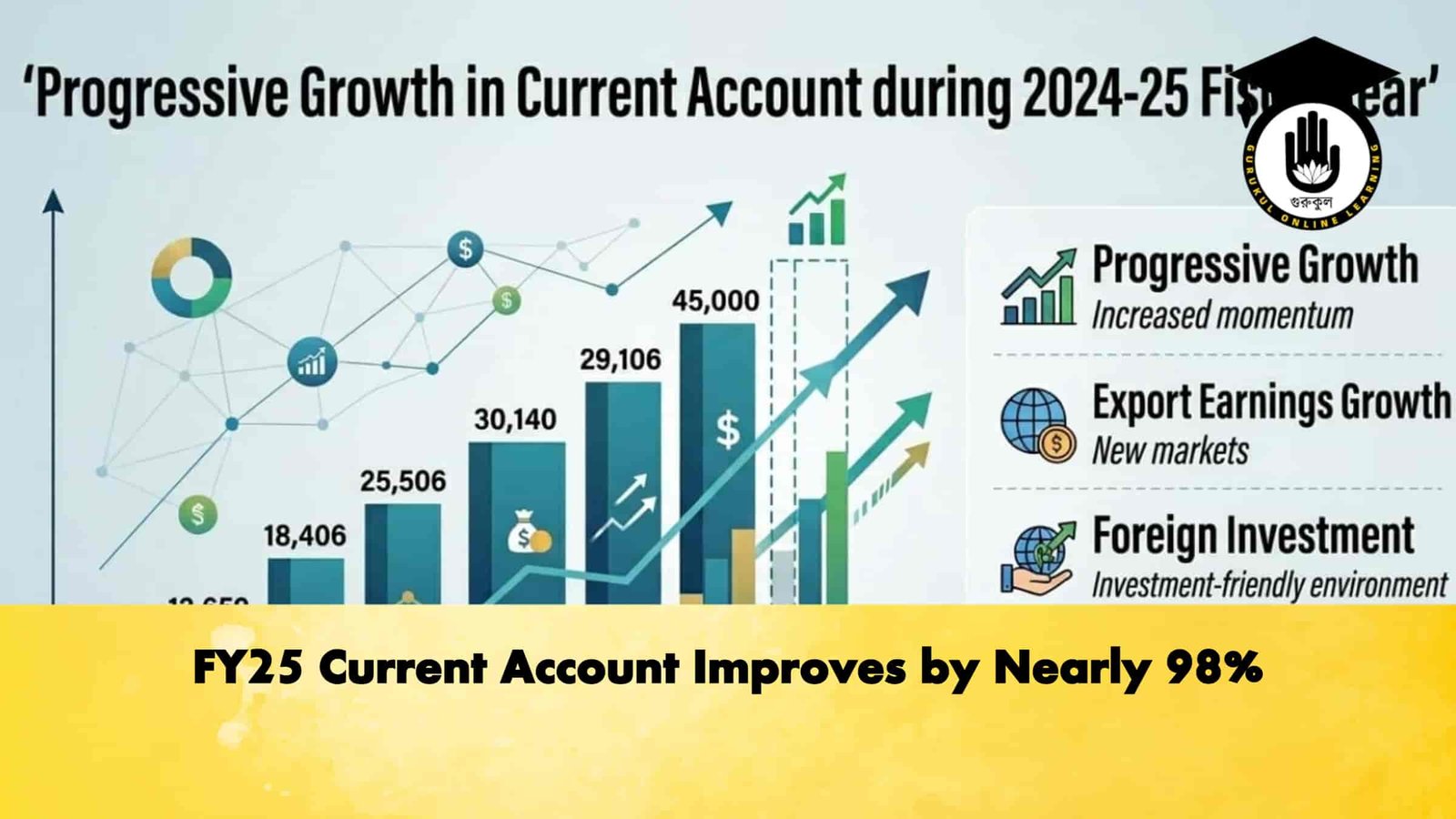
Bangladesh’s current account balance registered a remarkable improvement in the 2024-25 fiscal year, driven primarily by robust remittance inflows and resilient export performance. However, a persistent trade deficit continued to exert pressure on the country’s external position.
According to data released last week by the Bangladesh Bank, the current account balance rose by nearly 98 per cent year-on-year, primarily bolstered by a 38.1 per cent increase in net workers’ remittances and a 17.1 per cent rise in export earnings on a free-on-board (f.o.b.) basis. Despite this sharp increase, the current account remained slightly in deficit at Tk 15.1 billion.
Trade and Current Account Overview (FY24–FY25)
| Item | FY24 | FY25 | Year-on-Year Change |
|---|---|---|---|
| Current Account Balance | Tk 7.6 bn | Tk 15.1 bn | +98% |
| Trade Deficit | Tk 2.49 tn | Tk 2.47 tn | -0.8% |
| Export Earnings | Tk 4.54 tn | Tk 5.31 tn | +17.1% |
| Import Payments | Tk 7.56 tn | Tk 7.78 tn | +2.9% |
| Remittances (Net) | Tk 2.72 tn | Tk 3.75 tn | +38.1% |
| Services Outflows | Tk 645.2 bn | Tk 688.1 bn | +6.6% |
| Primary Income Outflows | Tk 578.4 bn | Tk 609.8 bn | +5.5% |
Export earnings climbed to Tk 5.31 trillion during the year, continuing a long-term upward trajectory despite periodic fluctuations. Imports also rose substantially to Tk 7.78 trillion, reflecting Bangladesh’s growing reliance on foreign goods and industrial inputs for domestic production. The inflow of secondary income, largely driven by remittances, reached Tk 3.75 trillion, providing a crucial buffer against external imbalances.
However, substantial outflows in trade, services (Tk 688.1 billion), and primary income (Tk 609.8 billion) limited the net improvement in the current account. Historical trends indicate that Bangladesh’s trade deficit has widened markedly since the mid-2010s, peaking between FY21 and FY23 when elevated current account deficits were also recorded.
Economists view the latest data as a mixed signal. While the combination of export resilience and rising remittances is strengthening external stability, the structure of trade—with import growth consistently outpacing exports—poses ongoing risks.
“The improvement is encouraging but fragile,” said Dr Zahid Hussain, an independent economist. “Without export diversification and more effective import management, pressure on the external account will remain.” He also highlighted geopolitical uncertainties, particularly the Iran-US-Israel conflict, as potential challenges for sustaining the current account balance in the coming year.
Bangladesh’s deepening integration into global trade remains evident, with both export and import volumes expanding steadily. Yet policymakers face the delicate task of balancing growth, import demand, and external stability in a volatile global environment.