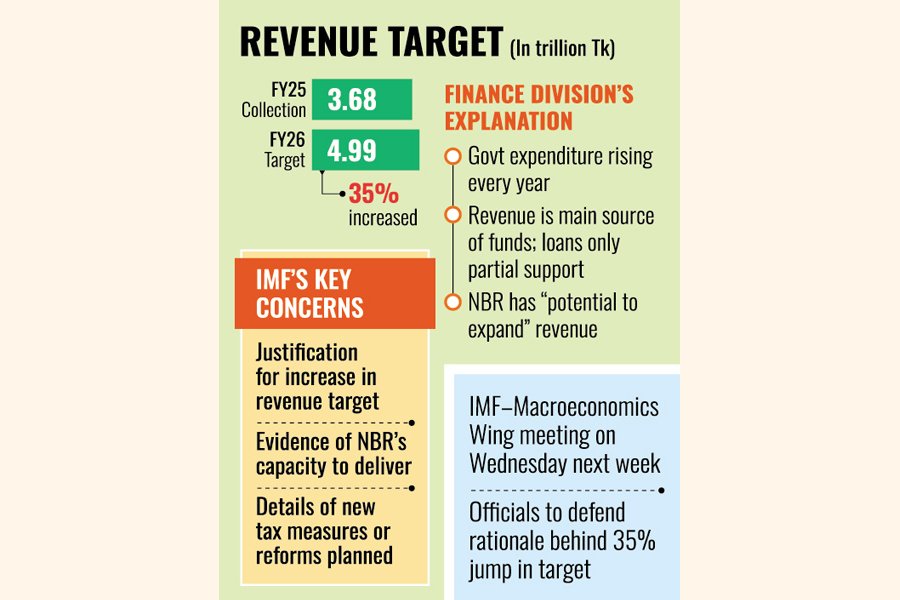
The International Monetary Fund (IMF) has expressed doubts over Bangladesh’s ambitious plan to raise government revenue by more than 35 per cent in the current fiscal year, questioning both the rationale and the capacity of the National Board of Revenue (NBR) to meet such a goal.
According to sources at the Finance Division, the visiting IMF creditworthiness-review mission appeared unconvinced by explanations provided by Bangladeshi finance officials during a meeting last week. The IMF team sought detailed justification for the steep rise in the revenue target, which has been set at Tk 4.99 trillion for the 2024–25 fiscal year, compared to Tk 3.68 trillion actually collected in the previous year against a target of Tk 4.8 trillion.
The IMF delegation, which has been in Dhaka since 29 October to review progress on the US$5.5 billion lending programme ahead of the next tranche release, questioned whether the NBR possesses the institutional capacity to mobilise such a large amount of revenue.
Finance Division officials explained that the government’s total expenditure for the current fiscal year is projected at Tk 7.9 trillion, with revenue serving as the main source of funding. They argued that as government expenditure continues to rise annually, revenue generation must also increase accordingly. However, they acknowledged that past collections have consistently fallen short of targets.
Officials further noted that Bangladesh’s tax-to-GDP ratio—just above 7 per cent—remains one of the lowest in the world, indicating substantial untapped potential. “The NBR has the scope to enhance revenue generation if proper measures are taken,” one official said. However, when pressed, the delegation was reportedly unable to specify what additional steps would be implemented to boost revenue collection.
Sources added that the IMF team is scheduled to meet officials from the Finance Division’s Macroeconomics Wing on Wednesday to seek further clarification regarding the rationale behind such a substantial increase in the revenue target compared with last year’s achievement.
Meanwhile, on Monday, the IMF delegation held discussions with the Finance Division and the Financial Institutions Division to assess the government’s progress on banking sector reforms following allegations of past mismanagement and irregularities.
The team specifically inquired about the bank-resolution process and funding plans for the proposed merger of five banks into a single state-owned Shariah-based institution. Other topics included potential recapitalisation of banks, arrangements for the deposit protection fund, central bank indemnity for liquidity support to weak banks, and legal and operational measures to strengthen asset recovery efforts.
The IMF also revisited the government’s progress on the long-discussed Corporate Insolvency Act, a key reform aimed at improving financial discipline and the stability of the banking sector.