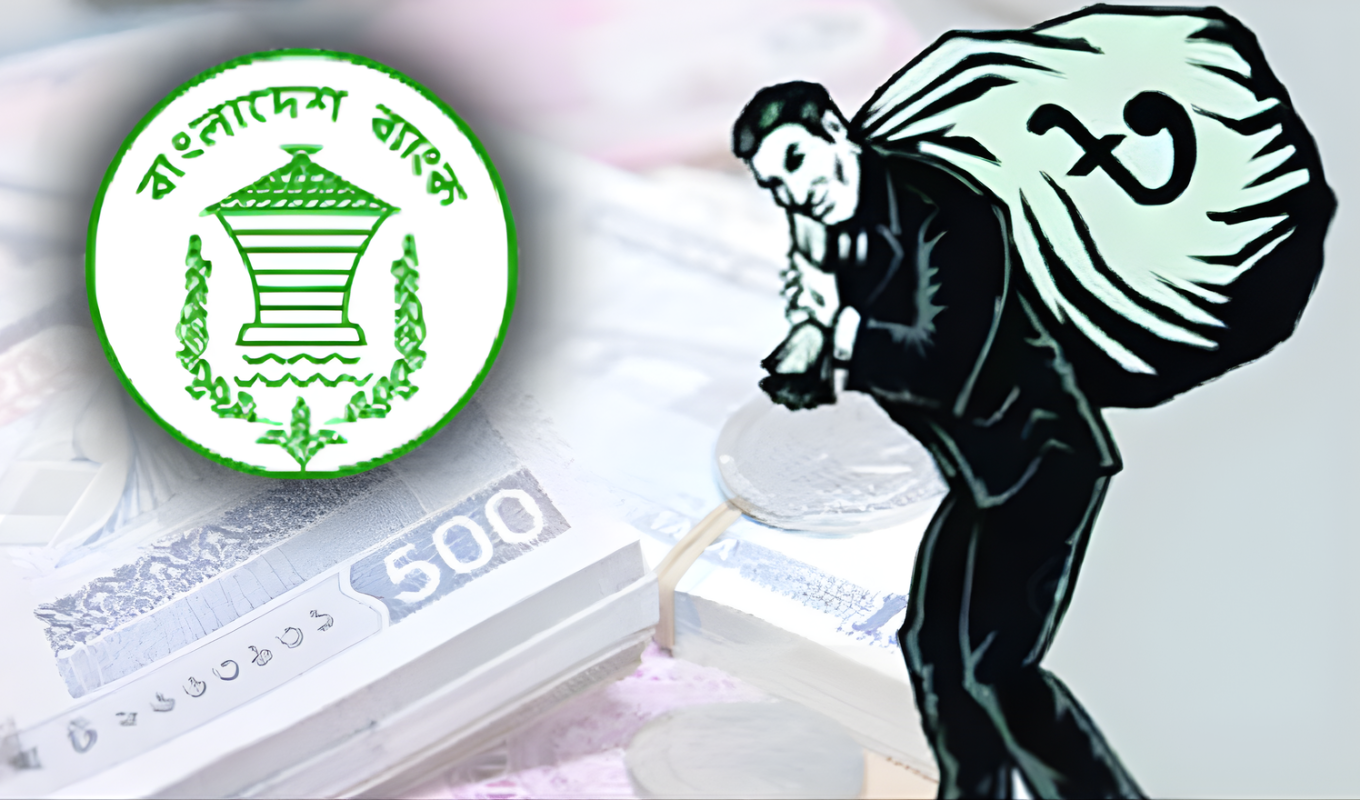
The alarming rise in non-performing loans within Bangladesh’s banking sector has taken a critical turn, with six banks now reporting default rates exceeding 90 per cent. This extraordinary level of financial distress has raised serious concerns about systemic risk, regulatory failure, and the long-term viability of certain financial institutions.
Among the six banks, the foreign-owned National Bank of Pakistan stands out as the worst performer. Of its total loan portfolio amounting to Tk 1,370 crore, a staggering 99.84 per cent has become non-performing. Such figures effectively render the bank non-functional as a lending institution and raise urgent questions about oversight, both domestic and international.
Union Bank follows closely, with Tk 27,113 crore in defaulted loans, representing 96.64 per cent of its total lending. First Security Islami Bank has reported Tk 59,988 crore in bad loans, accounting for 96.20 per cent of its portfolio. Global Islami Bank’s defaulted loans stand at Tk 14,014 crore, or 95.70 per cent. Padma Bank and ICB Islami Bank are also deeply distressed, with default ratios of 94.17 per cent and 91.38 per cent respectively.
The crisis is not confined to a single category of banks. Private commercial banks have also shown deeply troubling trends. AB Bank has emerged as the worst performer among private banks, with Tk 30,136 crore, or 84.04 per cent of its loans, classified as non-performing. National Bank has recorded a default ratio of 75.46 per cent, while Bangladesh Commerce Bank, Social Islami Bank, and IFIC Bank have all crossed the 60 per cent threshold.
Even Islami Bank Bangladesh, once regarded as a pillar of Shariah-based banking, has not been spared. Its defaulted loans have reached Tk 1,06,275 crore, amounting to 58.24 per cent of total outstanding loans. This has dealt a significant blow to public trust in Islamic banking institutions.
State-owned banks present an equally grim picture. Janata Bank holds the largest volume of defaulted loans among government-owned institutions, with Tk 70,671 crore, or 73.18 per cent of its lending, classified as non-performing. BASIC Bank, Bangladesh Development Bank, and Rupali Bank all report default ratios exceeding 50 per cent.
Experts argue that these figures reflect long-standing governance failures, politically influenced lending, and weak legal enforcement. Repeated loan rescheduling and regulatory leniency have encouraged a culture of non-repayment, allowing powerful borrowers to evade accountability.
While Bangladesh Bank has announced plans to restructure and merge weak banks, analysts caution that mergers alone cannot resolve deep-rooted problems. Without legal consequences for loan defaulters and a fundamental overhaul of banking governance, the sector risks further deterioration.