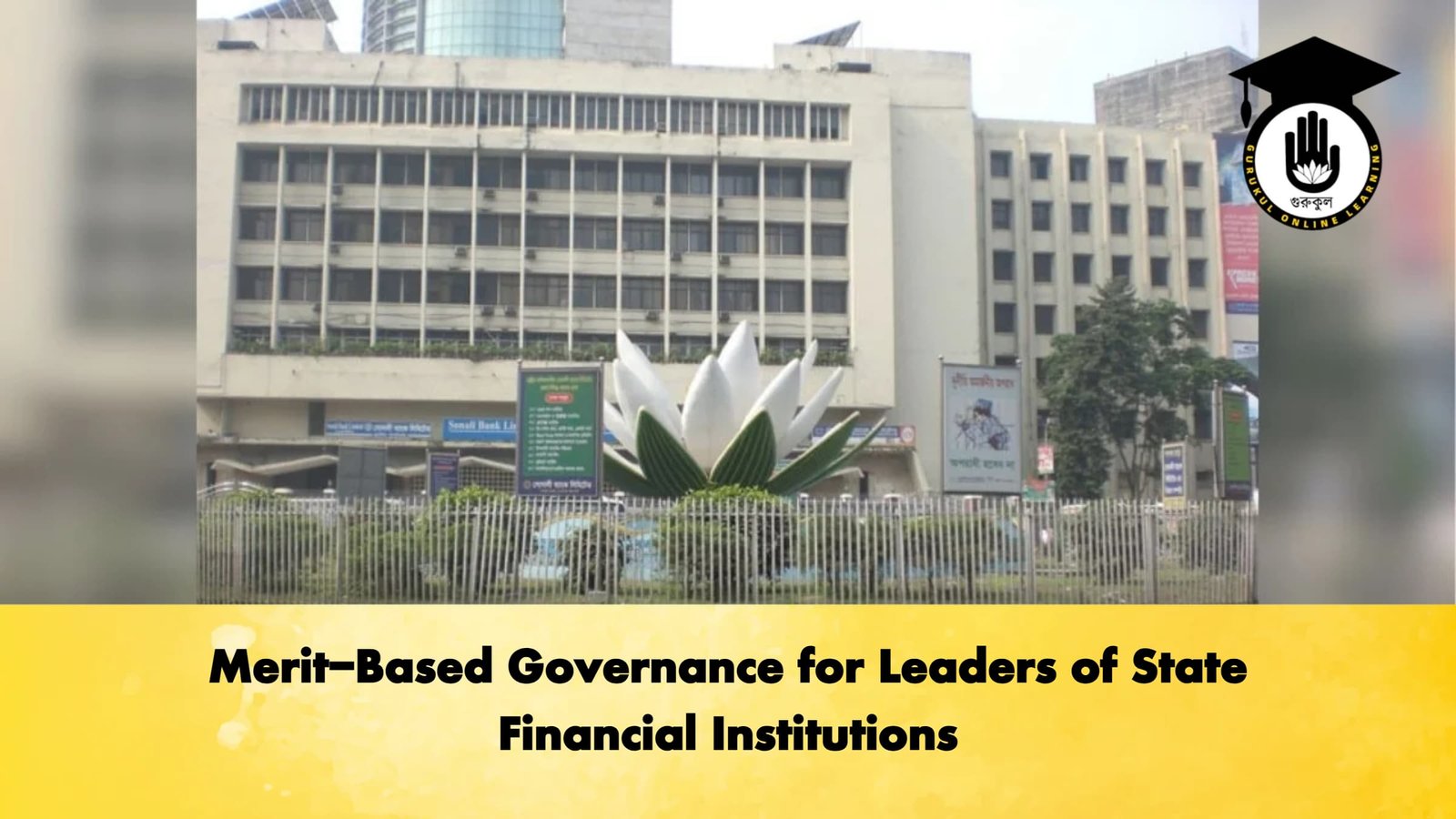
The Government of Bangladesh has enacted a transformative regulatory framework designed to overhaul the leadership structures within fourteen of its most prominent state-owned banks and financial entities. Issued by the Financial Institutions Division on Sunday, 18 January 2026, the new policy replaces the 2023 guidelines, introducing more stringent academic requirements and a transparent, points-based system for high-level appointments and promotions.
A Unified Standard for 14 Institutions
This policy creates a standardised executive pipeline for six commercial banks—including titans like Sonali and Agrani—alongside six specialised banks and two pivotal financial corporations, namely ICB and BHBFC. The mandate focuses exclusively on the “top tier”: Managing Directors (MD), Deputy Managing Directors (DMD), and General Managers (GM).
Executive Experience & Promotion Thresholds
| Entry Level Rank | Years for DMD Promotion | Years for GM Promotion |
| 9th Grade (Standard) | 19 Years | 18 Years |
| Principal Officer | 17 Years | 15 Years |
| Senior Principal Officer | 14 Years | 12 Years |
| Assistant General Manager | 11 Years | 9 Years |
| Deputy General Manager | 8 Years | 6 Years |
The New MD Profile: Contractual and Specialized
Under the updated code, Managing Directors will no longer hold indefinite tenures; they are to be appointed on a contractual basis for a maximum of three years. To ensure technical proficiency, the government now prioritises candidates with postgraduate specialisations in Banking, Finance, Economics, or Accountancy.
Crucially, the policy introduces an “Academic Excellence” clause: any candidate with a third division or class at any stage of their educational history is disqualified. Furthermore, integrity is non-negotiable. Aspirants must undergo a double-vetting process involving the Anti-Corruption Commission (ACC) and intelligence agencies, with final appointment requiring the seal of the Prime Minister or Chief Adviser.
The 100-Point Evaluation Matrix
Promotion to DMD and GM levels is no longer merely a matter of seniority. Candidates will be judged on a 100-point merit scale administered by a high-powered selection committee, which includes the Bangladesh Bank Governor and the Principal Secretary. The evaluation covers:
Academic & Professional Exams: Testing theoretical and practical banking knowledge.
Annual Confidential Reports (ACR): Assessing past performance and conduct.
The Interview: A final rigorous assessment of leadership and strategic vision.
Perks, Penalties, and Resignation
Successful executives will enjoy a comprehensive benefits package, including government-provided vehicles, housing, and group insurance, with salaries aligned to the National Pay Scale. However, the policy is equally firm on discipline; those with pending departmental cases or a history of “major penalties” face an immediate freeze on their promotion eligibility.
In a move to ensure operational stability, the policy dictates that any executive wishing to resign must provide one month’s notice or pay a financial penalty equivalent to one month’s salary. All retirements and dismissals will henceforth be governed by the Public Service Act, 2018, bringing bank governance in line with the highest standards of the civil service.