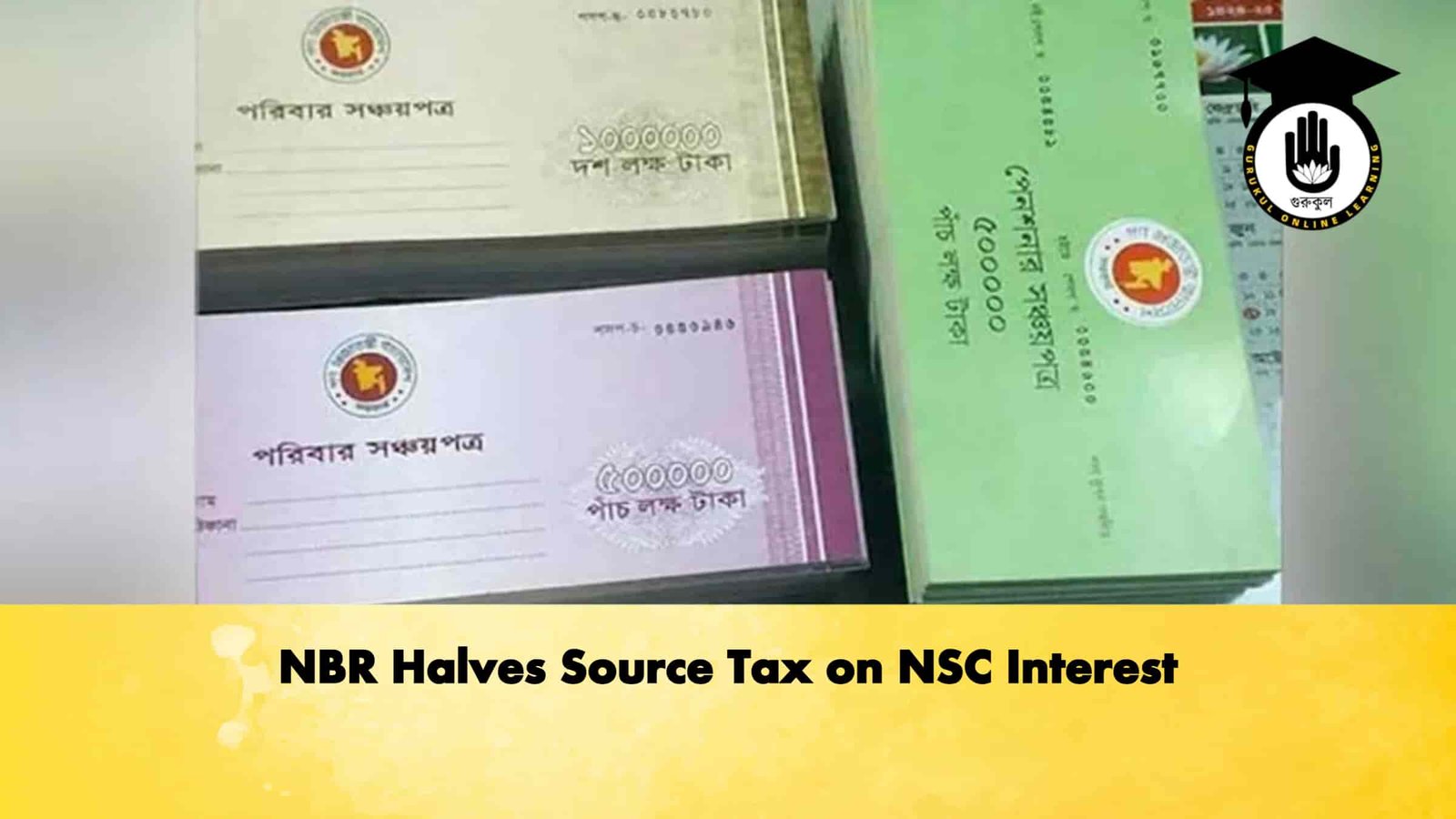
The National Board of Revenue (NBR) has announced a reduction in the source tax on interest earned from National Savings Certificates (NSCs), commonly known as “Shonchoypotro”, for smaller investments. From now on, interest on NSCs up to Tk 500,000 will attract a 5 per cent source tax, instead of the previous 10 per cent.
A senior NBR official confirmed on Tuesday that the board had sent an official communication to the Director-General of the Department of National Savings to clarify the matter. The letter specifies that pensioners investing in NSCs up to Tk 500,000 will continue to enjoy tax-free interest. For NSC investments exceeding Tk 500,000, the 10 per cent source tax remains applicable.
This clarification comes after allegations emerged that, since January, interest on NSCs up to Tk 500,000 had been incorrectly subject to a 10 per cent source tax. The NBR’s directive now settles any confusion, ensuring that smaller investors and pensioners benefit from reduced taxation.
Earlier this year, the government briefly lowered interest rates on certain NSC schemes for the first six months, prompting public criticism. Following the backlash, the reductions were withdrawn, and investors are once again receiving the same interest rates as in the preceding six months.
NSCs remain one of the most popular savings instruments in Bangladesh, particularly among retirees and conservative investors, offering both capital security and a fixed return. The NBR’s latest move is expected to encourage greater investment in these schemes, particularly among individuals with moderate savings, by easing the tax burden.
The revised taxation structure on NSC interest can be summarised as follows:
| Investment Amount (Tk) | Tax Rate on Interest | Beneficiary Notes |
|---|---|---|
| Up to 500,000 | 5% | Pensioners exempt; standard investors taxed at 5% |
| Above 500,000 | 10% | Standard source tax applies |
Financial experts have welcomed the NBR’s clarification, noting that the measure provides both relief and certainty to small investors. By ensuring that modest savers retain a larger portion of their returns, the policy is likely to bolster household savings and encourage continued participation in government-backed investment instruments.