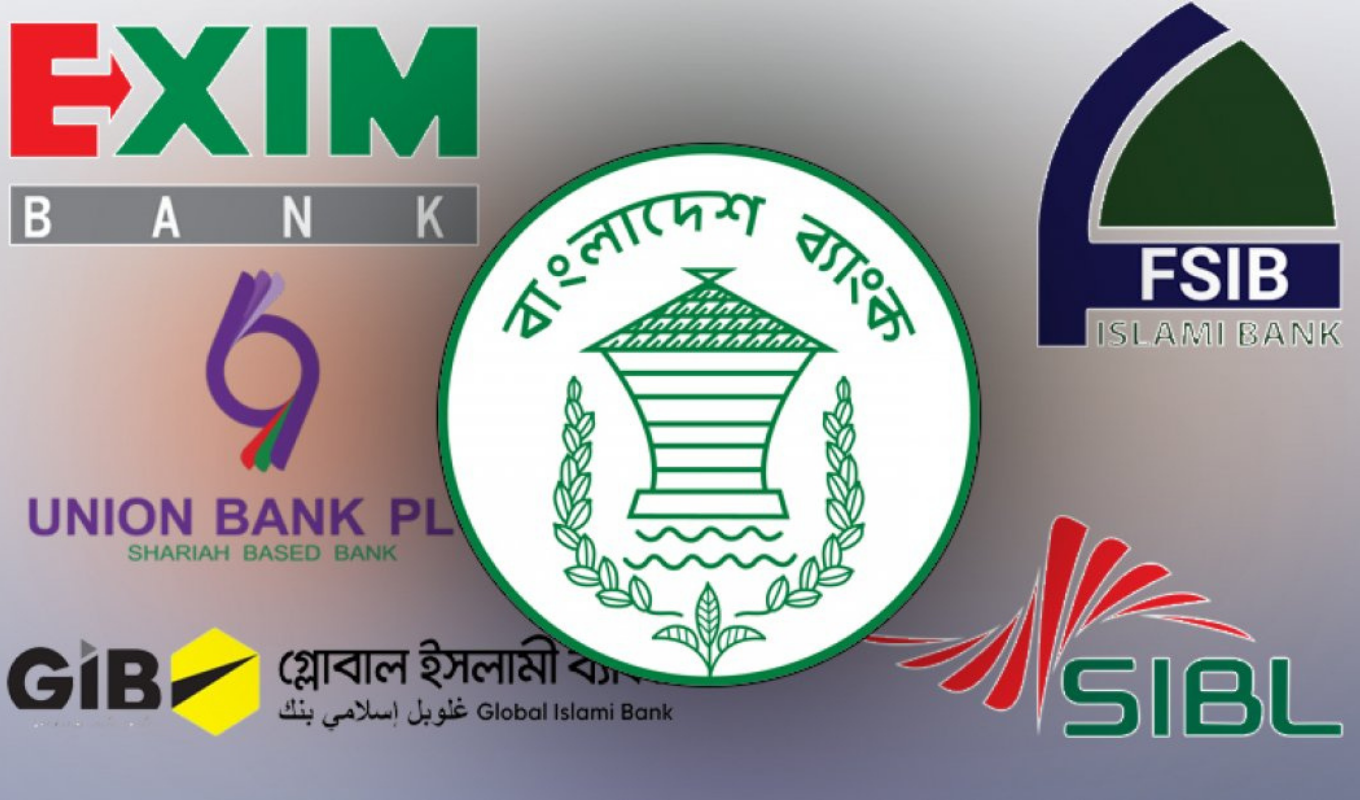
The interim government has approved the formation of Sammilito Islami Bank PLC, a new Shariah-compliant bank created by merging five troubled Islamic banks—Exim, First Security Islami, Global Islami, Social Islami, and Union. The consolidation is being overseen by the Ministry of Finance and Bangladesh Bank, and the new bank is expected to begin operations by December.
Despite the potential for reducing operational costs and streamlining administrative processes, economists have raised concerns that the merger of these weak banks into a state-owned entity could undermine the stability of the sector, especially if the responsibility for these struggling institutions is passed to stronger banks.
Merger Details
The newly formed bank will have an authorised capital of Tk40,000 crore and a paid-up capital of Tk35,000 crore. Of this, the government will contribute Tk20,000 crore—half in cash, and the remainder through Sukuk bonds. Additionally, around Tk15,000 crore of institutional deposits will be converted into shares in a “bail-in” process.
Under this process, the claims of customers and other creditors will be converted into shares in the new bank, and repayments will be made over a period of time according to a detailed plan. While this move aims to stabilise the banks, many customers are already feeling the impact, with numerous complaints of withdrawal difficulties following the merger announcement.
Financial Distress
The five banks have been facing severe liquidity problems for some time. They have not received fresh liquidity support from Bangladesh Bank in the past few months, and reports indicate that customer complaints are rising as people struggle to access their funds. At many branches, disputes between customers and bank officials have led to daily confrontations.
Dr Zahid Hussain, former chief economist of the World Bank’s Dhaka office, attributed the current crisis to years of mismanagement, noting that depositors will only be reimbursed once the new bank is operational, which could take months. Mohammad Nurul Amin, chairman of Global Islami Bank, confirmed that loan recoveries have stalled, and with no new deposits coming in, the banks are struggling to meet their obligations.
The central bank has assured customers that they will receive their money back, though this could take anywhere from six months to five years, with the process beginning as soon as it is formally gazetted.
Post-Merger Plans
Once operational, Sammilito Islami Bank will assume all assets and liabilities of the five merging banks. The government has stressed that small depositors will be prioritised, with their funds paid out first, while larger creditors will see their dues repaid over time. The bank’s assets and infrastructure will also be streamlined, including the integration of IT systems and treasury operations.
In addition, Bangladesh Bank has begun preparations to reorganise the branch network, moving several branches from district towns to upazilas (sub-districts), where they will better serve local populations.
Mohammad Nurul Amin confirmed that work is already underway to assess the status of loans, deposits, and branch infrastructure. Once the legal formalities are completed, administrators will be appointed to oversee the merger process, with the boards of directors from the five banks being dissolved.
Employment and Branch Realignment
With over 18,000 employees working across the five banks, concerns are mounting about how the new institution will manage the workforce, which costs the banks around Tk2,000 crore annually in salaries and allowances. Experts warn that unless the bank can effectively manage such a large and costly operation, its long-term sustainability may be at risk.
Moreover, the merger will involve the reorganisation of 761 bank branches. Some branches will be closed or relocated, particularly in areas where multiple branches exist within the same district.
Financial Strain
As of the end of 2024, the five banks had significant levels of defaulted loans. Exim Bank’s non-performing loans stood at Tk14,903 crore, First Security Islami Bank at Tk55,920 crore, and Social Islami Bank at Tk23,633 crore. Global Islami Bank reported Tk13,880 crore in defaults, while Union Bank’s figures were not yet finalised.
Economists warn that assuming these liabilities could strain the financial health of the new bank, especially if it struggles to restore its balance sheet. Nevertheless, the central bank has stressed that the new bank will be under state ownership for the time being, with plans to privatise it within five years.
A Cautionary Tale
While mergers of this kind have been attempted in the past—such as the creation of Bangladesh Development Bank (BDBL) in 2009—experts remain sceptical. BDBL itself continues to face financial challenges despite the merger of Shilpa Bank and Shilpa Rin Sangstha. Dhaka University’s Prof Md Maksudur Rahman Sarkar expressed concerns that without a cultural shift in banking practices, this new merger may be doomed to repeat past mistakes.
Ahsan Ullah, advisor to the governor of Bangladesh Bank, urged that the merger should be seen not as a punitive measure but as a restructuring effort. He stressed that good governance and accountability were critical to the success of this initiative, as the Islamic banking sector is looking for a fresh start.
The future of Sammilito Islami Bank PLC now hinges on the successful execution of its formation and restructuring plans. The coming months will be critical in determining whether this merger can bring stability to a troubled sector or simply perpetuate the issues that have plagued it for years.