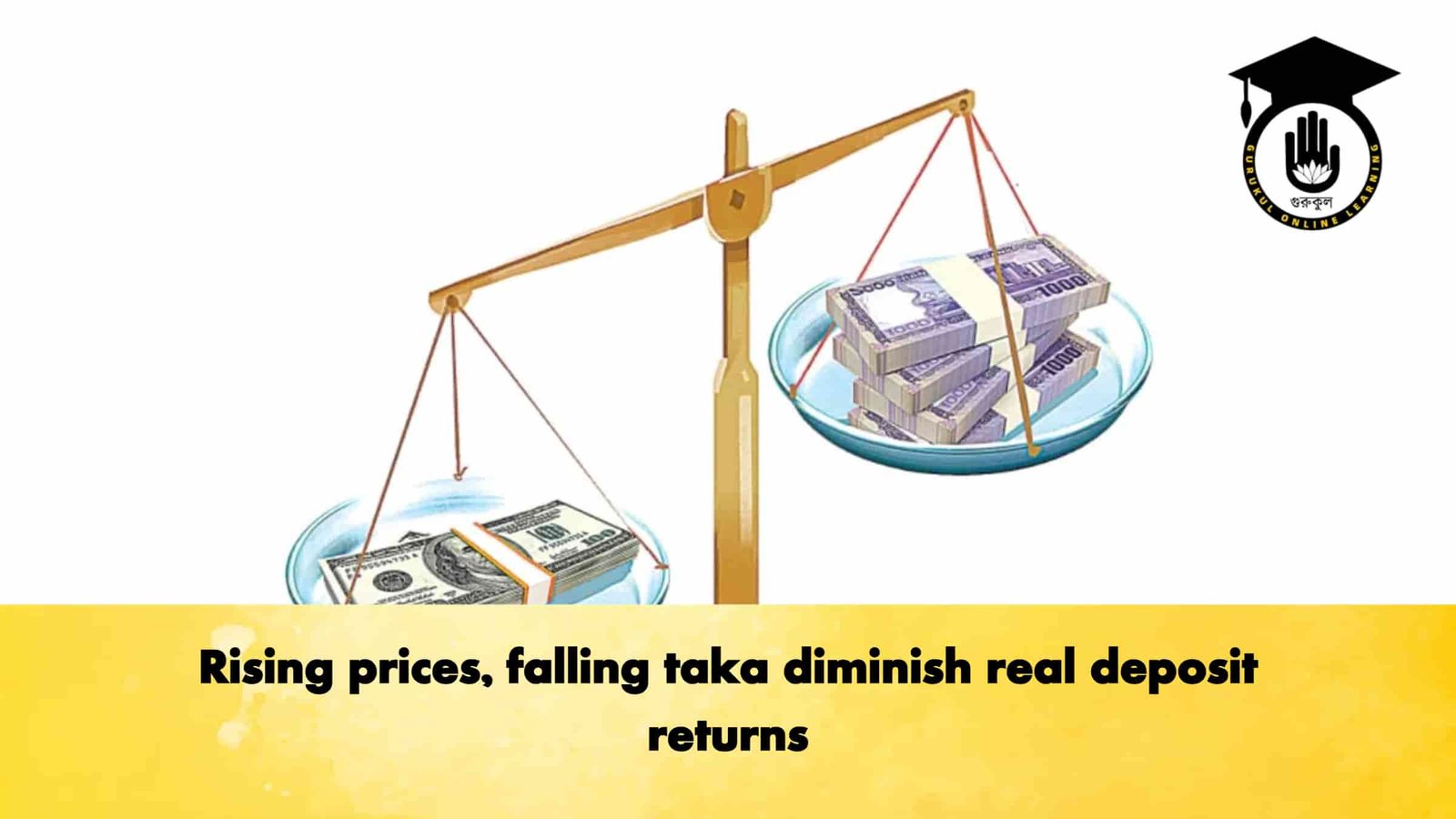
Savers in Bangladesh experienced a further erosion of real returns on bank deposits in 2025, as inflation consistently outpaced deposit interest rates, reducing purchasing power despite continued expansion in overall deposits within the banking system.
According to the Bangladesh Bank’s report titled “Banking Sector Update 2025”, the weighted average interest rate on deposits stood at around 6% during the year, while average inflation remained in the range of 8% to 9%. This gap resulted in an estimated negative real interest rate of 2% to 3%, meaning depositors effectively lost value in real terms.
A simple illustration provided by the data shows that a depositor holding Tk1 lakh would earn approximately Tk6,000 in annual interest. However, with inflation eroding roughly Tk9,000 in purchasing power over the same period, the net real loss would be around Tk3,000.
Deposit returns versus inflation (2025)
| Indicator | Rate/Value |
|---|---|
| Average deposit interest rate | ~6% |
| Average inflation rate | 8%–9% |
| Estimated real interest rate | -2% to -3% |
| Example interest on Tk1 lakh | Tk6,000 |
| Estimated inflation loss | Tk9,000 |
| Net real impact | -Tk3,000 |
Despite this negative real return, the banking sector maintained profitability. Lending rates remained above 12%, allowing banks to preserve a spread of more than 3% between lending and deposit rates, even after accounting for costs and provisioning.
Ezazul Islam, Director General of the Bangladesh Institute of Bank Management (BIBM), noted that while overall weighted returns were negative, longer-term fixed deposits of one year or more still generated slightly positive real returns. However, he cautioned that currency depreciation could further weaken depositor returns and erode purchasing power.
He added that continued devaluation of the taka would intensify inflationary pressure, particularly through higher import costs, making real returns even more negative and reducing the attractiveness of bank savings.
Currency and cost pressures
The exchange rate has already shown gradual depreciation since March 2025, with the US dollar rising close to Tk123 after months of relative stability around Tk122.30. Market projections based on central bank models suggest potential movement towards Tk130. Rising global oil prices and supply disruptions in key maritime routes have also increased import costs of raw materials and energy.
Import-dependent industries have reported cost increases ranging from 10% to as high as 183% in certain inputs, adding further inflationary pressure on domestic prices.
Deposit growth despite losses
Despite falling real returns, bank deposits increased by more than 11%, reaching Tk21 lakh crore by December 2025, up from Tk18.8 lakh crore a year earlier. Growth was largely supported by remittance inflows and continued reliance on the formal banking system.
Deposit expansion was concentrated in retail and middle-income segments. Accounts holding up to Tk2 lakh and up to Tk25 lakh accounted for a significant share of total growth, with deposits in the latter category rising from Tk5.52 lakh crore to Tk6.52 lakh crore.
In contrast, the number of very large accounts above Tk25 crore declined, indicating a gradual redistribution towards smaller depositors.
The Bangladesh Bank report noted that sustained deposit growth amid negative real returns reflects continued public confidence in the banking system, driven by safety considerations, accessibility, and remittance inflows rather than return maximisation.
Lending dynamics and liquidity
Banks maintained profitability due to high lending rates and elevated spreads. However, non-performing loans and regulatory constraints have increased financing costs, limiting credit expansion. The advance-deposit ratio declined to 85.8% in 2025 from 89.3% in December 2024, indicating higher liquidity buffers but slower lending activity.
While overall credit growth remained modest at 5.6%, the structure of deposits continued to shift towards retail and middle-tier savers, reinforcing the sector’s reliance on household savings as a primary funding source.