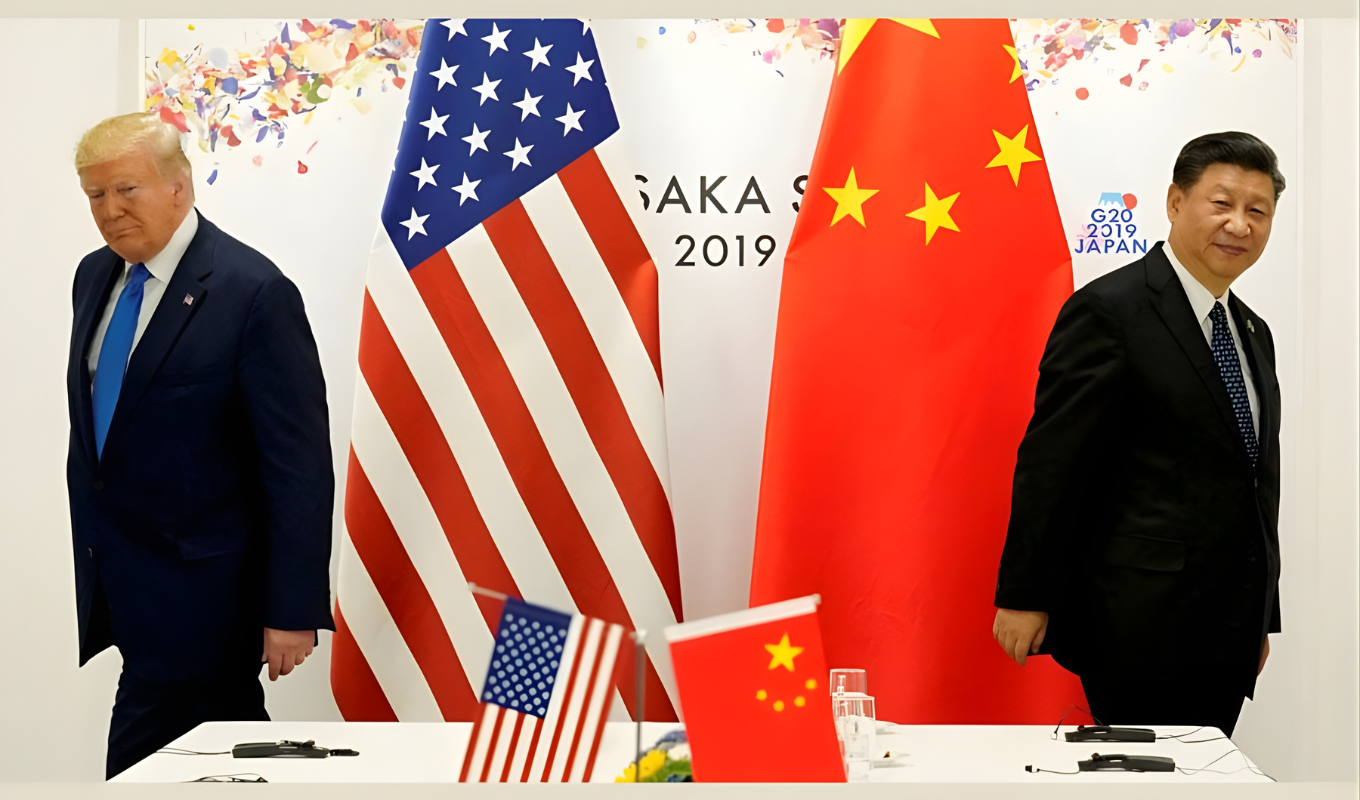
US President Donald Trump is set to test his vaunted deal-making skills in a region still reeling from his hardline trade policies, as he embarks on a five-day trip to Asia next week. The journey — covering Malaysia, Japan, and South Korea — marks his first visit to the region and his longest overseas trip since beginning his second term in January.
Trump departs Washington on Friday night, with plans to secure a series of trade, business, and ceasefire agreements before facing his biggest diplomatic challenge — a one-on-one meeting with Chinese President Xi Jinping on Thursday in Seoul.
The visit comes as Trump seeks to uphold what he calls the signature foreign policy achievement of his second term — a fragile ceasefire in the Israel–Gaza conflict — while the war in Ukraine grinds on and US–China trade tensions remain unresolved.
Washington and Beijing have imposed mutual tariffs on each other’s exports and have even threatened to restrict access to key minerals and advanced technologies, unsettling global markets.
The White House formally announced the trip on Thursday, but several details remain fluid, including confirmation of the Trump–Xi meeting itself. Neither side expects a breakthrough restoring pre-2025 trade terms, according to a source familiar with the planning. Instead, discussions have focused on managing disputes and achieving modest progress.
Possible outcomes could include limited tariff relief, an extension of current rates, or Chinese commitments to purchase US-made soyabeans and Boeing aircraft — similar to pledges made, but not fulfilled, in Trump’s 2020 trade deal.
In return, Washington might allow greater exports of high-end computer chips to China, while Beijing could ease restrictions on rare-earth magnets — a longstanding irritant in the relationship. Yet, officials caution that the talks may yield no agreement at all.
On Wednesday, US Treasury Secretary Scott Bessent described the planned Trump–Xi exchange as a mere “pull-aside”, implying no formal session. However, Trump later told reporters the two leaders would hold “a pretty long meeting”, saying it would allow them to “work out a lot of our questions and our doubts and our tremendous assets together”.
China has yet to confirm any such meeting is scheduled.
Mira Rapp-Hooper, visiting fellow at the Brookings Institution and a former Biden administration official, observed that Trump’s Asia policy has been shaped by “intense pressure on nations’ trade policies and defence spending”.
“The central question for this trip,” she noted, “is really who the United States stands with — and what it stands for.”
Trump will begin in Kuala Lumpur, Malaysia, attending the Association of Southeast Asian Nations (ASEAN) summit, which opens on Sunday.
There, he is expected to witness the signing of a ceasefire agreement between Thailand and Cambodia, formalising the truce that ended their most severe border clashes in years this past July. Though short of a comprehensive peace deal, the accord could strengthen Trump’s efforts to project himself as a global peacemaker.
Following Malaysia, Trump will travel to Japan for talks with Prime Minister Sanae Takaichi, recently elected to office. Takaichi is likely to reaffirm her predecessor’s plans to increase military spending and to direct $550 billion in investments towards the United States, a move welcomed by the Trump administration.
In South Korea, Trump’s final stop, he is slated to meet President Xi Jinping ahead of an international trade summit. According to the White House, Trump will return to Washington before the Asia-Pacific Economic Cooperation (APEC) leaders’ forum begins.
The US president has warned he may raise tariffs on Chinese imports to 155 per cent from 1 November if no deal is struck — a move expected to trigger a sharp response from Beijing and collapse the existing tariff truce.
Beyond trade, Trump and Xi are expected to discuss Taiwan — a perennial flashpoint in US-China relations — as well as Russia, Beijing’s ally and the target of expanded US sanctions over the war in Ukraine.
In addition to China, Trump is pursuing trade agreements with Canada, Malaysia, and India, while seeking to repair tensions with South Korea over an existing accord.
Relations with Seoul have been strained by concerns surrounding Trump’s push for $350 billion in US investments from Korean firms and the deportation of foreign workers. South Korean President Lee Jae Myung has urged Trump to resume peace efforts with North Korea’s Kim Jong Un.
According to another source familiar with internal deliberations, US officials had considered — but never confirmed — a visit to the demilitarised zone (DMZ) separating the two Koreas.
Meanwhile, the Asian Development Bank (ADB) announced on Friday that it had approved a US$180 million loan as additional financing for PT Geo Dipa Energy, a state-owned Indonesian firm, to further expand the nation’s geothermal power generation capacity.
The Geothermal Power Generation Project supports the construction and commissioning of two 55-megawatt geothermal plants on Java Island, which will provide environmentally friendly base-load electricity to the Java–Bali grid and reduce carbon dioxide emissions by over 550,000 tonnes annually, according to the ADB’s statement.
The additional funding will help offset rising costs and ensure continued progress towards Indonesia’s clean energy and climate goals.
“PT Geo Dipa Energy plays a catalytic role in driving the next phase of geothermal development,” said Jiro Tominaga, ADB Country Director for Indonesia. “We look forward to deepening our collaboration to expand Indonesia’s geothermal capacity and accelerate the transition to a cleaner, more resilient energy future.”