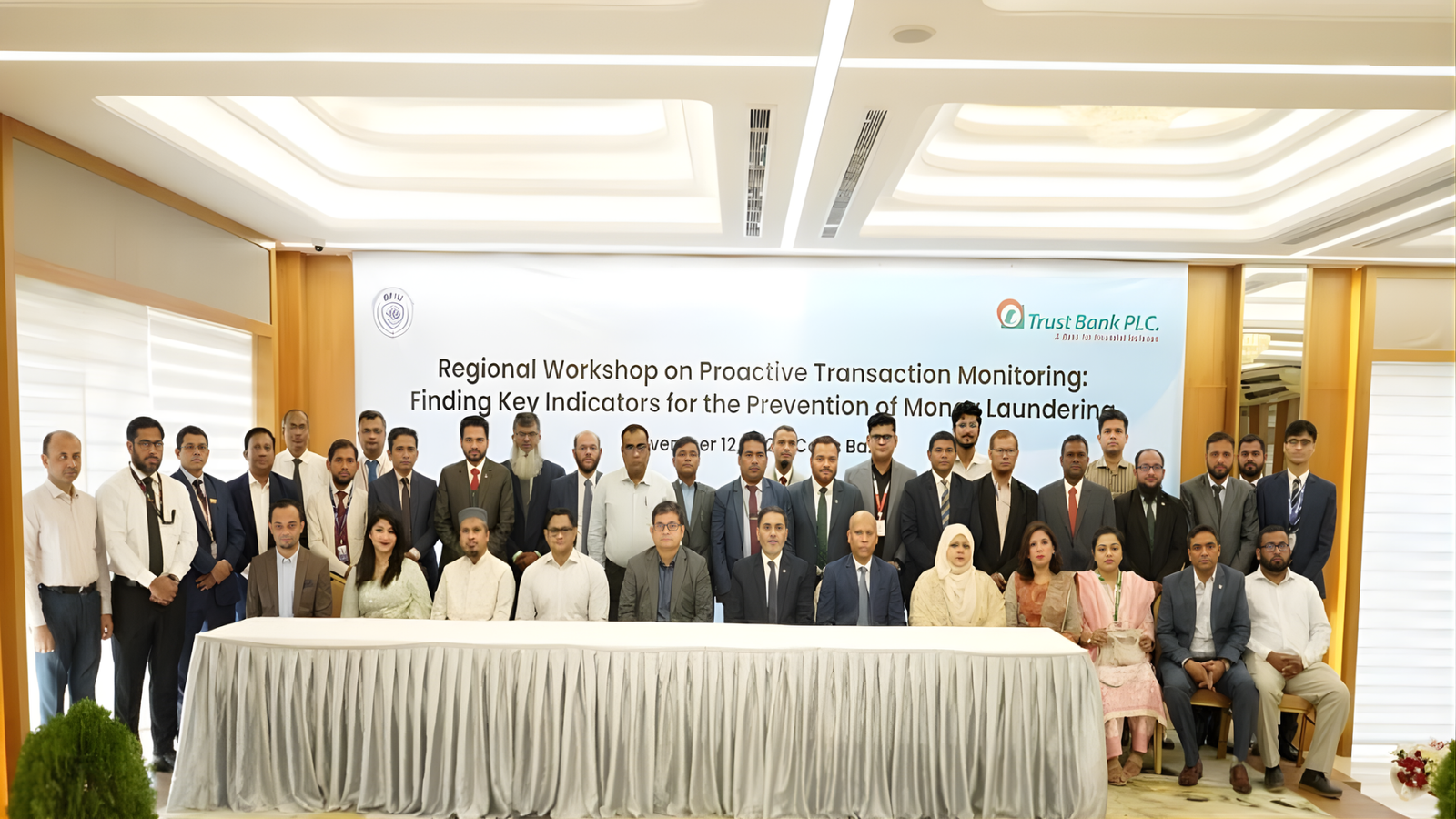
Trust Bank PLC, in partnership with the Bangladesh Financial Intelligence Unit (BFIU), has conducted a comprehensive regional workshop aimed at strengthening anti–money laundering (AML) capabilities across financial institutions. The event, held at City Hotel in Cox’s Bazar, carried the theme “Proactive Transaction Monitoring – Identifying Key Indicators for Detecting Money Laundering” and brought together banking professionals from across the region.
The workshop’s chief guest, AKM Golam Mahmud, Director of BFIU, emphasised the rising complexity of illicit financial flows and highlighted the urgent need for banks to adopt advanced surveillance tools. He noted that proactive monitoring—where banks detect suspicious patterns before they escalate—is essential to maintaining the transparency and credibility of Bangladesh’s financial ecosystem.
ABM Moinul Hasib, Head of Trust Bank’s Anti-Money Laundering Division, attended as the special guest. He stressed that the banking industry is experiencing new forms of transactional behaviour driven by digital banking, agent banking, and mobile financial services. Identifying unusual deposits, sudden spikes in cash withdrawals, or frequent fund transfers across multiple accounts has therefore become crucial for frontline banking officers.
The workshop was led by Ruman Ahmed, Additional Director of BFIU, who conducted several expert-led sessions throughout the day. His presentations covered global AML trends, recent regulatory updates, risk-scoring models, early-warning frameworks, and the emerging role of artificial intelligence in detecting financial crime. Participants were also guided through real-life case studies that demonstrated how sophisticated laundering schemes can be uncovered through data-driven analysis.
Officials from various banks in the Cox’s Bazar region joined the programme, taking part in interactive discussions and practical group exercises. These sessions focused on enhancing automated transaction monitoring systems, designing more accurate risk indicators, and strengthening inter-agency cooperation to reduce financial vulnerabilities.
Participants noted that the workshop offered valuable insights into identifying behavioural red flags, such as structured cash deposits, rapid movement of funds across unrelated accounts, and unusual account activity inconsistent with declared customer profiles.
According to the organisers, the workshop is part of a broader national effort to promote transparent financial practices and ensure compliance with both local regulations and international standards. Trust Bank PLC stated that collaborative training initiatives of this kind are vital in protecting Bangladesh from potential reputational risks associated with money laundering.
The event concluded with a call for stronger coordination among banks, continuous staff training, and the adoption of robust data-driven tools. Such proactive measures, officials noted, are essential to preserving financial integrity and safeguarding the nation’s economic stability.