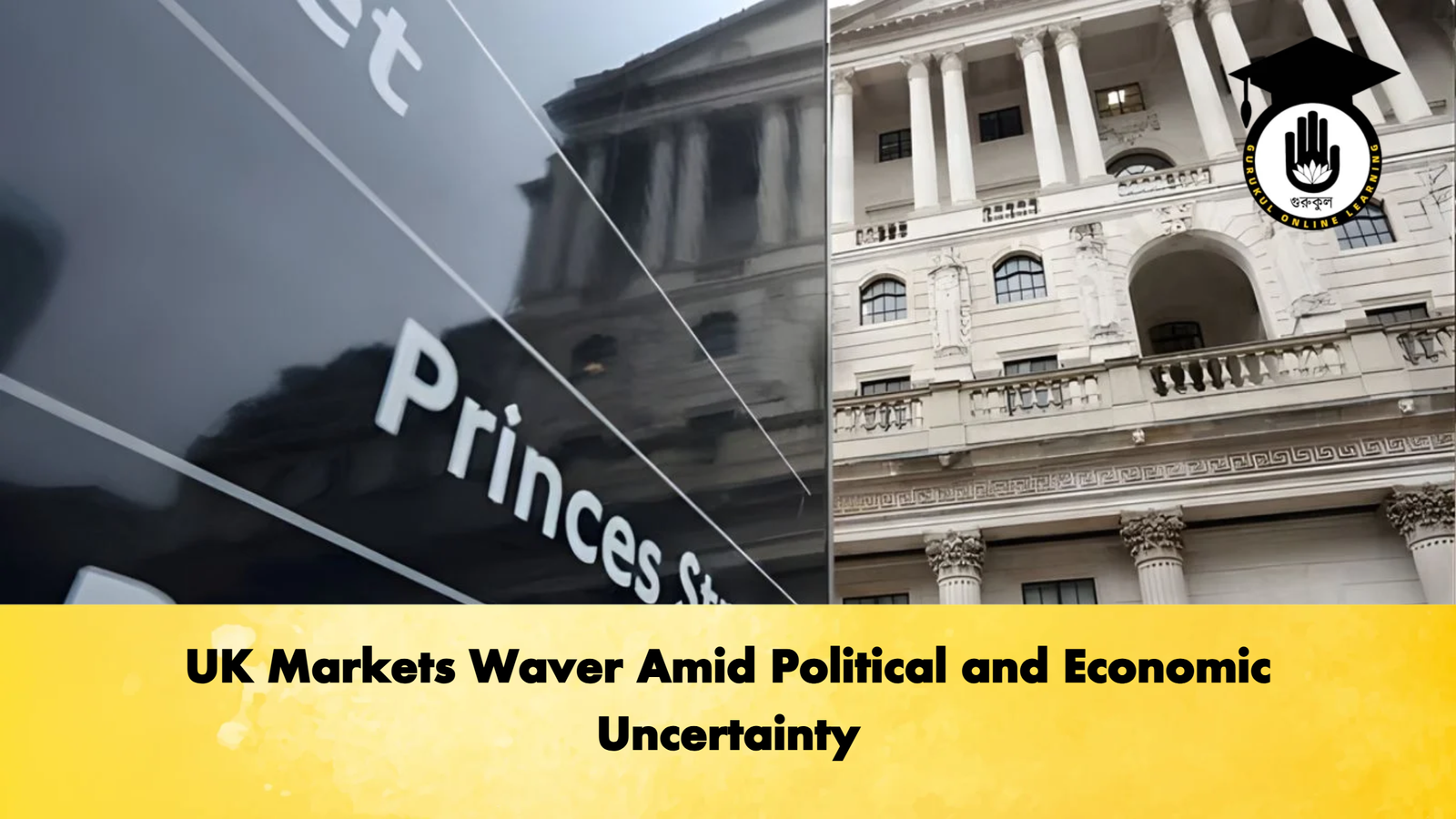
Recent weeks have seen heightened volatility in the United Kingdom’s financial markets, driven by a combination of political uncertainty and steady monetary policy. Investors are closely monitoring the Bank of England’s stance on interest rates, which is expected to remain unchanged, while domestic political tensions—particularly surrounding Prime Minister Keir Starmer’s leadership—have contributed to fluctuations in both sterling and government bond yields.
Chris Beauchamp, Chief Market Analyst at IG, commented: “Even in an otherwise stable economic environment, speculation over a potential resignation by Keir Starmer is unsettling the markets. Investors are wary of shifting positions due to possible leadership contenders within the Labour Party.” He added, “Political uncertainty is currently the dominant factor driving market volatility.”
Economists broadly support the Bank of England’s decision to hold interest rates steady. Professor Kostas Milas of the University of Liverpool noted: “Given public sentiment, keeping interest rates unchanged is a rational choice. Recent surveys suggest that inflation is expected to exceed 3% in the first quarter of 2026, aligning closely with the Bank’s forecasts.”
On the international front, significant developments have emerged in the global economy. At the US-led Critical Minerals Summit, fifty nations convened to reduce reliance on China through various bilateral and multilateral agreements. Europe and the United States have pledged to implement joint strategies within the next thirty days, signalling a coordinated effort to secure strategic supply chains.
Meanwhile, the UK construction sector, though still contracting, is showing signs of stabilisation. According to S&P Global’s latest survey, the total construction activity index for January 2026 was 46.4, indicating continued contraction but at a slower pace compared with December 2025.
UK Construction Sector Statistics (January 2026)
| Sector | PMI Index | Previous Month (Dec 2025) | Commentary |
|---|---|---|---|
| Total Construction | 46.4 | 40.1 | Contraction easing, yet sector not fully stable |
| Residential Construction | 42.0 | 39.5 | Slowest contraction in three months |
| Commercial Construction | 49.8 | 46.7 | Nearly stable, contract activity rising |
| Civil Engineering | 44.5 | 41.2 | Gradually slowing, but at a modest pace |
Tim Moore, S&P Global’s Economics Director, remarked: “The downward phase in construction appears to be ending. Optimism is rising around new projects, job losses have eased, and business activity expectations have reached an eight-month high.”
In summary, the UK economy continues to navigate a period of instability influenced by political uncertainty, steady interest rates, and slow growth in housing construction. Nevertheless, modest positive indicators suggest that 2026 could mark the beginning of a gradual sectoral recovery.