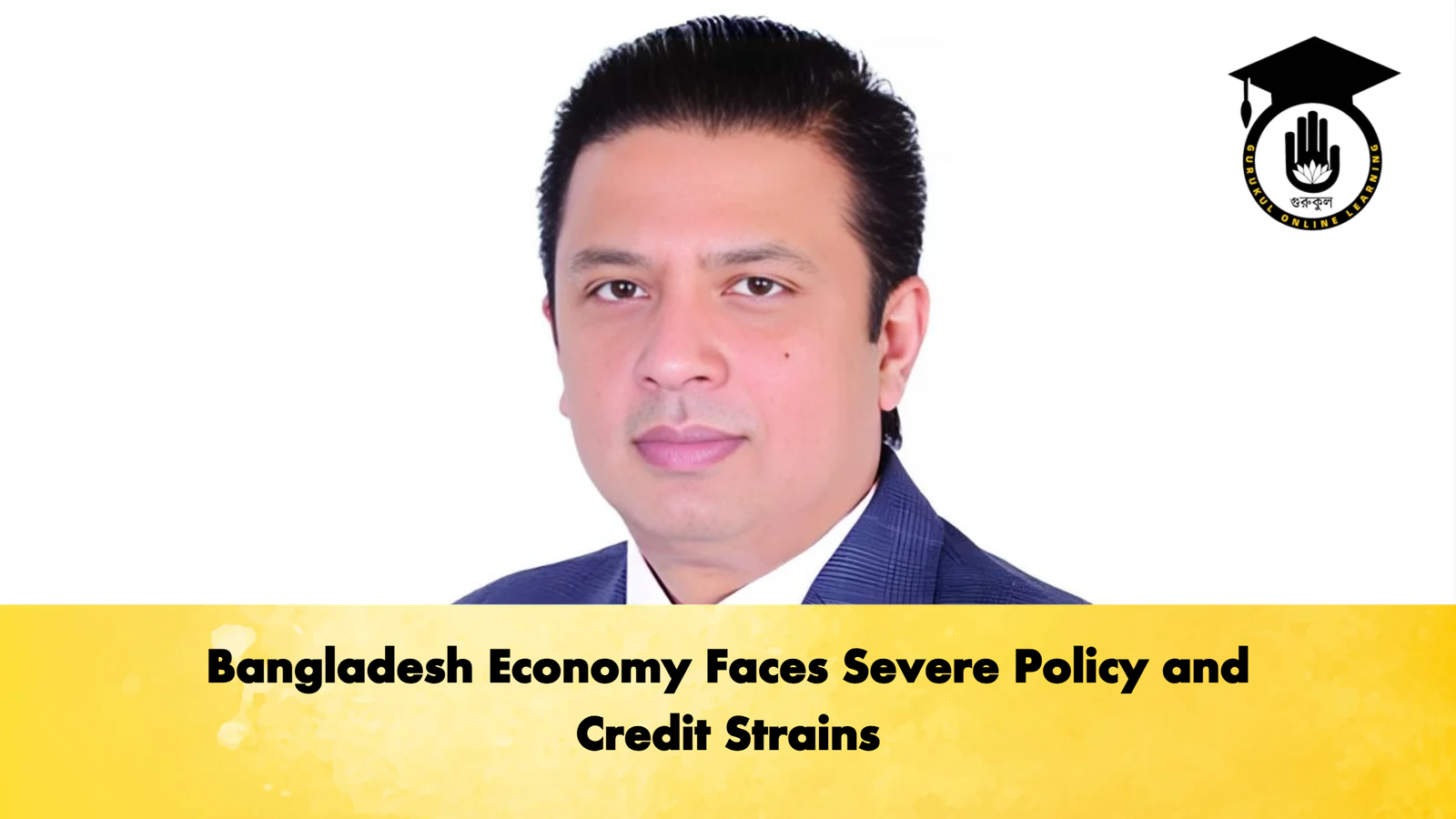
Taskeen Ahmed, President of the Dhaka Chamber of Commerce and Industry (DCCI), has warned that Bangladesh’s economy is under intense pressure due to high interest rates, bureaucratic complexities, and policy weaknesses. Speaking at a recent seminar, he highlighted that private sector credit growth has fallen to its lowest level in recent years, raising concerns over industrial and commercial activity.
The seminar, titled “Current State and Future of Bangladesh’s Economy from the Private Sector Perspective”, featured Planning State Minister Md. Junaid Abdur Rahim Saki as the virtual chief guest. Special guests included Dr. Manzur Hossain (Member, Bangladesh Planning Commission), A H M Jahangir (Additional Secretary & Project Director, SSGP), and Dr. Mohammad Aktar Hossain (Chief Economist, Bangladesh Bank).
Prominent economists and private sector leaders participated in the discussion, including Dr. Zayed Sattar (Chairman, PRI), Dr. A K Enamul Haque (Director General, BIDS), Professor Mohammad Abu Yusuf (Dhaka University), Professor M Riaz Asadullah (University of Reading, UK), and Faisal Samad (Director, BGMEA & Managing Director, Surma Garments).
Planning State Minister Junaid Saki emphasised that the government is vigilant in addressing global crises affecting the Middle East and has taken necessary preparatory measures. He stressed the importance of expanding the tax net to reduce dependence on both domestic and international borrowing.
Taskeen Ahmed cautioned that the ongoing Iran–US and Israel conflicts pose a serious threat to global trade. He also noted that Bangladesh’s private sector remains highly vulnerable due to its dependence on imported energy for industrial production. Additionally, the new US tariff policies could significantly impact both domestic and foreign investment.
Dr. Mohammad Aktar Hossain of Bangladesh Bank highlighted that inflation currently stands at 9 per cent, and the Middle East crisis could exacerbate economic volatility. He warned that without contractionary monetary measures, sudden interest rate cuts or excessive money supply could create further uncertainty.
Faisal Samad pointed out that Bangladesh’s export markets in the US and EU are particularly vulnerable, given the absence of free trade agreements. He added that high bank lending rates are discouraging entrepreneurs, and the timely utilisation of GTF funds is critical.
Key Economic Indicators
| Indicator | Current Value | Comments |
|---|---|---|
| Private sector credit growth | 5.2% | At historically low levels |
| Inflation | 9% | Rising risk under crisis conditions |
| Average bank lending rate | 12–13% | High for entrepreneurs |
| Dependence on energy imports | 70% | Significant impact on industrial costs |
Experts emphasised that policy weaknesses, high interest rates, and global instability collectively place the Bangladeshi economy under strain. They recommend targeted measures such as credit expansion, interest rate reduction, tax base broadening, and foreign trade promotion to stabilise industrial and commercial sectors.
Without enhancing private sector capacity and ensuring effective policy implementation, the current economic pressures could have far-reaching long-term effects on Bangladesh’s economic stability.