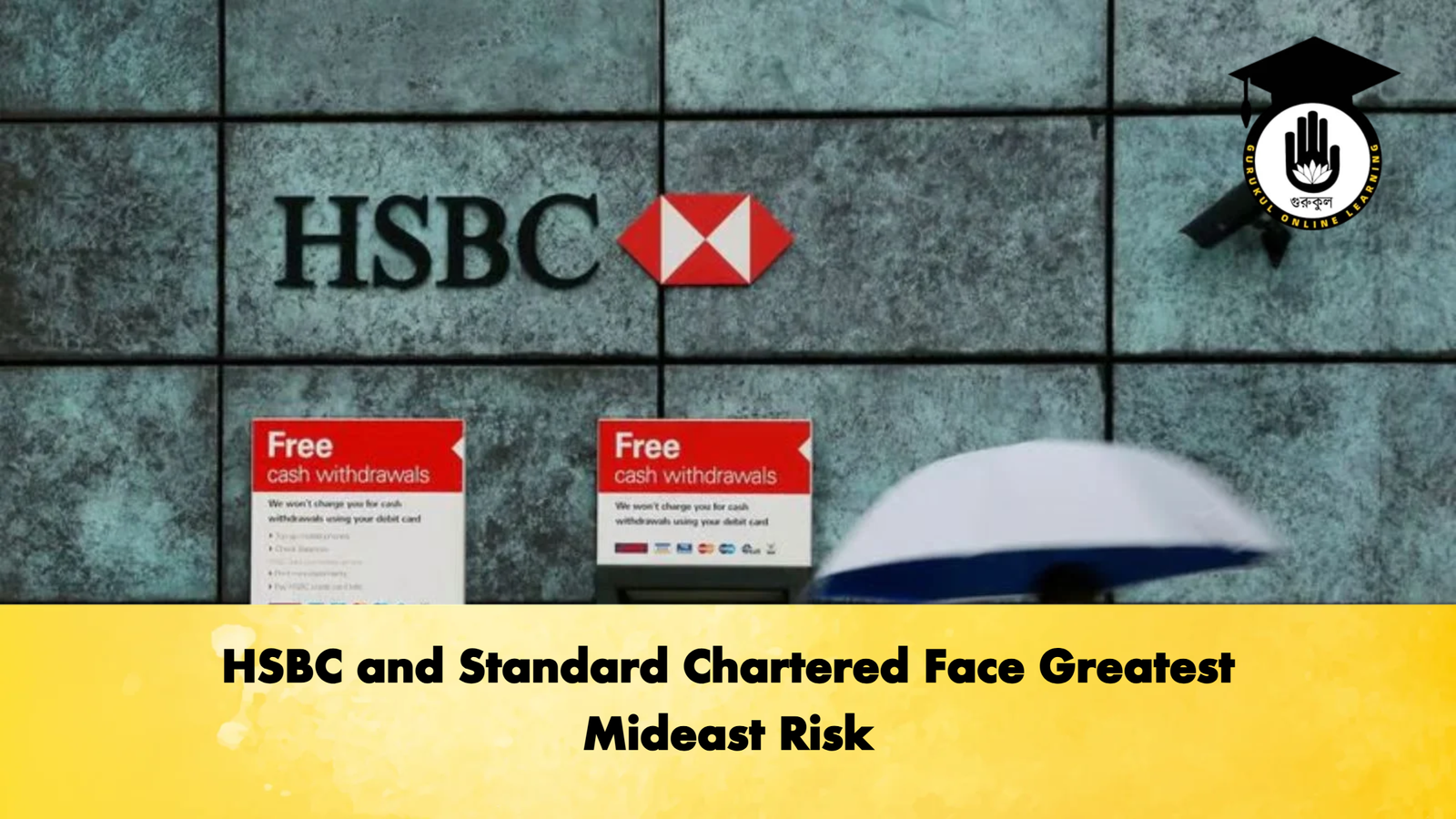
Among Europe’s leading banks, HSBC and Standard Chartered are facing the highest financial exposure due to recent political and economic volatility in the Middle East. On Thursday, J.P. Morgan cautioned that potential stresses in the region could have a direct impact on both banks’ earnings, signalling heightened investor concern.
Earlier this week, the STOXX 600 Banks Index fell to a three-month low, down roughly 6% since 27 February. On the same day, HSBC shares declined by over 5%, while Standard Chartered fell by approximately 2%. Analysts note that surging energy prices in the Middle East could affect the corporate lending capacity of sectors such as agriculture, manufacturing, construction, and transportation, intensifying revenue and profit pressures for banks with significant regional exposure.
Middle East Exposure of HSBC and Standard Chartered
| Bank | Revenue Exposure | PBT Exposure | Regional Loan Portfolio (Fiscal 2025) |
|---|---|---|---|
| Standard Chartered | 8% | 12% | Approx. $9bn in UAE; $6bn through UAE branch in Q3 |
| HSBC | 4% | 9% (including Egypt, Turkey, Saudi Arabia) | Approx. $23bn concentrated in UAE and Qatar |
For Standard Chartered, excluding Turkey and Egypt, revenue and PBT exposure are estimated at 8% and 12%, respectively. HSBC’s PBT exposure reaches nearly 9% when including Egypt, Turkey, and Saudi Arabia. Additionally, HSBC holds a 31% stake in Saudi Arabia’s Alawwal Bank and has further loan exposure linked to global multinational clients.
Risk Assessment and Earnings Pressure
J.P. Morgan notes that the two banks’ Middle East portfolios are predominantly high-quality corporate loans, suggesting a relatively low likelihood of credit losses. Nonetheless, the primary risk lies in earnings pressure, as revenue streams and profit margins could be adversely affected by regional instability.
By contrast, other European banks such as Julius Baer, Société Générale, ING, Barclays, Banco Santander, BNP Paribas, and Deutsche Bank have limited exposure, with revenue and PBT contributions from the Middle East below 1%. For instance, Julius Baer receives around 11% of its total assets from Middle Eastern clients. Some institutions, like UBS and Julius Baer, benefit from diversification across wealthy clients in multiple countries, providing partial insulation from geopolitical risks.
Market Outlook
UBS Global Wealth Management issued a “neutral” rating on European banks in a note released Wednesday. The report emphasises that even if energy supply is rapidly restored, long-term earnings potential from the region remains constrained.
In summary, this analysis highlights the heightened Middle East exposure for HSBC and Standard Chartered, the potential impact on profits, and the broader market implications. Investors are advised to monitor regional developments closely, as geopolitical tensions could continue to shape earnings outcomes for European banks with significant Mideast operations.