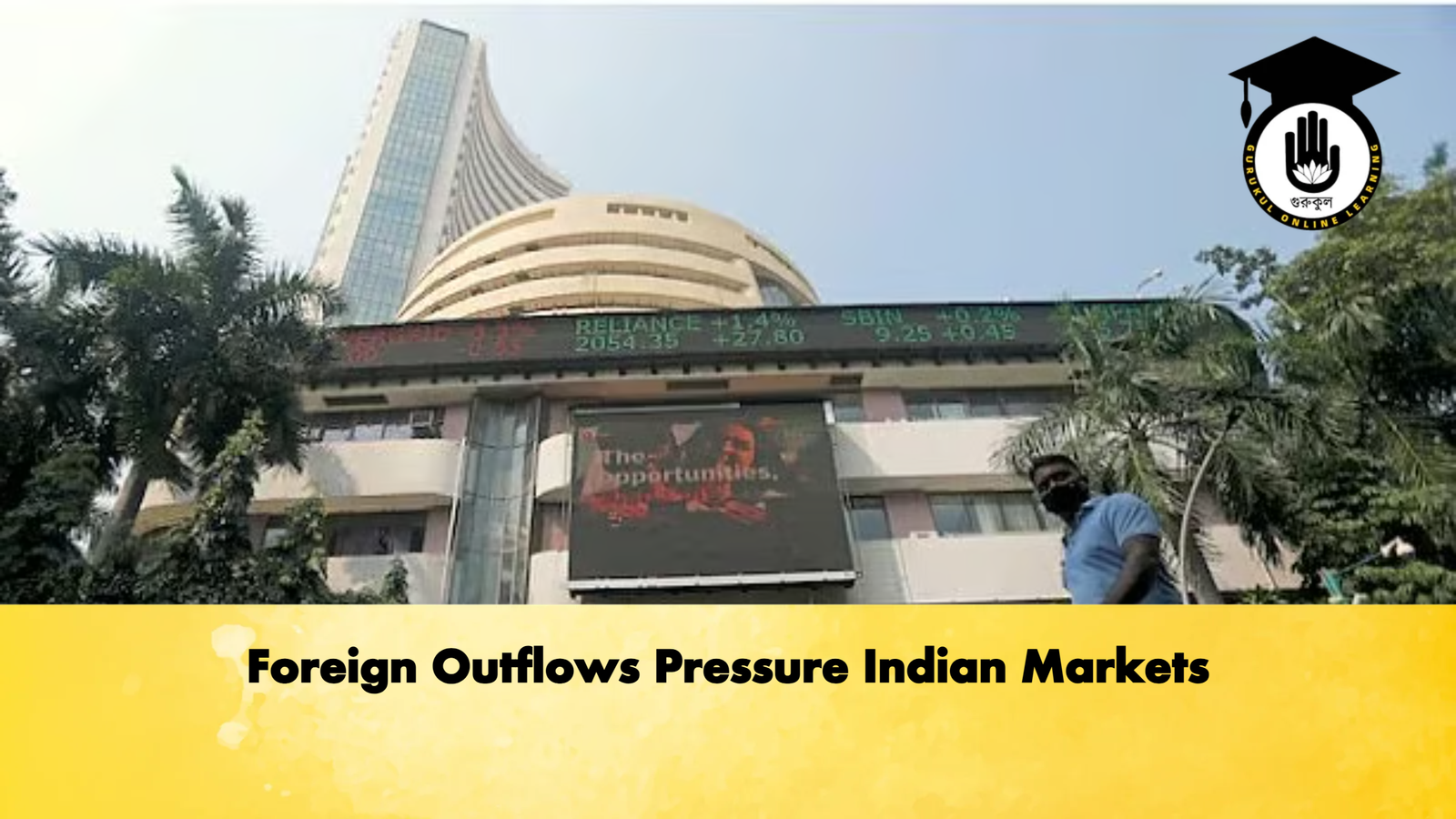
Foreign portfolio investors have continued to withdraw capital from India’s equity markets for several consecutive months, with the latest data for May showing a significant net outflow. Market analysts attribute this sustained trend to a combination of global economic uncertainty, currency volatility, and rising crude oil prices, all of which have weighed on investor sentiment.
According to the latest figures from the National Securities Depository Limited, foreign portfolio investors (FPIs) pulled out approximately ₹32,963 crore from Indian equities in May alone. This marks the third consecutive month in which overseas investors have remained net sellers, reinforcing concerns over short-term market stability. The information has been widely reported by Indian financial media outlets.
The pattern of outflows has been volatile but persistent throughout the year. April recorded a substantially larger withdrawal of around ₹60,847 crore, while March witnessed the most severe sell-off, with FPIs offloading nearly ₹117,775 crore—one of the highest monthly outflows on record. In contrast, February briefly broke the trend, with net inflows of approximately ₹22,615 crore, suggesting a short-lived return of investor confidence. January, however, saw renewed selling pressure, with outflows of about ₹35,962 crore.
On a cumulative basis, India’s equity markets have experienced a net FPI withdrawal of roughly ₹224,932 crore so far this year, highlighting the scale of foreign capital exit despite intermittent inflow periods. Analysts note that although the direction remains negative, the pace of monthly withdrawals appears to be gradually moderating, potentially indicating early signs of stabilisation.
Monthly FPI Flow Overview
| Month | Foreign Portfolio Investment Flow |
|---|---|
| January | ~₹35,962 crore outflow |
| February | ~₹22,615 crore inflow |
| March | ~₹117,775 crore outflow |
| April | ~₹60,847 crore outflow |
| May | ~₹32,963 crore outflow |
Market experts suggest that global geopolitical tensions, particularly heightened instability in West Asia, have played a major role in shaping investor behaviour. In addition, fluctuations in crude oil prices have added further pressure, with Brent crude at one point nearing the US$100 per barrel mark. Such levels raise concerns over India’s import bill and inflationary pressures, both of which tend to deter foreign investment.
The Indian rupee has also faced downward pressure against the US dollar, prompting foreign investors to adopt a more cautious stance. According to market analyst V K Vijayakumar, recent trading patterns indicate a strategy of buying during market dips and booking profits during rallies, a behaviour that may be driven largely by institutional investors adjusting their exposure amid global uncertainty.
Despite these challenges, some resilience has been observed in India’s small and mid-cap segments. Reports from financial observers such as the Economic Times suggest that several companies within these categories continue to deliver relatively strong performance, supported by optimistic growth projections. This has helped sustain partial investor interest even amid broader outflow trends.
Nevertheless, the overall sentiment remains subdued, with foreign investment flows continuing to reflect caution in the face of global macroeconomic instability and currency risks.