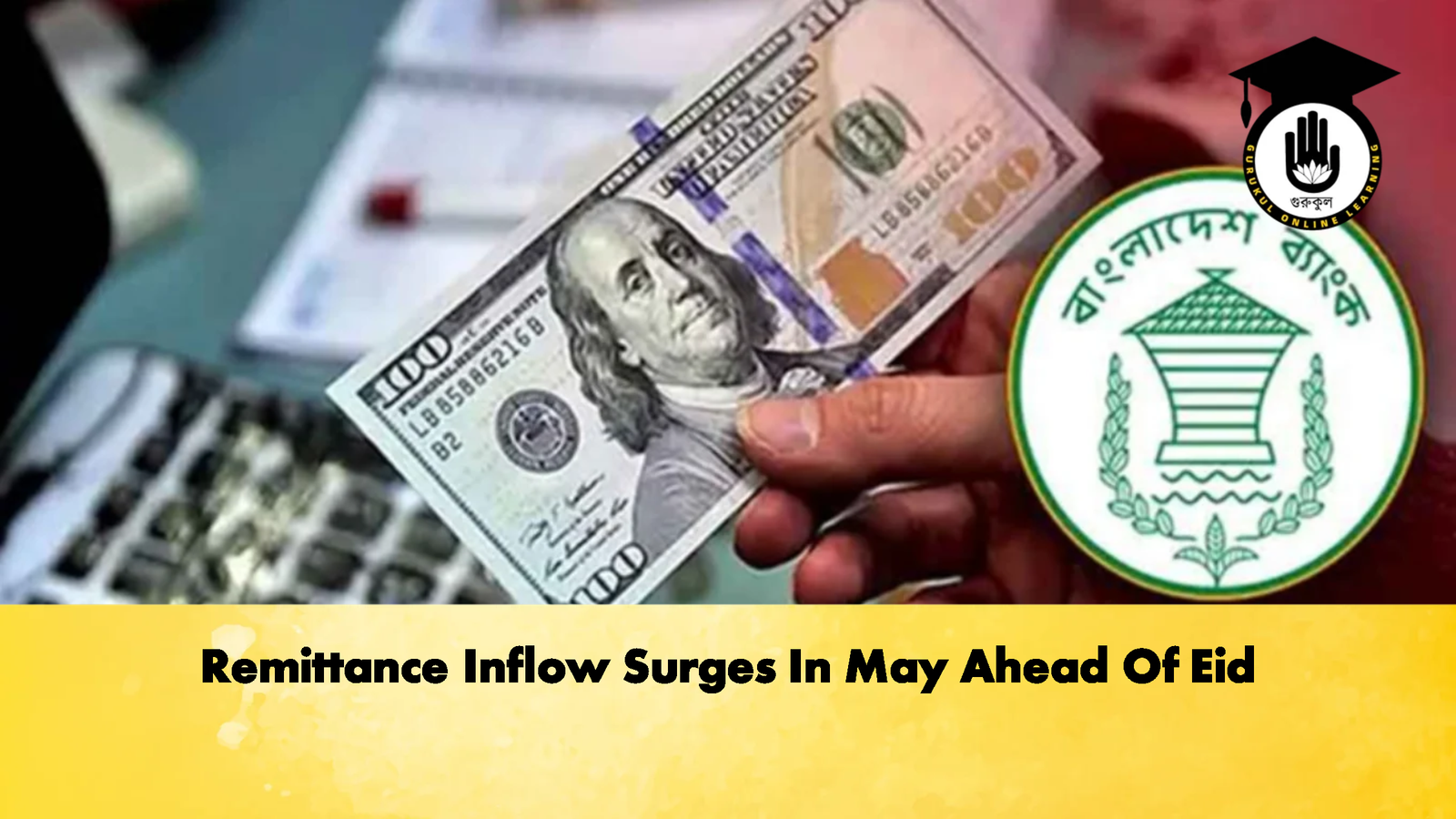
The remittance inflow into Bangladesh experienced a substantial increase during the month of May, driven primarily by the upcoming celebration of the holy festival, Eid-ul-Adha. Non-resident Bangladeshis channelled a total of $3.425 billion (approximately 3,425,030,000 US dollars) into the country through formal banking networks during this thirty-one-day period.
Comparative Data Analysis and Monetary Value
According to official statistics released by the Bangladesh Bank on Sunday, 31 May, this latest figure represents a significant growth of 15.34 per cent compared to the corresponding period from the previous calendar year. In the local currency, the financial value of the inbound capital for May translates to approximately 41,745 crore Bangladeshi Taka.
The updated reports from the central banking authority illustrate the upward trajectory of these financial transfers:
In May 2025, the country recorded a remittance inflow of roughly $2.969 billion (2,969,460,000 US dollars).
The final week of May 2026 alone—specifically from 24 May to 31 May—accounted for an influx of $448.97 million (448,970,000 US dollars), as expatriate workers transferred additional funds to support their families during the festive season.
Fiscal Year Performance and Structural Growth
The data for the broader fiscal year demonstrates a sustained upward trend across the national economy. Accumulative figures for the current 2025–26 fiscal period, measured from 1 July through to 31 May, show that the grand total for national remittance has reached $32.756 billion (32,756,780,000 US dollars).
By way of contrast, during the same eleven-month timeframe in the prior fiscal year, the total amount generated stood at $27.506 billion (27,506,860,000 US dollars). This comparative variance equates to an overall remittance growth rate of 19.09 per cent for the current fiscal cycle.
Senior officials from the Bangladesh Bank have attributed this consistent positive momentum to several interconnected fiscal factors. These include the official cash incentives offered by the government for choosing legitimate banking options, an increased level of public trust in the formal domestic banking institutions, and the customary seasonal practice of non-resident citizens sending larger sums of money home to meet domestic holiday expenditures.
Historical Comparison of Monthly Records
The newly recorded performance for May follows a sequence of high-volume financial periods observed throughout the recent months of the year:
March 2026: Inbound transfers reached an unprecedented $3.75 billion, establishing the highest single-month remittance volume in the historical record of Bangladesh.
March 2025: The prior calendar year’s March figure holds the position of the second-highest monthly total on record, yielding $3.295 billion (329,560,000 US dollars).
December 2025: The third-highest historic volume was registered at the close of the previous year, documenting an intake of $3.226 billion (322,660,000 US dollars).
April 2026: The month immediately preceding this latest report brought in $3.22 billion.
January 2026: At the start of the current year, the country witnessed an entry of $3.17 billion, which remains classified as the fourth-highest single-month remittance inflow in national economic history.
The continuous influx of foreign currency through valid banking channels remains an important pillar for the national economy, reinforcing external reserves and providing essential financial liquidity during peak periods of domestic consumer activity.