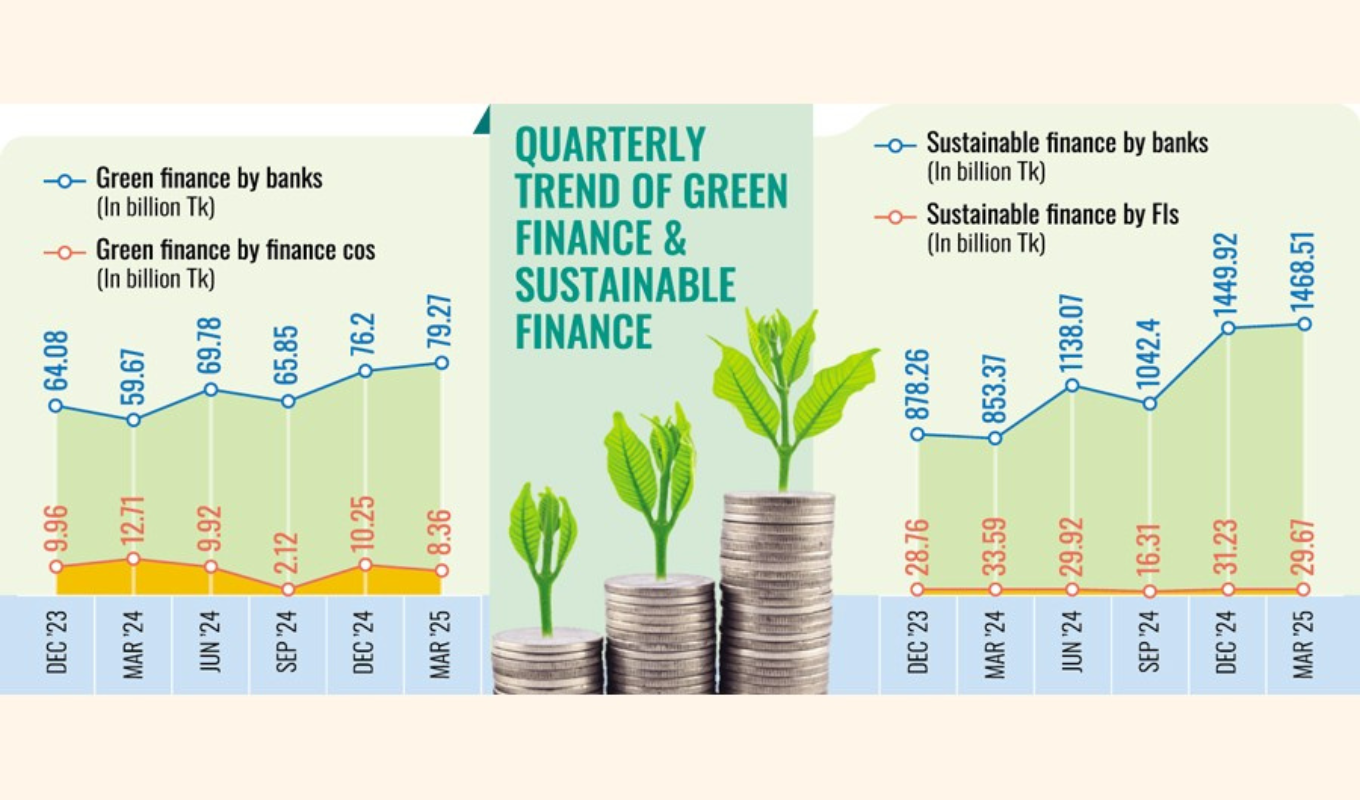
Bangladesh’s banks and financial companies (FCs) experienced a noticeable decline in green and sustainable finance disbursements during the April–June 2025 period, signalling reduced momentum in environmentally friendly and socially responsible lending compared with the previous quarter.
According to the latest data from Bangladesh Bank (BB), total green finance distribution by banks and FCs stood at Tk 78.49 billion, down from Tk 87.63 billion in January–March 2025, marking a 10.43% decrease.
Similarly, sustainable finance disbursements dropped to Tk 1.41 trillion in the same quarter from Tk 1.50 trillion in the previous one — a 6.0% decline.
Comparative Performance
| Category | Jan–Mar 2025 | Apr–Jun 2025 | Change (%) |
| Green Finance | Tk 87.63 billion | Tk 78.49 billion | -10.43% |
| Sustainable Finance | Tk 1.50 trillion | Tk 1.41 trillion | -6.00% |
A total of 43 banks (out of 61) and 10 FCs (out of 34) had exposure to green finance during the reporting quarter.
Of the total green finance disbursement:
- Banks accounted for Tk 70.70 billion, and
- Financial companies for Tk 7.78 billion.
Policy Framework and Targets
The Sustainable Finance Policy introduced by Bangladesh Bank has encouraged banks and FCs to contribute to inclusive, sustainable, and green growth. The policy encompasses:
- Green finance
- Sustainable agriculture
- Sustainable cottage, micro, small, and medium enterprises (CMSMEs)
- Socially responsible financing
- Other sustainability-linked initiatives
| Target Type | 2025 Target (Tk) | Share of Net Loans & Advances |
| Green Finance | Tk 678.21 billion | 5.0% |
| Sustainable Finance | Tk 5.43 trillion+ | 40.0% |
These targets were calculated based on the net loans and advances outstanding as of 31 December 2024. From 2025 onwards, all banks and FCs are required to maintain these proportions in their financing portfolios.
Expert Analysis and Recommendations
Industry analysts warn that achieving the set targets will demand:
- A stronger policy push,
- Improved access to concessional funds, and
- Greater private sector engagement.
Dr Masrur Reaz, Chairman of Policy Exchange Bangladesh, notes that the slowdown highlights the need for better alignment between financial incentives, environmental goals, and regulatory frameworks.
“Banks are still approaching sustainability largely as a compliance requirement rather than a business opportunity,” Dr Reaz observes.
He suggests that targeted fiscal and regulatory incentives, alongside enhanced risk assessment tools and robust project pipelines in renewable energy and the circular economy, could help accelerate green financing.
“Unless banks begin to view sustainability as part of their core business model, progress will remain uneven despite strong regulatory guidance,” he adds.
Overall, while Bangladesh has made steady progress in establishing a framework for sustainable finance, the Q2 2025 figures underscore the urgent need for deeper structural reforms, incentive-based mechanisms, and strategic alignment between regulators, lenders, and the private sector to ensure sustainable growth in the years ahead.