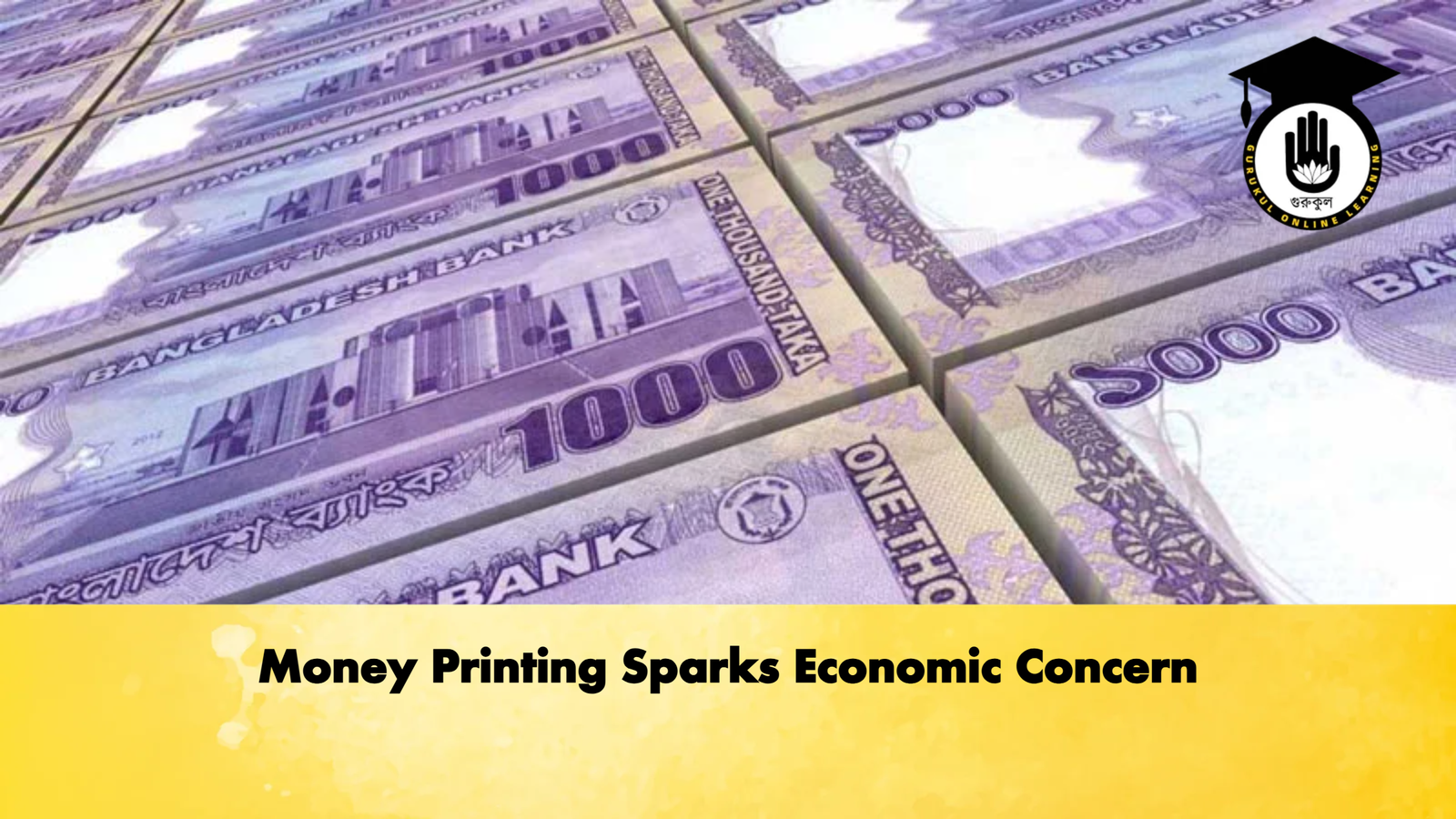
Economists and policy analysts have expressed deep concern over the increasing tendency of the central bank to finance government expenditure through money creation. They warn that such a policy could intensify inflationary pressures and pose long-term risks to macroeconomic stability.
These concerns were highlighted at a recent seminar held at the Policy Research Institute office in Banani, Dhaka. It was disclosed that in March alone, the government borrowed approximately 2 trillion Bangladeshi Taka from the central bank. In monetary terms, this is considered high-powered money, which can significantly expand liquidity in the economy and fuel inflation.
Experts argue that due to insufficient revenue generation, the government has become increasingly dependent on both the banking sector and central bank financing. This growing reliance is creating structural imbalances in the economy.
Chief Economist of the Policy Research Institute, Ashikur Rahman, stated that the current recovery process is built on a fragile foundation. He noted that non-performing loans in the banking sector have risen to nearly 30 per cent, while credit growth in the private sector has slowed sharply, weakening overall economic momentum.
He further added that during the second quarter of the current fiscal year, the country’s GDP growth has declined to around 3 per cent, marking one of the lowest levels in recent years. Combined with global economic uncertainty, rising energy prices, and disruptions in international trade, the situation is becoming increasingly challenging.
On the other hand, Mahbubur Rahman, President of the International Chamber of Commerce Bangladesh, warned that prolonged high inflation is significantly increasing the cost of living for ordinary citizens. He emphasised that without controlling excessive public spending and money creation, the situation could deteriorate further.
Chair of the seminar, Zaidi Sattar, pointed out that global conflicts, volatility in energy markets, and uncertainties in international trade are directly affecting Bangladesh’s economy. He stressed that without deep structural reforms, sustainable growth would remain difficult to achieve.
Summary of Macroeconomic Situation
| Indicator | Current Status |
|---|---|
| Government borrowing from central bank | Around BDT 200 billion |
| GDP growth rate | Around 3% |
| Non-performing loans | Nearly 30% |
| Private sector credit growth | Around 6% |
| Key risks | Inflation, global shocks, rising energy costs |
Economists recommend urgent reforms in revenue collection, restoration of discipline in the banking sector, and increased investment in productive industries. Without timely and effective policy interventions, the economy may face further strain in the coming months.