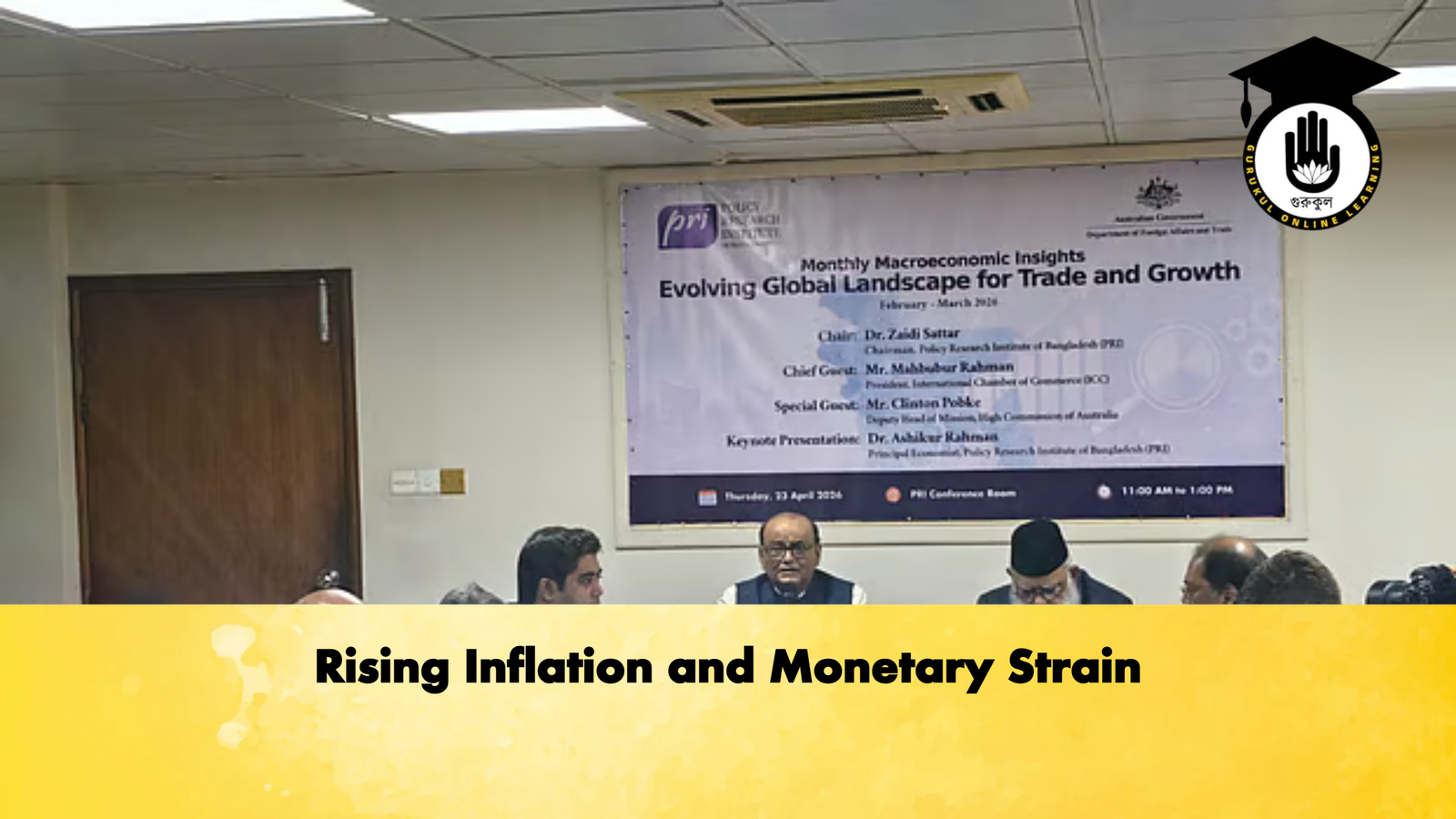
The pressure on Bangladesh’s macroeconomic framework is intensifying, with growing concerns over monetary expansion and inflationary risks, according to leading economists. Ashikur Rahman, Chief Economist at the Policy Research Institute, has warned that recent fiscal and monetary developments could undermine price stability and long-term economic resilience.
Speaking at a seminar in Dhaka reviewing the country’s macroeconomic performance for February and March, Rahman noted that the government reportedly borrowed nearly Tk 20,000 crore from the central bank in March alone. He argued that such borrowing is effectively equivalent to the creation of new money, thereby increasing liquidity in the economy. While this may provide short-term relief in terms of cash flow and market liquidity, he cautioned that it carries significant medium- to long-term inflationary consequences.
The event, held at the Policy Research Institute’s Banani office, brought together senior policymakers and business leaders. It was attended by Mahbubur Rahman, President of the International Chamber of Commerce Bangladesh, as the chief guest, while the session was chaired by Zaidi Sattar, Chairman of the institute.
Rahman further emphasised that delaying structural reforms could prove costly for the economy. In particular, he highlighted the importance of properly implementing banking sector restructuring and resolution mechanisms. According to him, sluggish reform progress not only creates uncertainty regarding the fulfilment of conditions linked to international financial assistance but also weakens investor confidence and macroeconomic stability.
Concerns were also raised about the prevailing business climate. Mahbubur Rahman pointed to declining investor confidence amid uncertainty in energy supply, particularly in gas and electricity distribution. He stressed that without coordinated action between the public and private sectors, stabilising the investment environment would remain difficult.
Zaidi Sattar added that global energy price volatility and supply disruptions continue to exert upward pressure on commodity prices worldwide. He noted that geopolitical tensions in strategically important maritime corridors, such as the Strait of Hormuz, are further contributing to global economic instability. He also underscored the necessity of comprehensive structural reforms under a politically stable and elected government framework to ensure sustainable growth.
Key Macroeconomic Indicators
| Indicator | Current Status | Commentary |
|---|---|---|
| Government borrowing (March) | ~Tk 20,000 crore | Taken from Bangladesh Bank, increasing liquidity |
| Inflation risk | Rising | Driven by expanded money supply |
| Investment climate | Uncertain | Affected by energy shortages and policy ambiguity |
| Banking sector reform | Slow progress | Ongoing restructuring process |
| Global impact | High | Volatile international energy markets |
Analysts suggest that while central bank financing may temporarily ease fiscal pressures, it risks fuelling inflationary momentum if not carefully managed. They also warn that without decisive reforms in the banking sector, financial stability could face increasing vulnerabilities.
Overall, the discussion highlights a dual challenge facing the economy: rising inflationary pressures on one side and weakening investor confidence on the other. Policymakers, experts argue, must strike a delicate balance between short-term stability measures and long-term structural reforms to safeguard economic sustainability.