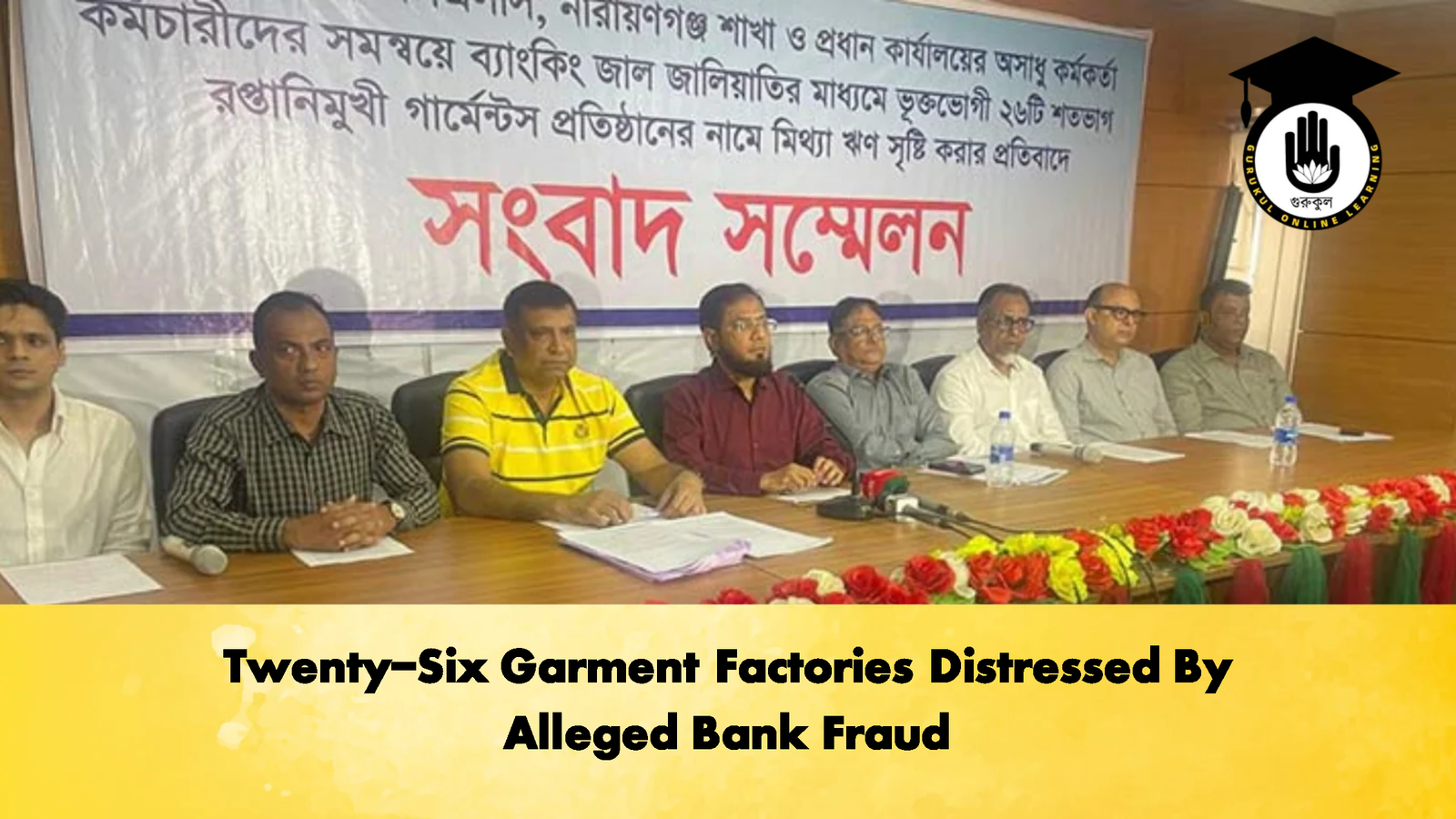
A group of export-oriented readymade garment manufacturers have publicly alleged that extensive financial irregularities at the Narayanganj branch of Premier Bank PLC have pushed 26 factories into a severe operational crisis. The affected business owners claim that bank officials engaged in back-to-back Letter of Credit (LC) fraud, illicit foreign currency transactions, and the unauthorised creation of substantial phantom loans under the names of legitimate clients.
These severe allegations were detailed during a press conference held on Saturday, 16 May 2026, at the Economic Reporters’ Forum (ERF) office in Purana Paltan, Dhaka. The affected entrepreneurs formally called upon the government, the Ministry of Finance, and the central bank to initiate a high-level independent inquiry to assess the true financial position of the businesses.
Unauthorised Financial Mechanisms and Systemic Malpractice
Arifur Rahman, the Managing Director of Deutsche Land Apparels Limited, presented the written statement on behalf of the distressed businessmen during the conference. He explicitly stated that massive sums of money had been misappropriated from the Narayanganj branch under the guise of their respective corporate names without their knowledge or consent. According to Rahman, bank officials executed these fraudulent activities in collusion with their head office and the former chairman of the financial institution, H.B.M. Iqbal.
The entrepreneurs noted that they had maintained productive and regular business relations with Premier Bank’s Narayanganj branch for many years. However, the operational issues reportedly began in 2017 when certain bank officials allegedly began utilising forged identities to manufacture fraudulent sales contracts. On the basis of these artificial contracts, multiple back-to-back LCs were opened without any actual raw materials being supplied to the factories. Subsequently, the liabilities generated from these artificial LCs were adjusted through current accounts to illegally procure US dollars from the volatile foreign exchange market.
According to the written brief, the bank purchased these dollars at rates fluctuating between 12 to 15 Taka above the prevailing market price, imposing an artificial financial burden on the apparel companies. Furthermore, 80 to 90 per cent of the funds against actual export documents were deposited into current accounts and subsequently diverted to clear the liabilities of the alleged fraudulent back-to-back LCs. Through this mechanism, the bank unilaterally created forced loans and demand loans, accruing immense interest charges without serving any prior notice to the clients.
Fabrication of sales contracts using falsified identities.
Opening of back-to-back LCs without physical raw material supply.
Purchase of US dollars at 12 to 15 Taka above market rates.
Unilateral creation of forced and demand loans without client notice.
Refusal to provide comprehensive account statements to affected clients.
Initiation of legal action in money loan courts using blank security cheques.
The business owners stated that these practices directly violated the foreign exchange guidelines established by Bangladesh Bank. Despite repeated formal requests from the manufacturers, Premier Bank reportedly refused to provide comprehensive account statements or transaction histories. Instead, the institution allegedly utilised blank security cheques, which had been collected for standard business purposes, to initiate legal proceedings against the garment owners in the Money Loan Court (Artha Rin Adalat).
Regulatory Overlook and Operational Paralysis
Dil Mohammad Imran, the Managing Director of Knit Reflex Limited, specifically identified the then-manager of the Narayanganj branch, Md. Shahid Hasan Mallick, and the second officer, Mushfiqur Rahman, alongside other administrative staff, as the key individuals responsible for orchestrating the anomalies. Imran raised critical questions regarding the oversight role of the central bank, asking why the annual audits and institutional inspections conducted by Bangladesh Bank failed to detect such systemic malpractices over the years.
The entrepreneurs pointed out that their financial liabilities remained entirely normal until 2023, but spiked inexplicably in 2024 when the bank suddenly documented vast, irregular debts against their businesses. They asserted that the central bank will be unable to factually substantiate the liabilities currently being attributed to the manufacturers in recent regulatory reports.
The affected businessmen explained that they had previously approached the central bank on 22 separate occasions to seek redress, but received no functional assistance. Furthermore, they alleged that bank officials routinely threatened to cancel all existing active LCs and banking facilities unless the business owners signed loan rescheduling agreements under duress. While several firms eventually signed the documentation to protect their workers’ wages and avoid labour unrest, Bangladesh Bank subsequently cancelled those specific rescheduling orders. As a direct consequence of this regulatory action, the active banking operations of 23 affected institutions were completely frozen.
Human Cost and Formal Demands
The press conference highlighted the severe human and psychological toll inflicted by the ongoing financial crisis. The business owners revealed that the continuous pressure from the bank and the resulting mental anxiety led to the untimely deaths of two managing directors, while another suffered a stroke and remains paralysed.
Specifically, the late Managing Director of Total Fashion Limited, Md. Hasibuddin Miah, was reportedly subjected to intense harassment, receiving 37 phone calls from bank personnel on a single day—23 December 2024—demanding his signature on loan documents. He was subsequently admitted to hospital under extreme stress and passed away on 27 December 2024. Similarly, the Managing Director of West Apparel passed away from a fatal heart attack on 12 September 2025, following immense psychological pressure resulting from what the family describes as fabricated allegations submitted to the Anti-Corruption Commission (ACC).
The owners of the 26 affected factories emphasised that completely shutting down their banking operations is counterproductive, as it effectively closes all channels for revenue generation and debt settlement. They reiterated their willingness to clear all legitimate liabilities once the actual figures are transparently verified through an independent process. Maintaining factory operations is vital to protecting the national export volume and securing the livelihoods of approximately 25,000 industrial workers.
Consequently, the entrepreneurs have requested the deployment of a reputable international audit firm to conduct a thorough forensic investigation, having already submitted a formal written appeal to the Governor of Bangladesh Bank on 6 April. The briefing was also attended by Mehrab Bin Hasib, the current Managing Director of Total Fashion Limited, and Gautam Poddar, the Managing Director of Janani Fashion Limited.